
Electronic Gates Tested at Bekasi Timur Railway Crossing
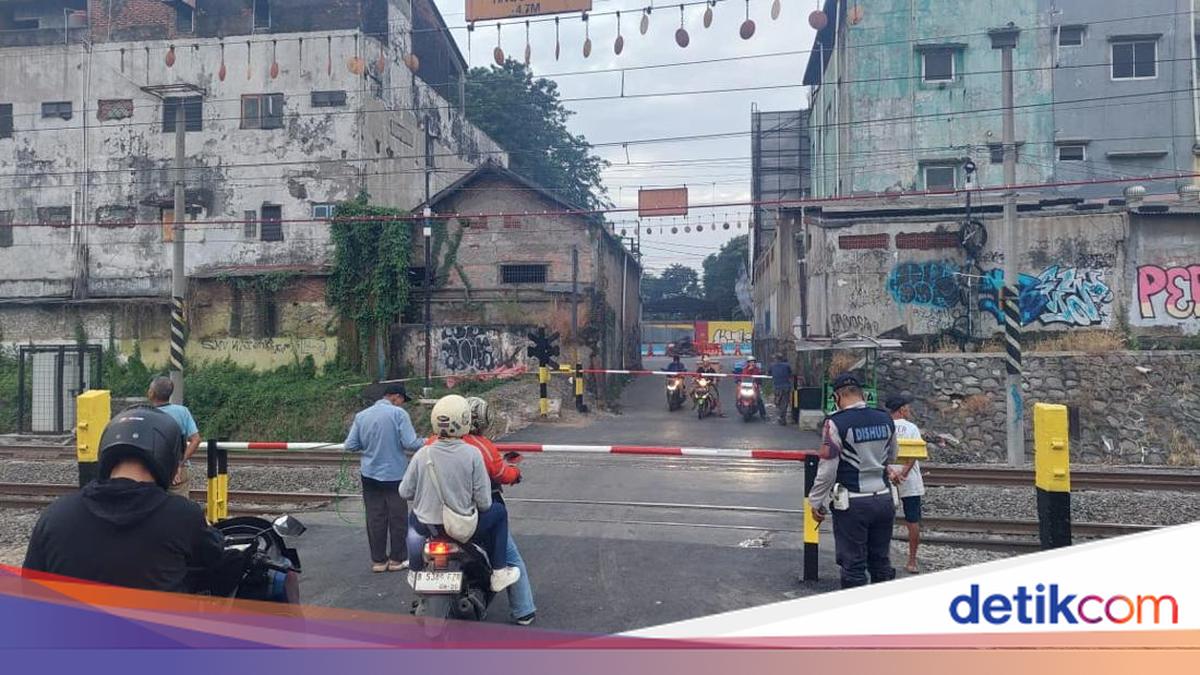
Electronic gates have been installed at a railway crossing near Bekasi Timur Station in Bekasi City, West Java. The installation of these automatic gates is part of the acceleration of level crossing management, which is also being carried out in other regions.
Vice President of Corporate Communication at KAI, Anne Purba, stated that accelerating the arrangement of level crossings is currently an important part of strengthening risk-based transportation safety systems.
“Level crossings are points where train journeys and public mobility intersect at the same time. Therefore, their management needs to be carried out more quickly, measurably, and integrally so that the safety space in the field is increasingly improved,” said Anne in her statement on Thursday (14/5/2026).
The new level crossing gates, which are currently in the refinement and operational testing stage, are part of strengthening security for train journeys and road users.
During the refinement process of facilities in the Ampera area, train journey security is still carried out using the old gates, which remain functional. In addition, temporary security is also supported through community self-help while awaiting the construction of guard posts and the placement of official personnel.
According to Anne, field collaboration is an important part in maintaining safety during the facility improvement process. The existence of safety facilities also needs to be followed by road users’ discipline when crossing the crossing area.
“We invite the public to be more disciplined when crossing level crossings, not to force through the gates, stop for a moment, look left and right, and ensure conditions are safe before continuing the journey,” explained Anne.
KAI, together with local governments and stakeholders in various regions, is striving to improve road user safety at points where rail lines intersect with highways.
Other Safety Improvement Efforts
In the period from 27 April to 12 May 2026, KAI together with stakeholders has closed 20 crossing points and narrowed 7 crossing points in several operational areas and regional divisions.
The handling was carried out in the regions of Jakarta, Banten, West Java, Central Java, Yogyakarta, East Java, North Sumatra, West Sumatra, and South Sumatra, particularly at illegal crossings, unofficial access, and points with high safety risk levels.
In addition to closures and narrowing, KAI also targets gradual safety improvements at 1,638 crossing points through the construction of safety facilities, strengthening guarding, improving operational supervision, and cross-agency coordination to strengthen train journey and road user safety.
2,111 Crossings Guarded, 1,776 Others Not Yet
Based on data from the First Quarter of 2026, there are 3,888 level crossings in Indonesia. Of this number, 2,112 points are guarded, while 1,776 other points are not yet guarded.
“For the crossings that are already guarded, their management involves various parties. KAI currently guards 977 points or about 46 percent of the total guarded crossings. Local governments through provincial or district/city Transportation Offices guard 680 points or about 32 percent. In addition, there are 417 points guarded by community self-help and 38 points guarded by private parties,” explained Anne.
Meanwhile, for unguarded crossings, the composition is spread across various road classes, namely 3 points on national roads, 4 points on provincial roads, 415 points on district/city roads, and 1,354 points on sub-district roads, villages, and other environmental access.
According to her, this structure shows that crossing safety requires cross-institutional involvement because the management authority follows the road class under the central government, provincial government, or district/city government.
In regulatory provisions, it is stated that the management and evaluation of crossing safety based on road class is the authority of the Minister of Public Works for national roads, the governor for provincial roads, and regents and mayors for district/city roads and village roads.
Therefore, KAI has also submitted a request for delegation of authority for the management and improvement of crossing safety to several local governments so that acceleration of field handling can be carried out more effectively and gradually.
In addition to physical arrangement, KAI is currently carrying out guarding at 977 crossing points with the support of 3,908 Crossing Guard Officers (PJL) who work 24 hours in shifts. These officers undergo regular competency training and certification to ensure optimal journey security.
Currently, there are 3,674 level crossings in Indonesia, with 1,810 points as the focus of handling. Of this number, 172 crossings are targeted for closure due to limited road conditions, while the remaining 1,638 crossings require gradual safety facility improvements.
Technically, trains require sufficient safe space for braking. At a speed of 120 kilometres per hour, the ideal braking distance can reach 800 to 1,200 metres. Therefore, ensuring a clear track before the train passes is a very determining factor for journey safety.
“Train journey safety requires consistent field handling. The faster high-risk points are inventoried, arranged, and guarded together, the greater the safety space that can be built for the public,” concluded Anne.