
El Niño Not Guaranteed to Hamper Food Production, Provided Indonesia Does This
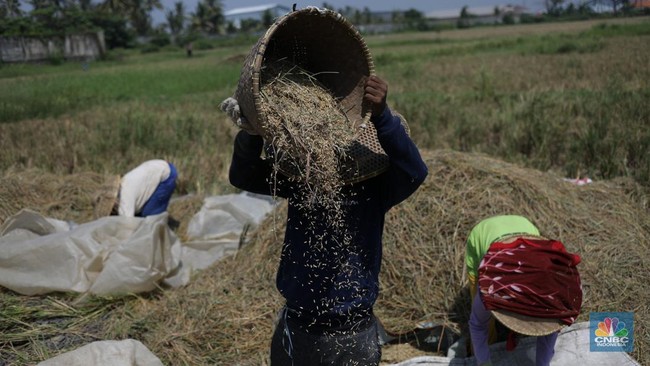
Jakarta, CNBC Indonesia - An agriculture expert from the Center of Reform on Economics (CORE), Eliza Mardian, assesses that the extreme El Niño phenomenon, often dubbed “Godzilla”, does not necessarily cause food production to plummet, although it still poses serious risks to the agricultural sector.
“This super El Niño represents a serious risk to our food system, as it is not merely an ordinary climate cycle. Our experience shows that a combination of El Niño and positive IOD almost always results in longer dry spells, significant reductions in rainfall, and substantial pressure on water availability, especially in production centres like Java,” Eliza told CNBC on Thursday (26/3/2026).
In such conditions, she acknowledges that the agricultural sector could experience slowdowns or even contractions in several regions if failed plantings increase in scale. Nevertheless, Eliza stresses that the impact of El Niño is not certain to drastically suppress production.
“However, it should be noted that the impact of El Niño is not definitively a drastic reduction in production, but it all depends heavily on mitigation capacity and policy responses,” she said.
She explains that production can still be maintained if reductions in planted area can be compensated by increases in productivity.
“If the reduction in planted area due to drought can still be compensated by productivity improvements, the production volume will remain relatively stable,” she clarified.
An example of such conditions, she continues, can be seen in other countries like China.
“This is evident in countries like China, where during the 2023 El Niño, the harvested area declined but production volume still increased, supported by a robust irrigation system, advanced agricultural technology, and efficient production management,” she explained.
That said, she warns that in the Indonesian context, the capacity to make such compensations remains limited.
“The problem in the Indonesian context is that the capacity to make such compensations is still limited,” she stated.
She also highlights the national agricultural structure that still relies heavily on rainfall, along with uneven technological support.
“Because our agricultural structure is still very dependent on rainfall, with many rain-fed paddy fields, and the irrigation system is not yet fully capable of anticipating large-scale droughts,” Eliza said.
“Furthermore, the adoption of drought-resistant varieties and cultivation technologies is not yet widespread; many of our farmers still use seeds released 20 years ago, exacerbated by the small scale of farming, as the majority are smallholders with areas under 0.5 hectares, making intensification difficult to implement quickly,” she added.
In an extreme El Niño scenario, she emphasises that the potential for production declines remains, particularly due to reduced planted areas.
“In an extreme El Niño scenario, the potential for production declines still exists, due to reduced planted areas from drought,” she concluded.