
Egg Production Surplus Causes Price Plunge, Could MBG Be the Solution?
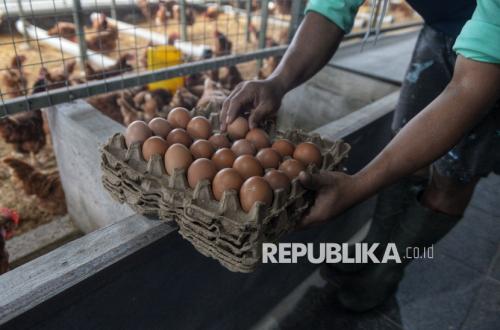
JAKARTA – Egg production is projected to reach around 7.3 million tonnes in 2026, according to data from the Ministry of Agriculture (Kementan). This figure exceeds the national requirement, which stands at approximately 6.4 million tonnes.
Amid this supply surplus, egg prices at the farmer level are under pressure or below the government’s reference price (HAP). This situation raises concerns about the sustainability of independent farming businesses in various production centres.
The production increase, not matched by expanded absorption, has led to stockpiling in several regions. In such conditions, small-scale farmers are the most vulnerable due to limited storage capacity, distribution access, and bargaining power in the market.
The Chairman of the National Poultry Organisations Association (GOPAN), Herry Dermawan, stated that current egg prices are highly sensitive to market and distribution issues. According to him, field prices do not fully reflect a healthy market mechanism.
“Today’s prices are not the real prices. Egg prices are very sensitive to issues,” said Herry when met at the Ministry of Agriculture office in Jakarta, quoted on Wednesday (13/5/2026).
Business actors and farmer associations are urging the government to strengthen absorption and distribution oversight to prevent egg prices from continuously falling below the economic costs for small-scale farmers. They assess that stabilisation cannot be limited to the downstream level but must also address the distribution chain and trade practices.
The Chairman of the National Layer Farmers Association, Musbar Mesdi, hopes that egg absorption through the Free Nutritious Meals Programme (MBG) will be continuously increased. According to him, boosting consumption in the programme is crucial to maintaining price stability at the farmer level.
“We hope that egg absorption by MBG is increased because it is still minimal at present. In addition, going forward, egg prices should not be below Rp25,000,” said Musbar.
The government is beginning to consolidate stabilisation measures with the National Food Agency (Bapanas), the National Nutrition Agency (BGN), farmer associations, and business actors. The government targets egg prices to return to the reference price of Rp26,500 per kilogram.
The Director General of Livestock and Animal Health at Kementan, Agung Suganda, stated that the recent rise in egg production was triggered by increased investment in the laying hen sector and growing food needs of the population, including to support the MBG Programme. Kementan records an annual increase in egg availability of around 30 percent.
“The purpose of today’s meeting is to discuss several matters, particularly regarding egg price stabilisation at the farmer level, which has recently dipped slightly below the reference price set by the government,” said Agung during a coordination meeting at the Ministry of Agriculture office in Jakarta on Tuesday (12/5/2026).
The government is also asking cooperatives and farmer associations to help maintain prices to approach the government’s reference price. The Food Task Force and Price Stabilisation Task Force are requested to strengthen field oversight, especially regarding distribution and inter-regional trade.
“The Minister of Agriculture, as the Head of the National Food Agency, has instructed us to take corrective action immediately. Tomorrow, we are requesting that prices at the farmer level rise towards the reference price,” said Agung.