
Effective in Recovering State Funds, Expert: Attorney General's Office Like Implementing Asset Forfeiture Law
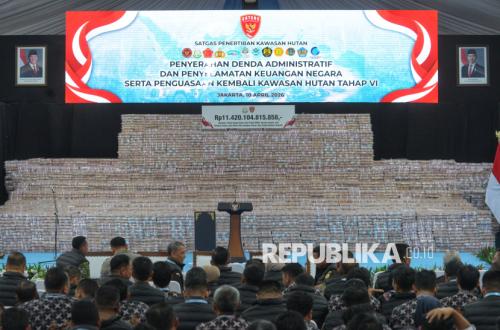
The Forest Area Rescue Task Force (Satgas PKH), led by the Attorney General’s Office (Kejagung), has requested businesses in violation to pay administrative fines amounting to trillions of rupiah, an approach deemed more effective than pursuing criminal proceedings.
“If the goal is to recover state losses, this is more effective than going through criminal processes. It doesn’t require lengthy legal proceedings, but the state can directly reclaim its losses,” said criminal law expert from Trisakti University, Prof. Abdul Fickar Hadjar.
This statement was made by Prof. Abdul Fickar in relation to the handover of administrative fines from forest area violators worth Rp11.4 trillion. The handover took place at Kejagung and was witnessed by President Prabowo Subianto.
He explained that criminal processes require a long procedure. Starting from trials at the District Court, High Court, up to the Supreme Court (MA). “Not to mention subsequent reviews and the like,” said this lecturer from Trisakti’s Faculty of Law.
Furthermore, he continued, if waiting for criminal legal processes, the assets to be seized by the state could be scattered everywhere. “They could end up scattered all over the place. Rather than waiting a long time and the assets getting scattered, it’s better to demand payment of fines,” he said.
He explained that paying administrative fines is like the state conducting asset forfeiture suspected to be proceeds of corruption. “The state seizes assets without prior court process,” clarified Prof. Abdul Fickar.
He elaborated that this does not mean a lack of trust in the state’s law enforcement, but often when legal processes are carried out, they do not meet public expectations. “There could even be other manipulations in the criminal process,” said Prof. Abdul Fickar.
If Kejagung through Satgas PKH has already demanded payment of administrative fines, with calculations via auditors, it would be more optimal. “Businesses usually (for operations) when applying for bank credit have financial reports. So it can be sourced from there,” he stated.
Prof. Abdul Fickar said that Kejagung through Satgas PKH must be consistent in the approach to pursuing state losses from forest area violation issues. The amount of administrative fines, according to Prof. Abdul Fickar, should consider the scale of natural resources extracted by the companies.
“This data can be obtained from audits conducted by public accountants. Just summon them (the business owners) and ask them to bring their audit results. It will show the amount. Rather than Satgas PKH or Kejagung calculating it themselves. Otherwise, the results might be smaller,” he explained.
This administrative fine approach, said Prof. Abdul Fickar, is actually similar to the Asset Forfeiture Law, which has not yet been enacted. “So this is seizing assets suspected to be proceeds of legal violations without court processes. It should be consistent,” emphasised this criminal law expert.
If administrative fines have already been imposed, continued Prof. Abdul Fickar, there should be no need for further criminal processes. “It’s a pity for criminal proceedings if (after paying administrative fines, they still have to face criminal processes. They (the business owners) did violate the law, but they’ve already paid the fines. It should be maximised there (paying the fines),” stated Prof. Abdul Fickar.