
Education Ministry outlines differences between Integrated National Schools and regular schools
Jakarta - The Ministry of Primary and Secondary Education (Kemendikdasmen) has outlined a number of differences between the implementation of Integrated National Schools (SNT), initiated by President Prabowo Subianto, and regular schools.
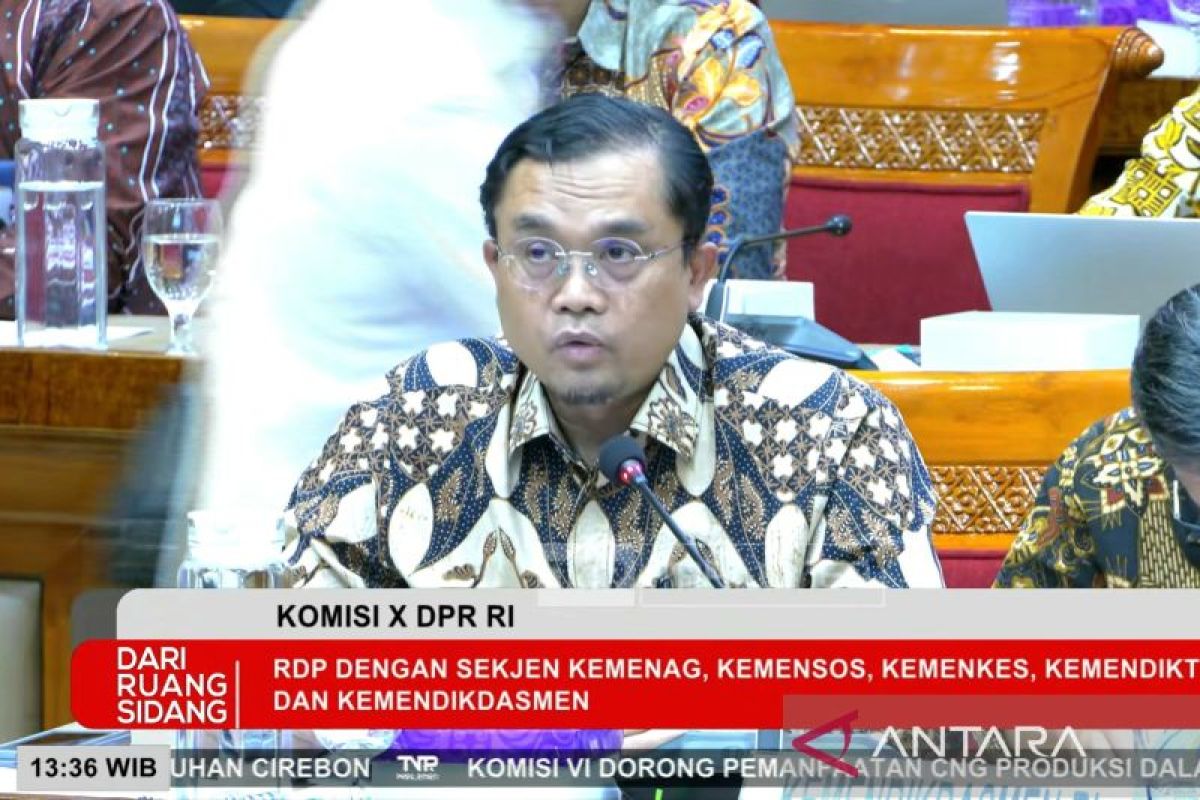
“As an illustration, we compare it with regular schools; there are several aspects that may serve as a foundation,” said Gogot Suharwoto, Director General of Early Childhood Education, Primary Education, Non-Formal and Informal Education at Kemendikdasmen, during a Hearing Meeting with Commission X, the Secretary General of the Ministry of Religious Affairs, the Ministry of Social Affairs, the Ministry of Health, the Ministry of Higher Education, Science and Technology, and Kemendikdasmen in Jakarta on Tuesday.
Broadly speaking, he continued, three elements are being transformed in the SNT implementation: infrastructure, human resources, and learning.
When compared with regular schools, he said one of the differences relates to the operational concept. Integrated National Schools, Gogot stated, will exist within a single ecosystem so that children’s talents, interests, and potential can be nurtured continuously from junior high school (SMP) to senior high school (SMA) level, as they are managed by one director.
“Regular schools are different, because SMP is managed by the district/city, while SMA is managed by the province, so student monitoring and development are handled or monitored by different local governments,” Gogot said.
The second aspect is that the Integrated National School curriculum will adopt a ‘national plus’ curriculum, enriched with global competencies such as STEM and sports.
The third difference is that prospective Integrated National School students are individuals with achievements at the district/city level, providing them with a place to learn and develop their achievements continuously.
“Thus, it is hoped that high-achieving children will have a place to study at the school they aspire to,” Gogot said.
Furthermore, in terms of facilities, he added that Integrated National Schools are set to be built with modern, world-class learning facilities and teaching staff with international competencies, supporting a continuous learning process from SMP to SMA level.
“Integrated National Schools must eventually become centres for teacher and curriculum development at the district level, and serve as catalysts for improving education quality in the regions through outreach to surrounding schools,” Gogot Suharwoto stated.