
Education Minister Outlines Efforts to Build Strong Relations at Schools
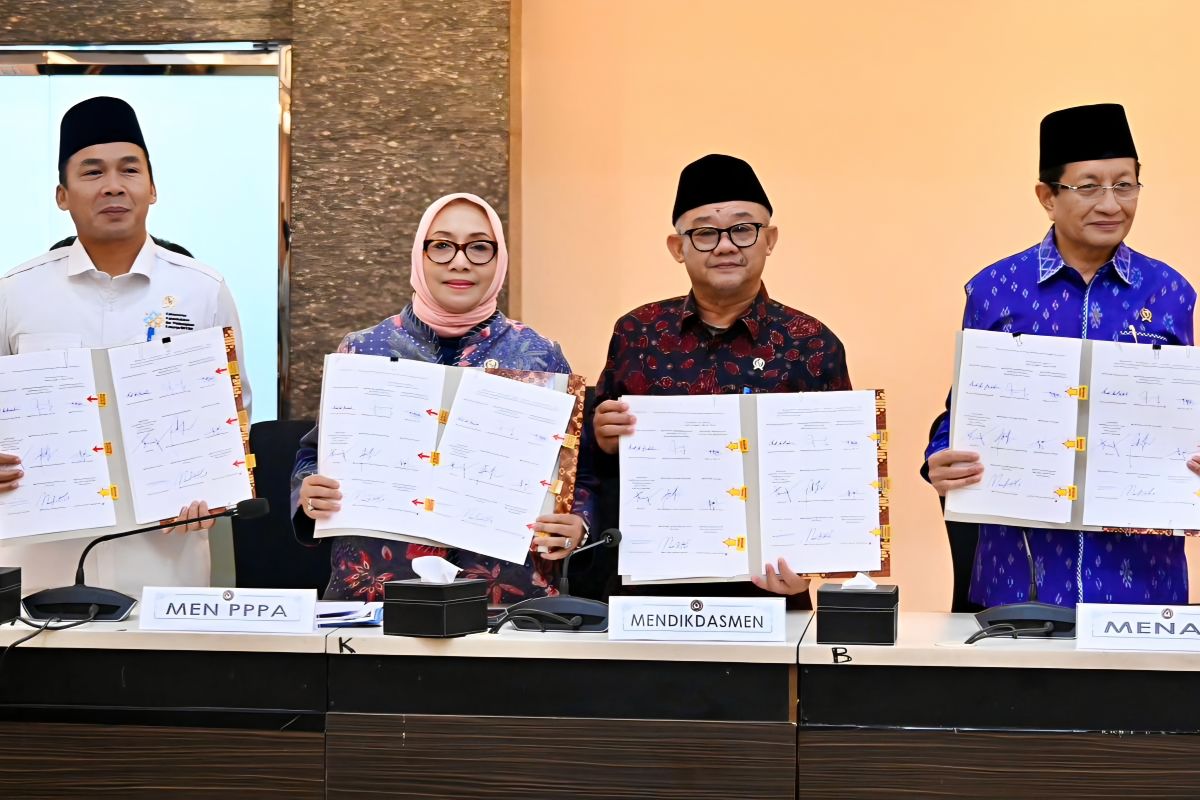
Jakarta – The Minister of Primary and Secondary Education (Mendikdasmen) Abdul Mu’ti has outlined a series of initiatives to build good and harmonious relations between schools, students, and parents as the educational “tricentre”.
The minister stated that the Ministry of Primary and Secondary Education has issued several regulations to shape student character, including the issuance of Ministerial Regulation on Primary and Secondary Education (Permendikdasmen) Number 6 of 2026 on Safe and Comfortable School Culture.
“We are therefore using a humanistic, participatory, and comprehensive approach. These are the three keywords in Ministerial Regulation number 6 of 2026,” Mu’ti said in Jakarta on Monday.
In implementing Safe and Comfortable School Culture, he cited four main aspects that are the focus: spiritual fulfilment, physical protection, psychological welfare, and sociocultural and digital security.
Schools, according to Mu’ti, need to strengthen governance, educate all school members, and reinforce the role of all school elements through classroom management.
He emphasised that existing regulations clearly set boundaries for rule enforcement and address cases appropriately.
According to Mu’ti, cases of violence in educational institutions outside of criminal acts or sexual violence should preferably be resolved through deliberation within the educational institution.
“Our agreement with the Police Chief is already working with restorative justice. Police cannot reject community reports, but can use restorative justice and we want to strengthen that,” he affirmed.
The ministry is also enhancing human resources management at schools.
It believes that the approach to student character development is not solely the responsibility of guidance and counselling teachers, but should be expanded to all teachers in the school.
Mu’ti explained that the duties of form tutors include academic guidance, competence development, skill training, and student character formation.
Additionally, he said, form tutors serve as a communication bridge between students, parents, and school authorities, including coordinating with guidance and counselling teachers and class teachers.
This role, he noted, differs from class teachers who focus more on daily administrative classroom duties and counselling teachers who focus on counselling services.
The ministry is also implementing hidden curriculum – unwritten lessons, values, attitudes, and norms that students learn at school through social interaction, policies, and school culture as an inseparable part of education.
“For example, teaching them to queue orderly does not require a separate subject, but can be instilled by having them queue to collect school meals. If meals are delivered directly to student desks, in my view that does not shape character. To develop character, simply place them at the front and have them queue to collect meals, eat, and then queue to return them,” Mu’ti said.