
Education Minister Allocates 23% of School Revitalisation Funds to Private Institutions
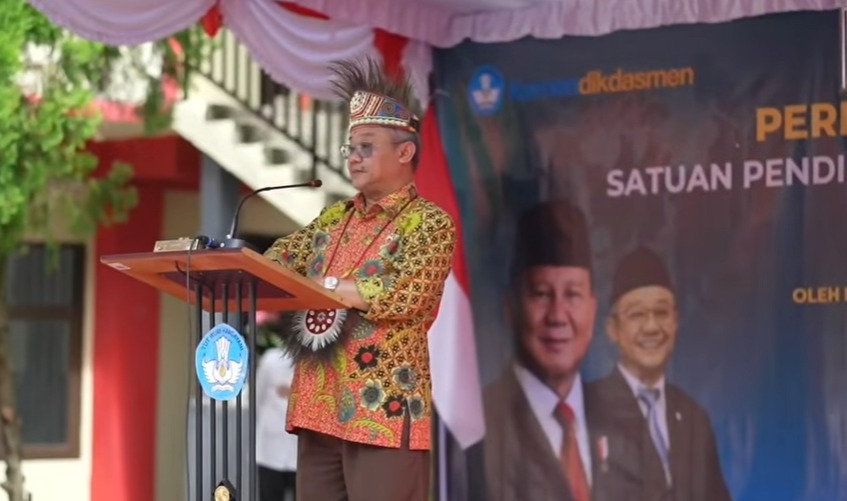
Minister of Basic and Secondary Education, Abdul Mu’ti, stated that private schools are receiving significant attention in this year’s school revitalisation programme.
‘This year, 23% of the revitalisation allocation is for private schools. This is a commitment we will continue to build together,’ he said during the inauguration of the school revitalisation programme in Manokwari Regency, West Papua, on Thursday (28 May).
He further explained that private schools are strategic government partners, and it is the government’s duty to provide assistance.
‘This is not just empty words. Realistically, when we support private schools, it may only be for the buildings, while they provide the land themselves. We might construct a few classrooms, and they cover the rest. All students are Indonesian children who must be educated together to become excellent individuals, part of the 2045 golden generation,’ Mu’ti said.
Support for private schools is also reflected in the New Student Admission System (SPMB) and regulations through the Ministry of Home Affairs.
‘When public schools reach capacity, they cannot exceed the standard limit. If they do, students will not be registered in the Dapodik system and will be directed to private schools. We also have Ministry of Home Affairs Regulation No. 3/2023, allowing local governments to allocate funds to private schools. This means all schools must coexist as part of an ecosystem we build together. As the state’s administrators, we must manage everything—public and private. This is our commitment and the law we are fulfilling to the best of our ability,’ he added.
Mu’ti also explained that the revitalisation programme is now more flexible, not limited to building schools but also addressing school ecosystem needs.
‘This year, revitalisation isn’t just for constructing buildings—it can also cover fences, integrated worship spaces, environmental arrangements including wells or water sources if needed, and teacher housing for schools in remote areas so teachers don’t have to commute,’ he stressed.
At the same event, Manokwari Regent Hermus Indou affirmed the Minister’s understanding of Indonesia’s education challenges.
‘The school revitalisation programme is high-quality, relevant, and beneficial for development needs across Indonesia, including Manokwari. We believe the Minister is a servant of God sent to witness, feel, and hear the aspirations, needs, and issues of basic and secondary education in Papua,’ Indou said.
‘Many regional issues, including education management, are beyond our capacity. Honestly, with current efficiency policies, Manokwari Regency has faced a budget cut of over Rp200 billion, severely limiting our ability to provide services, including education. But this revitalisation programme is helping fill the gap. We hope it continues,’ he added.
On 12 May 2026, the Ministry of Basic and Secondary Education provided revitalisation assistance to 3,084 schools with a total budget exceeding Rp2.9 trillion.
The ministry aims to revitalise 71,744 schools by 2026 as part of national efforts to equalise education quality.
Minister Abdul Mu’ti inaugurated the revitalisation of 576 schools in NTT with a budget of Rp589 billion to enhance education quality and digitalisation.
The Ministry of Basic and Secondary Education reaffirmed the government’s commitment to providing quality education for all. To support this, approximately Rp863 million has been allocated, with possible adjustments if field shortages persist.