
Edge vs Cloud in Indonesia: Business Opportunities in Two Complementary Worlds
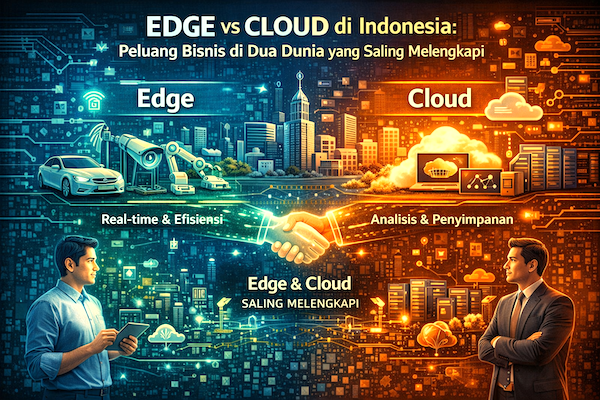
In the midst of Indonesia’s rapid digital transformation, data has become the primary “fuel”. Every online transaction, video watched, and daily app activity generates vast amounts of data. To manage this data, two technological approaches are increasingly discussed: cloud computing and edge computing.
Cloud has long been known and widely used. Meanwhile, edge is gaining popularity alongside the need for speed and efficiency. The question is, between the two, which offers more promising business opportunities in Indonesia?
The answer is not as simple as choosing one.
Cloud: The Main Foundation of the Digital Economy
Cloud computing currently remains the backbone of Indonesia’s digital world. Many companies—from startups to large corporations—rely on cloud for data storage, running applications, and developing digital-based services.
Its growth is driven by several factors. First, more businesses are shifting to digital systems. Second, the need for flexibility—cloud allows companies to expand without building their own infrastructure. Third, the influx of major investments from global players building data centres in Indonesia.
In a business context, cloud offers vast opportunities. From data storage services and digital platforms to Big Data analysis and AI development. Even many SMEs are now starting to use cloud, either directly or through the applications they use.
In short, cloud is the “main engine” supporting the current digital economy.
Edge: Addressing the Needs of a Fast-Paced World
However, as the demand for real-time services increases, cloud’s limitations emerge. All data must first be sent to a data centre before processing. This process, though fast, still has a delay.
This is where edge computing comes in.
Edge enables data to be processed closer to its source—for example, on devices, sensors, or local networks. The result is a much faster response.
In Indonesia, edge opportunities are starting to appear in various sectors. For instance, traffic management in big cities, smart camera-based security systems, and manufacturing industries that require instant responses to maintain production efficiency.
For telecommunications operators, edge also opens new opportunities, especially with the development of 5G networks. Services like online gaming, streaming, and AI-based applications require low latency—something difficult to achieve without edge.
If cloud is the control centre, then edge is the “quick reflex” in the field.
Not Rivals, But Partners
Often, edge and cloud are seen as two competing technologies. In reality, the opposite is true.
They complement each other.
In many cases, data is first processed at the edge for quick needs, then sent to the cloud for deeper analysis. For example, a smart camera can immediately detect certain events on site, but the data is still sent to the cloud for further analysis.
This model—a combination of edge and cloud—is becoming the new direction in digital business.
This means the greatest opportunities lie not in choosing edge or cloud, but in how to effectively combine both.
Great Opportunities, Real Challenges
Although promising, the development of edge and cloud in Indonesia is not without challenges.
Infrastructure is still uneven, especially outside urban areas. Technology investment is also not insignificant, especially for edge which requires many distribution points. Additionally, the need for digital talent who understand these technologies remains high.
On the other hand, edge business models are still evolving. Unlike cloud, which already has clear service schemes, edge is still seeking the most effective monetisation form.
However, this is precisely where the opportunities lie. Immature markets often open up space for innovation for new players.
Where is the Future Heading?
Looking at the trends, Indonesia will not choose between edge or cloud. Both will grow together.
Cloud will remain the foundation—where large data is stored and analysed. Meanwhile, edge will be an additional layer that brings speed, efficiency, and a better user experience.
Going forward, we will see more services relying on the combination of both. From smart cities to automated industries, from healthcare services to digital entertainment—all will move towards more distributed systems.
For business actors, this change brings a clear message: opportunities are no longer only in the centre (cloud), but also at the “edge” (edge).
In an era where speed and user experience are key, those who can leverage the combination of edge and cloud will be one step ahead.
Because ultimately, the digital future is not about choosing technology, but about using it smartly.