
Eddy Soeparno Praises Prabowo's Commitment to Making Waste a National Priority
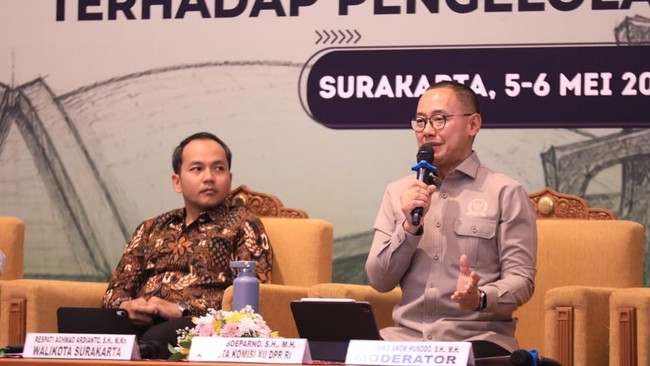
Jakarta, CNBC Indonesia - Deputy Chairman of the MPR from the PAN faction, Eddy Soeparno, was one of the speakers at the Parlemen Kampus 2026 event, a collaboration between the DPR and Sebelas Maret University (UNS) in Surakarta. Also present at the event were Solo Mayor Respati Ardhi and Deputy Chairman of Commission XII of the DPR, Aria Bima.
In his presentation, Eddy emphasised the importance of accelerating the development of waste-to-energy (WtE) or Waste-to-Power Plants (PLTSa) as a key strategy to address two major challenges facing Indonesia simultaneously: the waste management crisis and the need for a transition to clean energy.
Eddy stressed that Indonesia’s waste problem has reached emergency levels. Of the total national waste accumulation exceeding 56 million tonnes per year, around 61% remains unmanaged, with much of it ending up in open dumps or polluting the environment. This situation not only impacts environmental quality but also public health and national economic efficiency.
In particular, Eddy appreciated President Prabowo’s commitment to making waste management a national priority, as well as the breakthrough approach using WtE to handle waste.
“The waste issue is a priority for President Prabowo, and this deserves appreciation. Because conventional waste management approaches are no longer adequate. Therefore, transforming towards a circular economy model through the development of PLTSa is a strategic step taken by President Prabowo,” he said, as quoted in a press release on Wednesday (6/5/2026).
Globally, WtE development has proven effective. Countries like China lead with an installed capacity of 13.7 GW, followed by Japan, Germany, and the United States. According to Eddy, Indonesia has great potential to catch up by leveraging recent regulatory momentum.
According to this PAN deputy chairman, Presidential Regulation No. 109 of 2025 serves as a crucial milestone in accelerating national PLTSa development. This regulation brings several fundamental improvements, including electricity tariff certainty at 20 US cents per kWh, contract durations of up to 30 years, and a guaranteed minimum waste supply of 1,000 tonnes per day.
“Additionally, the elimination of the tipping fee scheme from regional budgets and the shift to national budget financing is seen as able to increase investment attractiveness while easing the fiscal burden on local governments. This Perpres gives a strong signal that the state is present to create investment certainty in the renewable energy sector, particularly waste-based,” said Eddy.
Furthermore, this UI Political Science Doctor explained that PLTSa development not only impacts the energy sector but also opens new economic opportunities. Each megawatt of PLTSa capacity is estimated to create up to eight new jobs.
Moreover, the development of 33 PLTSa locations in Indonesia has the potential to generate electricity capacity of up to 450-660 MW, while also opening revenue opportunities from carbon trading projected to reach up to USD 30 billion by 2030.
In this context, Eddy specifically emphasised the importance of involvement from academics and students. He views campuses as centres of innovation that can contribute to research on technology, policy design, and the development of more sustainable and equitable PLTSa governance models.
“WtE development must be seen as an integral part of the national energy resilience agenda and Indonesia’s leadership in global climate action. The success of this programme greatly depends on cross-sector collaboration and long-term policy consistency,” he concluded.