
EcoNusa trains Semangga Merauke residents to improve copra quality
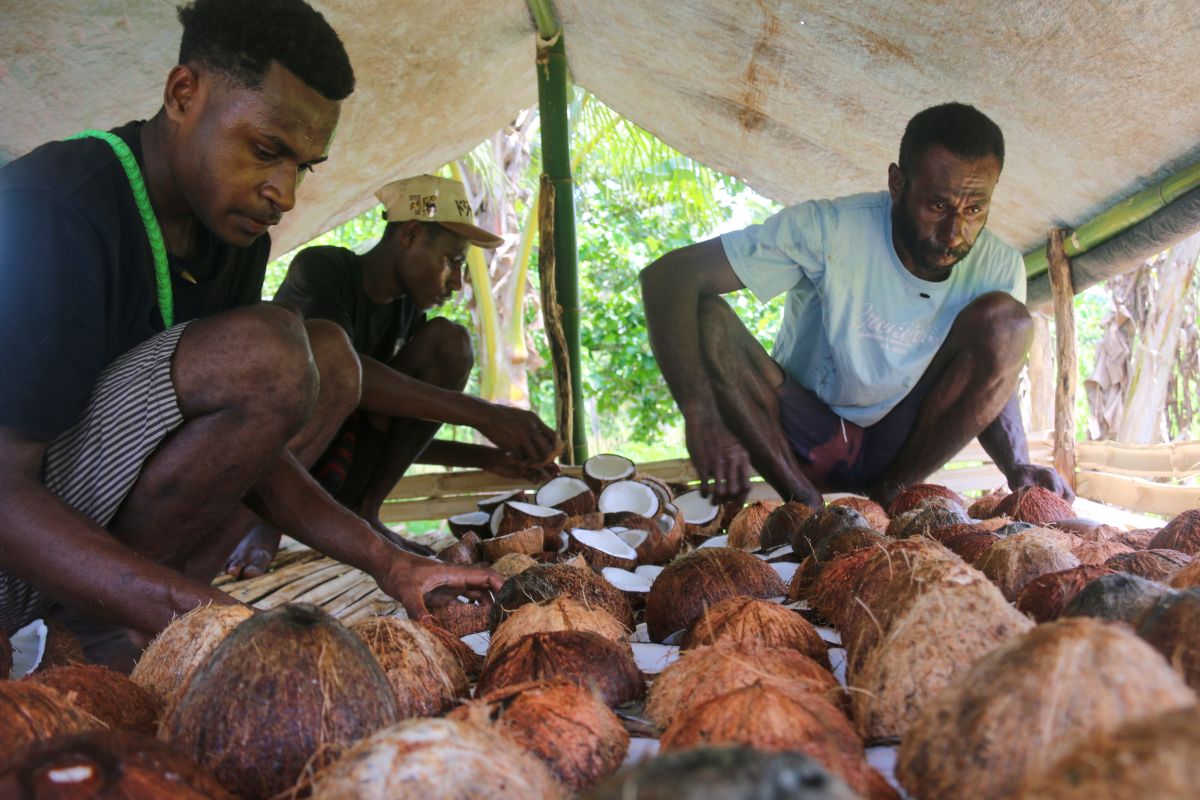
Jakarta (ANTARA) - The EcoNusa Foundation held training to improve copra quality for residents of Semangga District, Merauke Regency, South Papua, to encourage coconut processing that achieves higher selling value and can penetrate broader markets.
The training, which took place in Urumb Village from 18–24 March 2026, was attended by people from Urumb Village, Matara, Sidomulyo, and Waninggap Nanggo.
One of the residents who participated, Robert M.B., said that until now, copra processing has still been done traditionally by relying on sunlight, so the quality of the production results has not been optimal.
“Sometimes after just two days, the copra is already mouldy,” he said in an official statement from the EcoNusa Foundation in Jakarta on Wednesday.
Meanwhile, Chair of the Sinai UMKM, Sumarni, hopes that the training can enhance the technical skills of residents so that the copra produced is better and has a higher selling price.
“Until now, we have been making copra, but we still need to learn more so that the results are better and can sell at a good price,” she said.
EcoNusa Programme Associate, Moses Ramsis Boi, emphasised the importance of community cooperation in applying the correct production methods to improve copra quality.
“If we work together and follow the right methods, the copra from the village can improve in quality, and the price will surely rise too,” he said.
In the training, participants were equipped with understanding of copra quality standards in terms of physical, chemical, and hygiene aspects. Good copra must be clean white or light brown in colour, free of dirt, and have a moisture content below six percent.
In addition to theory, participants also carried out direct practice from selecting coconut fruits, splitting, washing, to the smoking process. In the smoking process, the fire must not burn large, but just enough to produce smoke to optimally reduce moisture content.
Residents were also taught to make drying racks or para-para using local materials like bamboo and wood so that the technique can be easily applied independently.
In the evaluation session, most of the copra produced showed quality improvements with dryness levels between two and seven percent.
Semangga District is one of the areas in Merauke that relies on natural resources for livelihood. In addition to farming and fishing, some communities in villages like Matara and Urumb depend on coconuts as a source of income, with around 6,000 coconut trees growing around Matara Village.
However, coconut utilisation is still dominated by sales in the form of whole fruits, while processing into copra is still limited and does not yet meet market standards.
EcoNusa states that improving production quality is an important step to expand market access.
Throughout 2025, coconut-based commodities from EcoNusa’s assisted areas have penetrated national and international markets, with achievements of 69 tons of copra from Kaimana, West Papua, 44 tons from Sarmi, Papua, and 5.1 tons from East Seram, Maluku.
With the improvement in copra quality in Semangga, EcoNusa hopes that products from the area can follow in the footsteps of other regions in strengthening community economies based on local resources in a sustainable manner.