
Economists Say Fuel Prices Don't Need to Rise, Here's the Explanation!
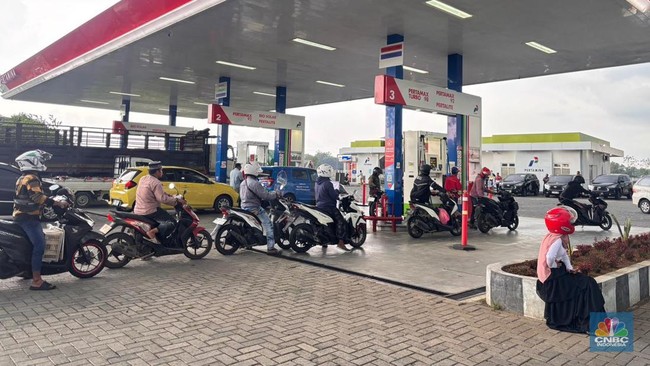
Economists see potential for an increase in fuel prices if the war in the Middle East drags on and causes global crude oil prices to remain high.
Global Markets Economist at Maybank Indonesia, Myrdal Gunarto, states that Indonesia’s fiscal resilience in facing the effects of high oil prices over the next three months remains strong. However, if the war continues beyond that, rationalisation of fuel subsidies for energy will be necessary.
“So, in my view, based on my calculations, for the period of three months from March, April, May, even if oil prices remain above the fuel assumption of US$70 per barrel, I think it’s still safe,” he told CNBC Indonesia on Wednesday (25/3/2026).
“But once June arrives, it needs to be reviewed again. How much fiscal room is left? If the fiscal deficit is starting to breach, approaching 3%, even if it’s just the June period, like it or not, they must take steps to rationalise fuel subsidies for energy. That’s what the government must do,” he continued.
According to him, one step that can be taken is to rely on windfall profits from rising commodity prices, such as crude palm oil (CPO) and coal, and redirect them to fuel subsidies.
“We hope, especially for subsidised fuel prices, the endurance is up to the end of May at most. So, if June comes, it needs to be reviewed again, whether there is an impact from windfall profits from rising prices of other commodities like CPO or coal. If there is, it must be exercised, how much the excess is, whether it can provide support to be redirected to compensation or subsidies for fuel or energy,” he concluded.
Meanwhile, Chief Economist David Sumual said that if oil prices remain high, fuel price rationalisation is needed to maintain fiscal resilience. According to him, the state budget will need adjustments due to high crude oil prices.
“State budget rationalisation, budget revision, yes, it needs to be done; calculations based on the scenario mentioned must already be carried out within this month. Including the fuel price increase if the war indeed drags on and oil prices remain high,” David told CNBC Indonesia when contacted on Wednesday (25/3/2026).
However, he emphasised that fuel price increases would only occur if the war lasts long. Although, in his view, the current war tensions will not last long, at most three months. Thus, there is a scenario where global crude oil prices return to normal.
“But usually, from experience, negotiations will happen; maybe the war doesn’t end, but a ceasefire like that. So ships can pass through first. Usually, it’s like that. Because this is a global interest, right? So there will definitely be pressure on both countries, to America and to Iran, to open the strait,” he said.
Chief Economist at Bank Permata, Josua Pardede, said that the government can take steps to maintain national economic stability without sacrificing fuel price increases.
“A more appropriate solution without raising fuel prices is to combine careful savings with additional revenue and protection of purchasing power,” he told CNBC Indonesia on Wednesday (25/3/2026).
Josua said that the government still has room to hold fuel prices in the meantime while strengthening food assistance, transport discounts, THR distribution, and spending that directly reaches households, because public consumption is currently the main pillar of growth.
“This is important, because consumer confidence in February 2026 is still optimistic at 125.2, retail sales in February are estimated to grow 6.9% year on year (yoy), but inflation in February has also risen to 4.76% annually, and Bank Indonesia is still holding interest rates at 4.75% to maintain rupiah stability,” he said.
According to him, in such conditions, raising fuel prices would risk adding price pressures and curbing consumption.
Josua also sees that for the energy sector, the government can accelerate the shift from diesel power plants to solar power, energy savings in government offices, restrictions on travel spending, logistics improvements, and enforcement.
This is considered better than directly shifting the burden to the public by raising fuel prices.