
Economists: Indonesia-US Trade Deal Is Asymmetric
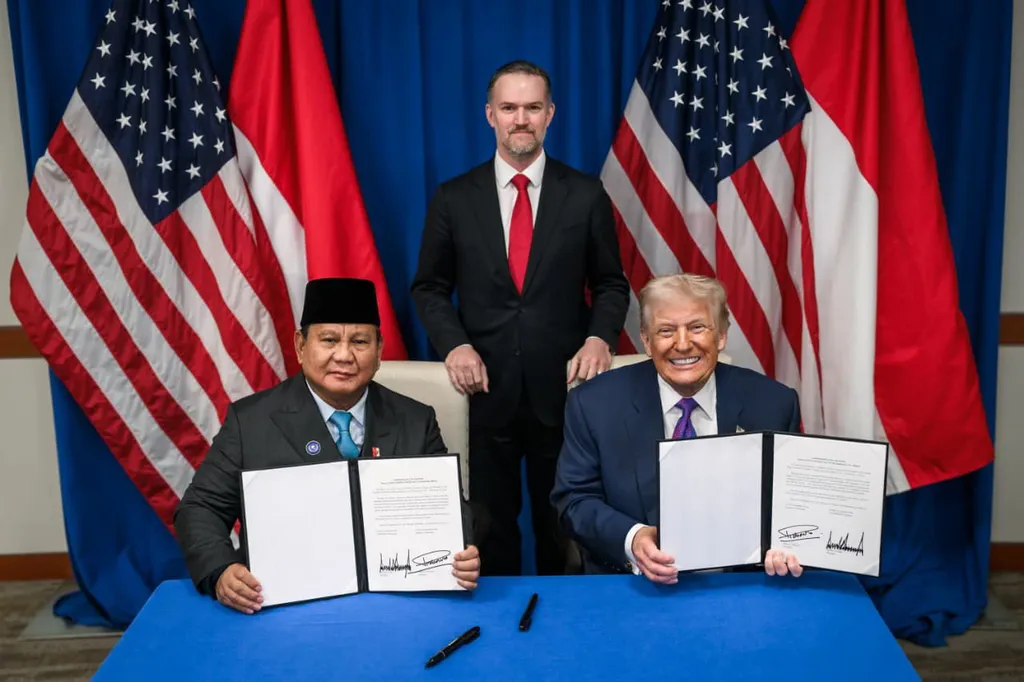
JAKARTA, KOMPAS — The trade agreement between Indonesia and the United States is asymmetric in nature and risks deepening Indonesia’s economic dependence on the United States. Behind the tariff reductions on 1,819 Indonesian product lines lie a number of binding obligations that narrow the scope of national industrial policy.
President Prabowo Subianto and US President Donald Trump signed a reciprocal trade agreement (ART) entitled “Toward a New Golden Age for the US-Indonesia Alliance” in Washington DC on Thursday (19/2/2026) local time.
Under the document, the US reduced import duties on 1,819 Indonesian product lines to zero per cent whilst maintaining a general reciprocal tariff averaging 19 per cent.
In return, Indonesia granted zero-tariff treatment and various non-tariff concessions for US-origin products, as well as agreeing to a number of commitments in the areas of investment, digital trade, and strategic minerals.
Deni Friawan, an economist at the Centre for Strategic and International Studies Indonesia (CSIS), argued that amid rising global protectionism, assured access to the US market provides Indonesia with a degree of “security.”
“Leading products such as palm oil, cocoa, coffee, textiles, garments, and footwear stand to expand their markets with tariff certainty,” he said when contacted from Jakarta on Friday (20/2/2026).
Integration into US strategic supply chains, particularly for critical minerals and energy transition materials such as electric vehicle batteries and rare earth metals, Deni continued, could help diversify Indonesia’s export markets, which have hitherto been heavily reliant on China.
Deni also assessed that commitments on regulatory transparency, strengthening intellectual property rights, and facilitating digital trade have the potential to improve the long-term investment climate. “If managed properly, the ART could serve as a momentum for industrial upgrading and encourage foreign direct investment inflows,” he said.
However, Deni warned of serious consequences for Indonesia’s policy space. A number of commitments were deemed to restrict the government’s flexibility in pursuing its national industrialisation strategy.
“For a country still in the catching-up stage like Indonesia, policy space is a valuable asset. Reducing it without a clear compensatory strategy risks deepening dependence,” he said.
Deni also highlighted potential pressure on domestic producers from the opening of imports of US agricultural and food products. Without productivity improvements and adaptation programmes, liberalisation could trigger social and economic pressures.
In the medium term, the risk of trade imbalances must also be anticipated if imports grow faster than value-added exports. Such conditions could widen the trade balance deficit and put pressure on the rupiah exchange rate.
Nailul Huda, Economics Director at the Center of Economic and Law Studies (Celios), assessed that Indonesia was in a disadvantageous negotiating position. The granting of zero-per-cent tariffs on more than 98 per cent of US-origin products and energy import obligations could widen the trade imbalance.
“I feel Indonesia has lost on many fronts. The 19 per cent tariff cannot simply be called a victory because it is highly dependent on non-tariff agreements,” he said.
From the perspective of national industry, he saw potential pressure on exports and limited scope for market share expansion. The palm oil sector may indeed benefit, but more because of US dependence on that product.
Huda also questioned the extent to which US mineral investment would drive technology transfer. “Has there actually been any knowledge transfer from US critical minerals company investments in Indonesia? We must ensure it is not merely resource exploitation,” he said.
In digital trade, he expressed concern about restrictions on Indonesia’s ability to impose taxes or regulations on US technology companies. Another issue is the provision requiring Indonesia to consult with the US before entering into digital agreements with other countries.
Achmad Nur Hidayat, an economics lecturer at UPN Veteran Jakarta, assessed the ART agreement as asymmetric in design. “This is not reciprocal in the sense of being equal. We are opening many doors; they are providing one door that remains guarded by tariffs,” he said.
According to Achmad, Indonesia’s obligations under the ART concern not only tariffs but also domestic policy discipline, ranging from product standards, local content requirements (TKDN), food, halal certification, personal data, critical minerals, to foreign exchange from natural resource exports.
He highlighted provisions requiring Indonesia to accept US standards or certain international standards without additional requirements. This was deemed to shift national regulators’ authority in determining product entry standards.
Achmad also criticised the exemption of US companies and products from TKDN requirements. According to him, TKDN is an industrial policy instrument for promoting domestic supply chain growth and technology transfer.
“If one country is granted an exemption, TKDN loses its bite as a tool of economic sovereignty,” he said.
On the digital front, he assessed that commitments on cross-border data transfers and recognition of US data protection standards could limit Indonesia’s ability to design independent digital economic policies. “When cross-border data flows are made a trade commitment, a country relinquishes part of its ability to regulate its own digital economy,” Achmad said.
He also highlighted commitments to eliminate restrictions on critical mineral exports to the US and facilitate investment without certain ownership limitations. Such policies were deemed to potentially erode the downstream processing strategy that has been built up over time.
“Divestment and ownership limits are not merely protectionism but levers to ensure value addition and control do not leak abroad,” he said.