
Economist: MSME Credit Could Grow Aggressively if Three Major Sectors Strengthen
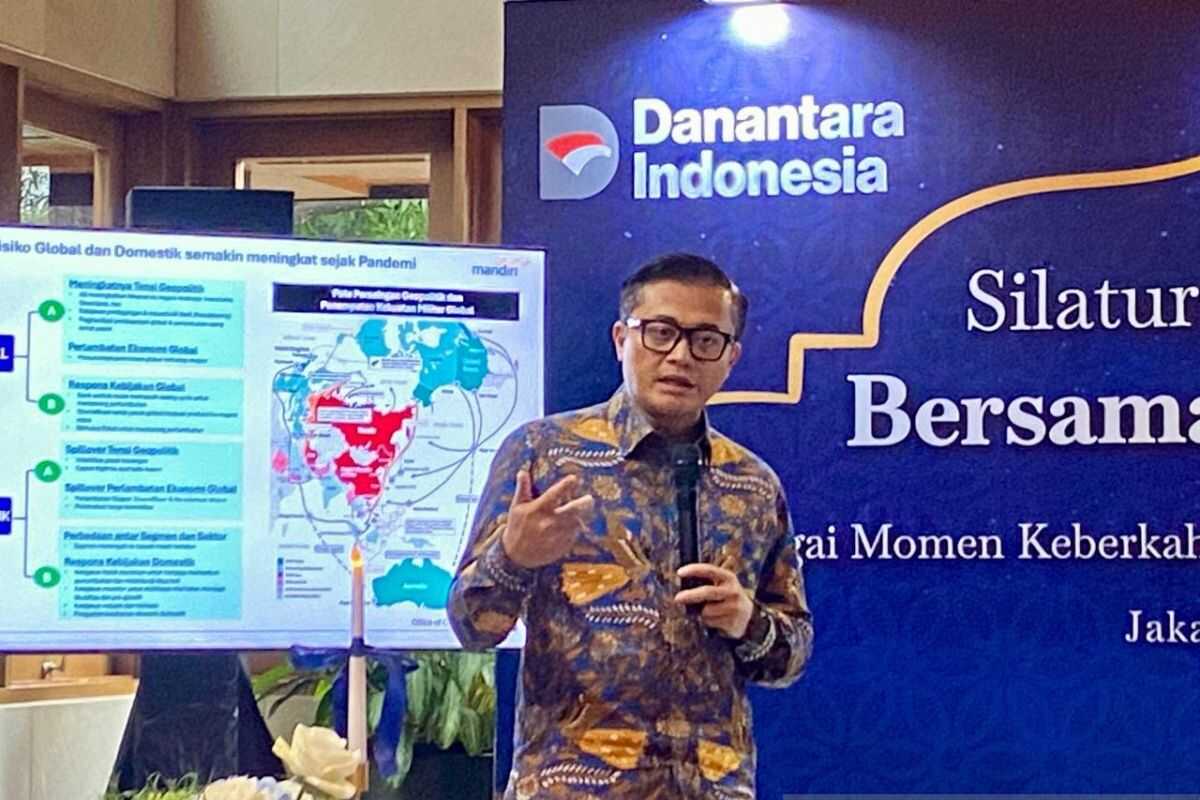
Jakarta (ANTARA) - Chief Economist of Bank Mandiri, Andry Asmoro, believes that MSME credit performance has the potential to grow aggressively if the trade, agriculture, and manufacturing sectors also consistently improve, as these three sectors contribute the majority of total MSME credit.
He noted that MSME credit is concentrated in three main sectors, which account for approximately 75 percent of total MSME credit, with wholesale and retail trade accounting for 45 percent; agriculture, forestry, and fisheries accounting for 19.4 percent; and the remainder being the manufacturing sector.
“If these sectors have not grown consistently, for example, if agriculture still only grows at an average of 2.4 percent, it will be very difficult to encourage more aggressive growth in the MSME sector,” said Andry Asmoro, also known as Asmo, in Jakarta on Wednesday evening.
As an illustration, these three sectors are the largest contributors to Indonesia’s gross domestic product (GDP).
Asmo noted that in the last three years, the average growth of the agriculture, forestry, and fisheries sector has lagged, at 2.4 percent.
Meanwhile, trade and manufacturing have grown at an average of 5 percent and 4.8 percent, respectively, in the last three years.
The growth of the banking industry’s credit this year is projected to be in the high single-digit to low double-digit range, at around 9-11 percent, according to projections by Bank Mandiri’s economic team.
Asmo estimates that MSME credit growth will be in the range of 4-5 percent, so growth at the 4 percent level is considered good enough. On the other hand, the ratio of MSME credit to total banking credit is expected to decrease to around 17 percent, from 19 percent previously.
According to him, the prospects for MSME credit are still quite promising, especially through government programs that support the business ecosystem. For example, the Free Nutritious Meal program can build a new value chain for MSMEs, thereby encouraging demand for micro credit and consumer credit.
Asmo also underlined that one of the main challenges for MSMEs is to ensure the existence of clear off-takers.
If MSMEs are integrated into the ecosystem, the existence of off-takers will be clear, making it easier to access invoice-based financing and create a safer source of credit for banks.
On the same occasion, SVP Micro Development & Agent Banking of Bank Mandiri, Bayu Trisno Arief Setiawan, explained that the company is implementing a similar strategy, where Bank Mandiri utilizes its corporate customer base to encourage the distribution of credit to MSMEs.
Corporations usually have downstream businesses to the lower levels, so Bank Mandiri can distribute financing to MSMEs that are part of their ecosystem.
Bayu mentioned that the growth of Bank Mandiri’s MSME credit in January 2026 was quite positive compared to the previous month. Compared to January last year, the micro banking portfolio also showed an increase.
This, according to him, confirms that the strategies implemented so far remain relevant and effective in supporting the growth of MSMEs.
“At Bank Mandiri, so far the MSME NPL is still below 2 percent, even below 1.5 percent. So we can manage it, because our growth strategy is directed towards a strategy to empower MSMEs that are derivatives of corporate customers,” said Bayu.
He noted that of the company’s total credit distribution of around IDR 1,500 trillion, the portion of micro banking is only around IDR 100 trillion. Although still relatively small, he said, this segment has recorded quite good growth in the last five years.
“This is what makes us even more confident that our role in empowering MSMEs, especially to move up a level, must continue to be encouraged,” said Bayu.