
Economist: Manufacturing and Agriculture are Key to Indonesia's Resilient Economic Growth
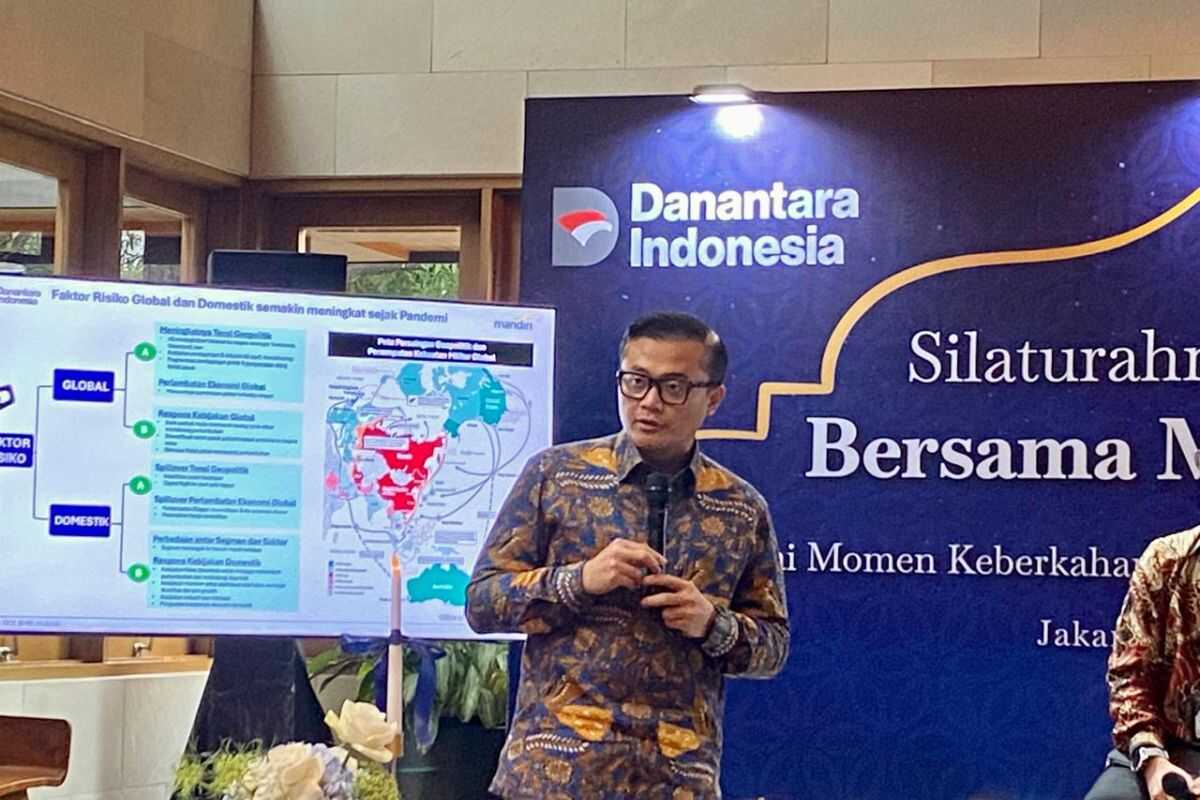
Jakarta (ANTARA) - Bank Mandiri’s chief economist, Andry Asmoro, believes that the manufacturing and agricultural sectors, as the largest contributors to Indonesia’s GDP, need to be accelerated to ensure resilient and sustainable economic growth.
“If you ask what the strategy is for Indonesia to grow resiliently and sustainably, then it is indeed necessary to grow the sectors that have a large contribution to the Indonesian economy,” he said, also known as Asmo, in Jakarta on Wednesday evening.
He noted that in the last three years, the average growth of the manufacturing industry and the agriculture, forestry, and fisheries sectors has lagged behind, at 4.8 percent and 2.4 percent, respectively.
According to him, the agricultural sector needs to move beyond its current average growth of 2.4 percent, especially since the government has priority programs directly related to this sector, such as food security.
Asmo estimates that if the agricultural sector can grow to 4 percent, then Indonesia’s economic growth has the potential to become more resilient and can reach above 5.5 percent.
In addition to driving economic growth due to its large contribution to GDP, Asmo believes that accelerating the manufacturing and agricultural sectors also plays an important role in solving the problem of labor absorption.
He also reminded that currently the majority of workers in the agricultural sector are still in the informal sector.
With proper management, the agricultural sector has the potential to create more formal jobs.
Furthermore, accelerating this sector is also considered to be able to increase the supply of foreign exchange. This is because commodities from the agricultural, forestry, and fisheries sectors have a strong export orientation, such as coffee, cocoa, coconut, cloves, and nutmeg, which have been Indonesia’s mainstay in the global market.
Furthermore, Asmo also highlighted the inequality in regional contributions to the national economy. In the last 40 years, from 1984 to 2024, the contribution of the gross regional domestic product (GRDP) of Sumatra and Kalimantan to the total national GDP has tended to decrease.
In fact, both regions are the main commodity-producing areas. In contrast, the contribution of the island of Java continues to increase.
According to Asmo, this condition shows the need for more serious efforts to encourage development in Sumatra and Kalimantan so that the distribution of economic growth becomes more evenly distributed.
Regarding the 2026 economic growth projection, Asmo assessed that the main challenge is to maintain momentum in the second and third quarters, especially the third quarter which usually has minimal seasonal sentiment.
Meanwhile, economic growth in the first quarter of 2026 is projected to be higher than in the fourth quarter of 2025. This is driven by the seasonal factors of Ramadan and Eid, the low base effect due to the slowdown in the previous period, and the acceleration of government spending.
“So, these three points are what will most likely cause growth in the first quarter to be at least flat with the fourth quarter of 2025, or possibly slightly higher than the fourth quarter of 2025,” said Asmo.