
Economist: Finance Minister-BI Visit to US Must Be Followed by Policy Credibility
Jakarta (ANTARA) - The Head of the Macroeconomics and Finance Centre at the Institute for Development of Economics and Finance (Indef), M Rizal Taufikurahman, stated that meetings between several Indonesian officials and investors and financial institutions in the United States (US) must be followed by policy credibility.
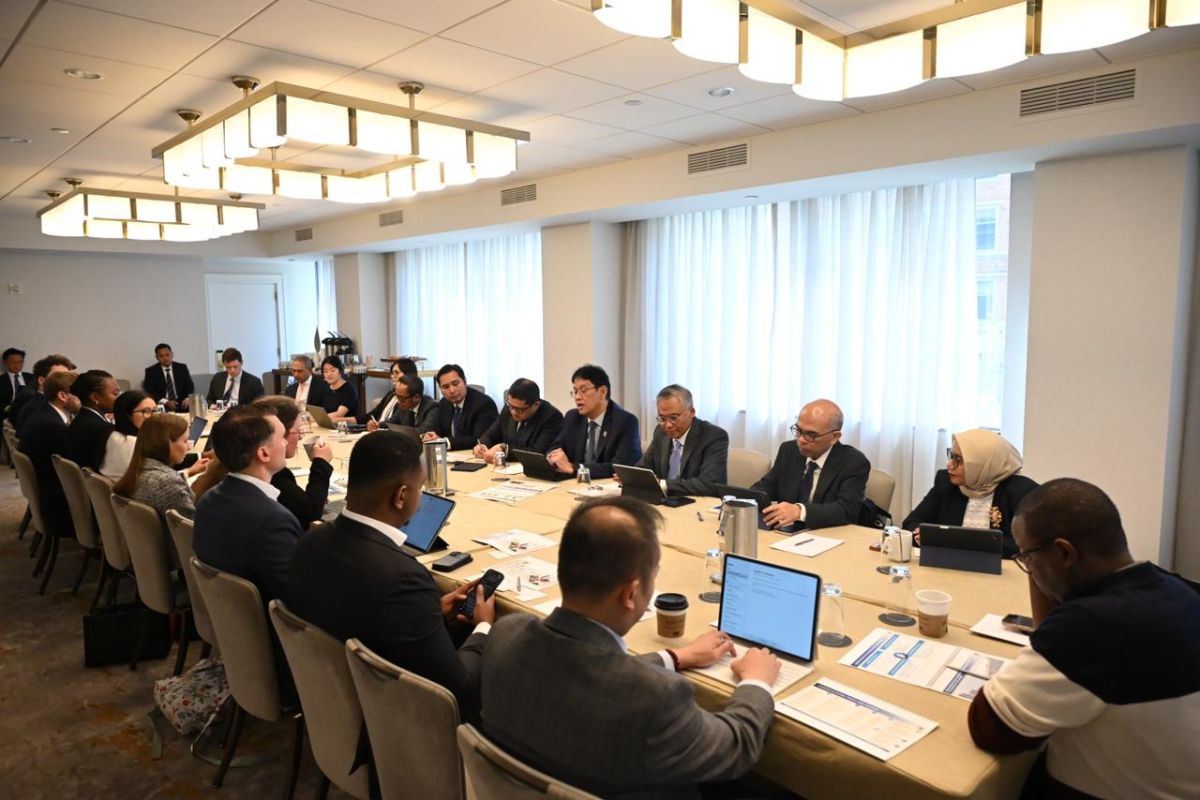
Finance Minister Purbaya Yudhi Sadewa and Bank Indonesia Governor Perry Warjiyo conducted a series of visits (roadshow) to the United States this week to convince investors and international financial institutions regarding the resilience of Indonesia’s macroeconomic and fiscal fundamentals.
When contacted by ANTARA in Jakarta on Wednesday, Rizal said that these meetings could enhance positive sentiment towards Indonesia’s domestic market in the short term.
“The meetings between the Finance Minister and Bank Indonesia Governor with global players such as HSBC, BlackRock, and the IMF will have an impact of providing short-term positive sentiment, not fundamental and structural changes,” he said.
He projected that the market’s response to these meetings would occur in the coming days or even weeks.
However, Rizal cautioned that investors would continue to examine the reality of the data and test the consistency between the narrative presented and the on-the-ground fundamentals.
He noted that Indonesia’s current economic conditions remain quite good, with relatively controlled annual (year-on-year/yoy) inflation at 3.48 per cent as of March 2026 and state revenues growing 10.5 per cent yoy to Rp574.9 trillion as of 31 March.
However, he said that pressures on the rupiah exchange rate reaching Rp17,100 per US dollar, a decline in foreign exchange reserves from USD151.9 billion to USD148.2 billion at the end of March, an upward trend in SBN yields, and concerns over the fiscal direction are restraining factors.
“This means that these meetings serve as confidence signalling (providing a confidence signal) that is temporary, not a game changer (significant change-bringer) for the domestic market,” said Rizal.
He also assessed that these meetings are not sufficient to fully restore investor confidence, making it important to implement concrete and disciplined follow-up policies.
Rizal said the government needs to ensure that fiscal management remains credible, deficit financing is transparent and accountable, and no instruments are introduced that increase risk perceptions.
In addition, coordination between the fiscal and monetary sectors must be truly effective in maintaining rupiah stability without excessively eroding foreign exchange reserves.
“In conditions like this, investor confidence is not built from roadshows, but from policy credibility that is consistent, measured, verifiable, and testable by the market,” he stated.
“Without such concrete steps, meetings with global investors will only become a signal without structural substance, whose effects fade quickly once the market re-examines the fundamental data,” Rizal added.
Previously, Finance Minister Purbaya Yudhi Sadewa reassured several global investors, including HSBC Global Asset Management, Lazard AM, BlackRock, Lord Abbett, and TD Asset Management, about the resilience of Indonesia’s macroeconomic fundamentals and fiscal strategy during meetings in New York and Washington DC, United States.
“Essentially, we explained our economic conditions and future fiscal strategy, so they are convinced that our fiscal movements or policies are already on the right track,” said Purbaya in his written statement.
Meanwhile, Bank Indonesia Governor Perry Warjiyo affirmed to global investors during the IMF Spring Meeting 2026 in the United States that Indonesia’s policy mix is on track or on the right path.
The policy mix focuses on external stability and resilience through interest rate management, foreign exchange interventions, and strengthening domestic liquidity, supported by a fiscal commitment to keep the deficit below 3 per cent of GDP through subsidy reforms and more productive budget reallocations.
“We continue to ensure a consistent and responsive policy mix to maintain stability and support Indonesia’s economic growth amid global dynamics,” said Perry, also from his official statement.