
Economist: BNI's 13 Trillion Rupiah Dividend Distribution Indicates Bank Stability
An economic policy analyst from the Indonesia 2045 Laboratory (Lab 45), Nadia Restu Utami, has assessed that the 13.03 trillion rupiah cash dividend distribution by PT Bank Negara Indonesia (Persero) Tbk (BNI) demonstrates bank stability.
According to her, the decision indicates efforts to maintain a balance between providing returns to shareholders and sustaining the bank’s business continuity.
“With a payout ratio of approximately 65 per cent of net profit, this policy signals that the bank’s performance is sufficiently strong to provide returns to investors,” said Nadia in a written statement in Jakarta on Tuesday.
The 65 per cent payout ratio from net profit still leaves room for retained earnings, which are intended to strengthen capital and support business expansion for the bank itself.
“In the banking sector, consistent dividend payments often serve as an indicator of stability and good governance, thereby enhancing investor confidence in the company’s long-term prospects amid current global uncertainty,” she explained.
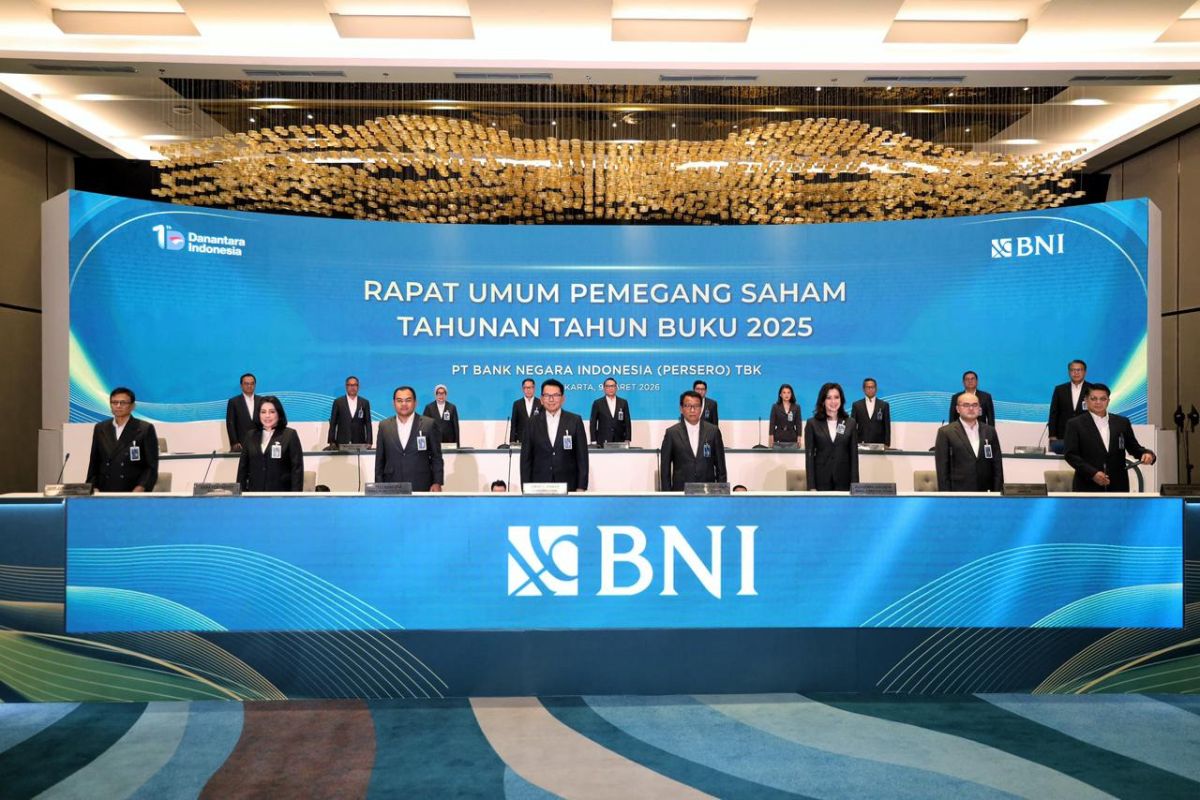
Previously, BNI, through its Annual General Meeting of Shareholders (AGMS) for the 2025 Financial Year, approved the distribution of a cash dividend of 13.03 trillion rupiah.
The dividend is equivalent to 65 per cent of the consolidated net profit attributed to the parent entity’s owners, amounting to 20.04 trillion rupiah.
“A number of strategic decisions agreed upon in this AGMS are part of efforts to maintain sustained performance and strengthen the Perseroan’s capital foundation going forward,” stated Okki.
In the meeting, shareholders also approved the allocation of 35 per cent of net profit, or approximately 7.01 trillion rupiah, as retained earnings.
These funds will be used to support business expansion and strengthen BNI’s capital capacity amid the dynamics of the banking industry.