
Economic Ministers Meet at Airlangga's Office Today; What's on the Agenda?
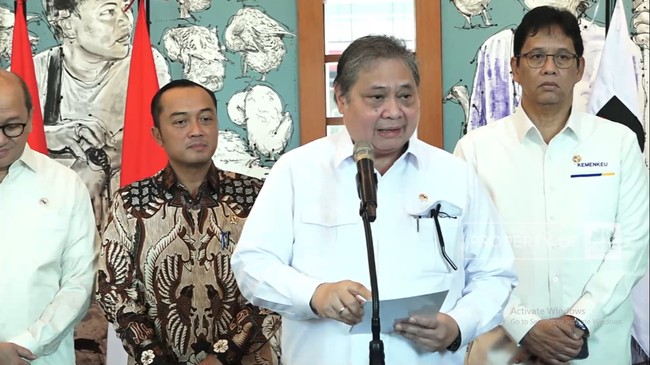
Jakarta – The economic ministers of the Red and White Cabinet are to attend a limited coordination meeting (Rakortas) at the office of Coordinating Minister for Economic Affairs Airlangga Hartarto on Monday afternoon, 16 March 2026.
According to information received, the meeting scheduled for approximately 13:30 WIB will follow up on discussions from the full cabinet meeting at the State Palace on Friday, 13 March 2026 with President Prabowo Subianto.
Finance Minister Purbaya Yudhi Sadewa is among the economic ministers expected to attend the coordination meeting with Coordinating Minister Airlangga.
At the full cabinet meeting last weekend, discussions centred on the impact of the conflict in the Middle East between the United States and Israel with Iran on Indonesia’s economy and the 2026 state budget. The meeting also addressed strategies for managing the Eid exodus in 2026.
During the meeting, Coordinating Minister for Economic Affairs Airlangga Hartarto proposed the issuance of a Government Regulation in Lieu of Law (Perppu) to President Prabowo Subianto should global oil prices continue to surge beyond the assumptions contained in the 2026 Budget Law.
Airlangga stated that global oil prices risk squeezing government finances, driven by conditions of global geopolitical uncertainty, particularly the Middle East conflict between the United States and Israel with Iran. This conflict has disrupted oil supply in the global market.
“With this Perppu, the government has flexibility for changes,” Airlangga said during the full cabinet meeting at the State Palace in Jakarta.
Airlangga based the Perppu proposal on various risk scenarios he had calculated. These scenarios assess the risks of the Middle East conflict lasting six to ten months, with average global crude oil prices rising to US$97 per barrel and US$115 per barrel.
Besides oil prices, the scenarios considered by Airlangga also took into account the exchange rate against the US dollar, government bond yields, and economic growth that could be disrupted by the conflict and further pressure the 2026 budget deficit.
Here are the scenario details:
Indonesian crude oil price (ICP) at US$86/barrel, exchange rate of Rp 17,000 per US dollar, whilst the budget assumes Rp 16,500 per US dollar, with growth maintained at 5.3%, government securities at 6.8% higher, the budget deficit is estimated to reach 3.18%.
Second moderate scenario with ICP at US$97 per barrel, exchange rate of Rp 17,300, growth of 5.2%, government securities at 7.2%, then the deficit reaches 3.53%.
Worst-case pessimistic scenario, with ICP at US$115 per barrel, exchange rate of Rp 17,500, growth of 5.2%, government securities at 7.2%, the deficit reaches 4.06%.
“This means with various scenarios like these, maintaining a 3% deficit would be difficult for us, unless we cut spending and slow growth,” Airlangga said.
A Government Regulation in Lieu of Law (Perppu) is an attributive power of the President, not a mechanism proposed directly by the public or parliament. Its requirements include urgent necessity, absence or inadequacy of existing law, and inability to be resolved through normal legislation. Although the Perppu is established by the President, it still requires approval from parliament.
If approved by parliament, the Perppu becomes law; if rejected, the Perppu must be revoked or declared null and void. Once a Perppu is issued, citizens who feel harmed may lodge a judicial review (constitutional review) with the Constitutional Court.
In the last five years, Indonesia issued Perppu during President Jokowi’s era: the Job Creation Perppu (Perppu 2/2022) and the Pandemic Response Perppu (Perppu 1/2020).
Airlangga then stated to Prabowo that discussion of this Perppu should be followed up in the coordination meeting. “These are some scenarios that we may need to discuss in a limited meeting,” he said.
Finance Minister Purbaya Yudhi Sadewa reassured President Prabowo Subianto that the government need not fear geopolitical shocks threatening Indonesia’s economy. This was conveyed by Purbaya during the Cabinet’s Full Session on Friday, 13 April 2026.
According to Purbaya, there are those who claim that Indonesia would collapse if oil prices touched above US$100 per barrel.
“Many say Indonesia’s economy will collapse into chaos. Yet our experience has not been like that. This chart shows the Coincident Economic Index in blue, an index depicting current economic conditions, and in green is the price of Brent crude,” Purbaya explained.
From the index depicting current economic conditions, Purbaya stated that Indonesia’s economy was performing well, with no collapse or recession.
In 2007-2008, Brent crude prices rose to high levels, reaching above US$220 per barrel on average per month. However, Indonesia’s economy was fine at that time.
This was because fiscal and monetary policies at that time were appropriate. As a result, Indonesia still managed growth of 4.6%. The same conditions occurred in 2011, when oil prices jumped to between US$110 and US$120 per barrel. Once again, the index showed Indonesia’s economy was still performing well.
“The blue line continues to rise. This means if we have appropriate fiscal and monetary policies, and your policies going forward, despite global economic fluctuations and oil price volatility, we have ways or experience to manage its impact on our economy,” he said.
During Covid as well, oil prices increased sharply. However, government policies at that time were able to manage the impact of rising fuel prices that climbed above US$100 per barrel.
“What we should note going forward is that we must adjust to policies or global oil prices, but we must tell our people that we will definitely succeed in managing this because our past experience shows we have succeeded,” he said.
“So we need not fear. Those analysts on TikTok and YouTube who say we will collapse—that is incorrect.”