
Economic Crisis Worsens, President Promises Cabinet Reshuffle Amid US Coup Warning
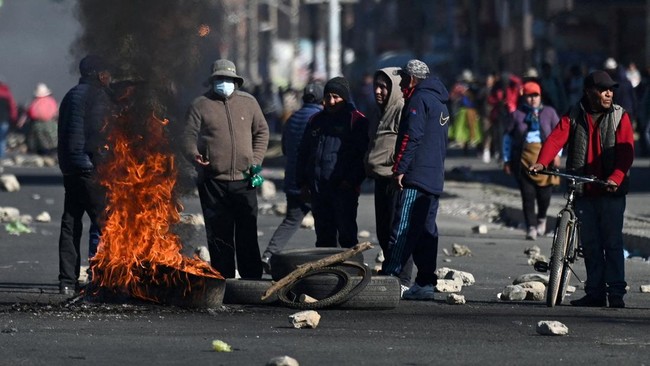
Bolivia has entered its most volatile political phase in recent years following large-scale demonstrations that blocked major roads across the country and escalated into open clashes between protesters and security forces in the capital La Paz.
The crisis, now in its second week, represents the greatest test yet for President Rodrigo Paz Pereira, who has held office for just six months since ending nearly two decades of leftist rule by the Movimiento al Socialismo (Mas) party.
Streets in central La Paz have become a battleground between riot police and demonstrators demanding the government’s resignation. The crisis has also evolved into a regional diplomatic conflict after Bolivia expelled Colombia’s ambassador following comments by Colombian President Gustavo Petro accusing the Paz Pereira administration of being a puppet of the United States.
Under mounting pressure, Paz Pereira announced plans to reshuffle his cabinet, whilst insisting he would not open dialogue with groups involved in violent actions.
“We need to restructure the cabinet, which must have the ability to listen,” Paz Pereira said at a press conference at the presidential palace, according to Al Jazeera. “The new cabinet will be a government that is more agile, closer to the people.”
The President also announced the formation of an “economic and social council” to establish a form of “joint governance” involving indigenous communities, farmers, miners and other workers participating in decision-making processes.
However, he drew a firm line against groups he considered responsible for violence.
“Is vandalism acceptable? No, and I will not dialogue with vandals,” he said.
This crisis represents the most dangerous moment since Paz Pereira assumed power in November. One of his first steps as a former senator was to restore relations with the United States, which now openly supports Bolivia’s government and has characterised the protests as a coup attempt.
US Deputy Secretary of State Christopher Landau on Tuesday called the ongoing demonstrations a “coup in progress”.
“Let us be clear about this; this is a coup that is being financed by an evil alliance between politics and organised crime in the region,” Landau said in Washington.
That statement was reinforced by US Secretary of State Marco Rubio a day later.
“Make no mistake: the United States stands fully in support of Bolivia’s legitimate constitutional government. We will not allow criminals and drug traffickers to overthrow a democratically elected leader in our hemisphere,” Rubio wrote.
Meanwhile, Bolivia has also been drawn into a diplomatic crisis with Colombia. Colombian President Gustavo Petro had previously shared a video calling Paz Pereira a “US puppet” and describing Bolivia as experiencing a “popular rebellion” in response to “geopolitical arrogance”.
In response, Bolivia’s government on Wednesday ordered the expulsion of Colombia’s Ambassador to La Paz, Elizabeth García.
Bolivia’s Foreign Ministry stated the measure was taken to “protect the principles of sovereignty and non-interference in internal affairs”.
Shortly thereafter, Petro responded strongly to the decision and warned that Bolivia was moving towards an extreme situation.
“Bolivia is hurtling towards extremism,” Petro told a Colombian radio station.
Hours after tensions escalated, Colombia’s Foreign Ministry announced that Bolivia’s ambassador would also leave Bogota.
The wave of demonstrations has claimed at least four lives. One protester was reported killed in clashes with security forces, whilst three others died because road blockades prevented access to medical care.
Additionally, dozens of people were injured and more than 40 roadblocks were recorded across Bolivia on Wednesday.
In La Paz, riot police engaged in hours-long clashes with demonstrators demanding Paz Pereira’s resignation.
A transport worker participating in the strike, Romer Cahuaza, warned that the situation could turn bloodier if the government held its ground.
“There will be bloodshed,” he said, whilst demanding the government’s resignation and improvements to fuel supplies.
Bolivia’s Foreign Minister Fernando Aramayo accused demonstrators of attempting to “disrupt democratic order”.
The political crisis comes as Bolivia faces one of its worst economic conditions in four decades, with severe US dollar shortages, a fuel crisis, and rising inflation dating from the final period of President Luis Arce’s administration from the Mas faction.
Paz Pereira, son of former President Jaime Paz Zamora who led Bolivia from 1989-1993, won the election with promises of “economic shock therapy”. However, after six months in office, economic conditions have not improved and several of his policies have triggered public anger.
One of his first decisions was to end fuel subsidies that had been in place for two decades. He promised that free markets would deliver better quality fuel to Bolivia.
The opposite has occurred. Fuel shortages have persisted, and a “dirty fuel” scandal soon emerged after some supplies were found to have been mixed or adulterated.
Paz Pereira claimed to be a victim of “sabotage” allegedly carried out by former officials connected to Mas.
The shadow of former President Evo Morales continues to haunt Bolivia’s new government amidst the chaos.