
East Java Investment Realisation Reaches Rp147.7 Trillion, Exceeds National Target
SURABAYA – East Java’s Investment and Integrated Single-Window Services Office (DPMPTSP) recorded stable investment realisation amid global geopolitical dynamics. Investment serves as a key performance indicator with direct impact on employment absorption.
For five consecutive years under Governor Khofifah Indar Parawansa’s leadership, East Java has maintained its position as the third-largest provincial investment contributor nationally, with steadily increasing contribution value.
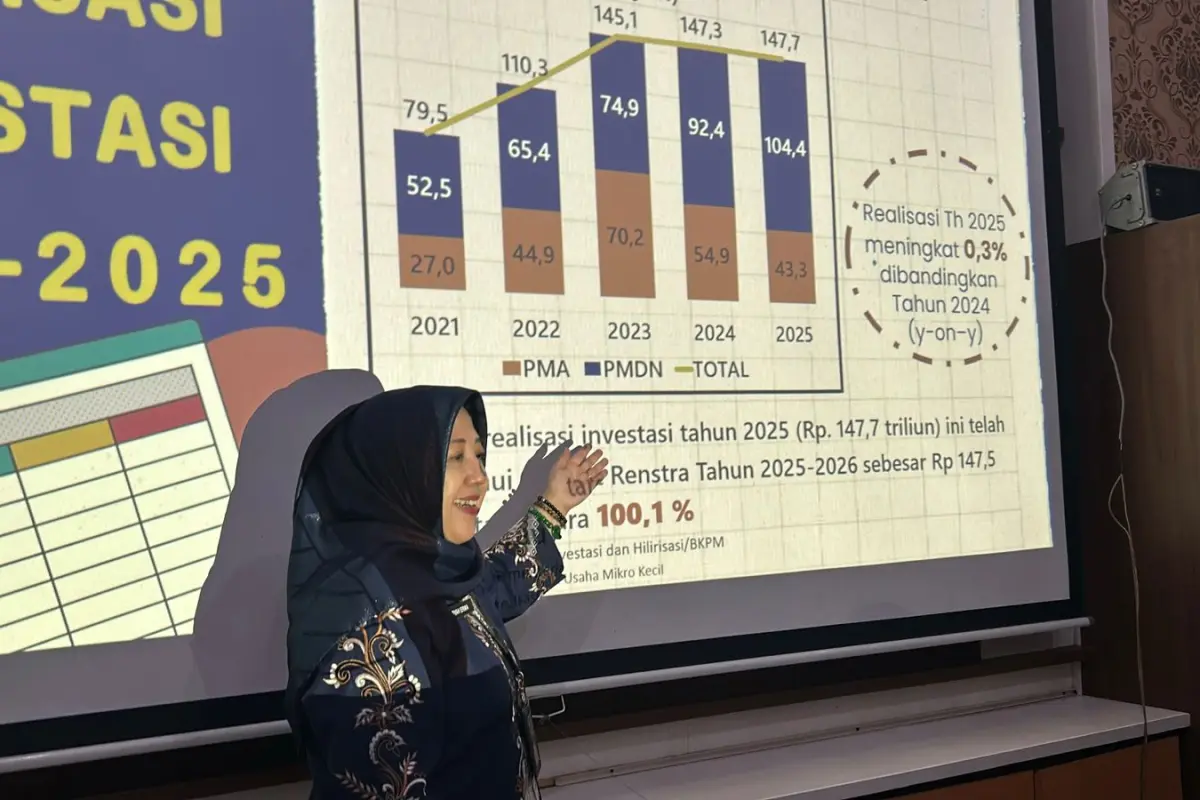
According to data from the Ministry of Investment/Investment Coordination Board (BKPM), East Java’s investment realisation in 2025 reached Rp147.7 trillion, up 0.3 per cent compared to 2024’s Rp147.3 trillion. This achievement exceeded the Ministry of Investment/BKPM’s 2025–2026 Strategic Plan target of Rp147.5 trillion. Cumulatively from January to December 2025, investment realisation reached 100.1 per cent of target.
Domestic Investment (PMDN) still dominated with Rp104.4 trillion or 70.7 per cent, whilst Foreign Direct Investment (PMA) reached Rp43.3 trillion or 29.3 per cent. PMDN realisation increased 13.0 per cent, whilst PMA contracted by 21.1 per cent. The dominance of PMDN demonstrates the strength of domestic investment in East Java.
“Investment characteristics in East Java are dominated by medium-to-high industries. We have advantages in PMDN. East Java contributes 7.5 per cent to national investment realisation,” said DPMPTSP Head Dyah Wahyu Ermawati during a presentation on investment realisation trends on Tuesday (17 March 2026).
She explained that East Java’s southern region from east to west forms an industrial agglomeration, particularly in labour-intensive sectors.
Regarding FDI, five countries were recorded as the largest investors. Singapore dominated with contributions to the food industry in Pasuruan Regency through Tri Sakti Purwosari Makmur with investment value of Rp7.8 trillion (17.9 per cent). Hong Kong ranked second with mineral non-metal industry investment in Gresik Regency through XinYi Solar Indonesia valued at Rp7.1 trillion (16.4 per cent). The United States ranked third through mining in Gresik Regency by PT Freeport Indonesia with investment value of Rp6.7 trillion (15.5 per cent). Japan invested in the motor vehicle and transport equipment industry in Pasuruan Regency through Jatim Autocomp Indonesia valued at Rp5.0 trillion (11.4 per cent). The People’s Republic of China held fifth position with mineral non-metal industry investment in Gresik Regency through Xinyi Glass Indonesia valued at Rp4.6 trillion (10.6 per cent).
The five regions with the largest FDI contributions were Gresik Regency at Rp14.3 trillion (33.1 per cent), Pasuruan Regency Rp8.8 trillion (20.3 per cent), Sidoarjo Regency Rp3.8 trillion (8.8 per cent), Surabaya City Rp3.3 trillion (7.5 per cent), and Ngawi Regency Rp2.3 trillion (5.4 per cent).
Sectors with the largest contributions included other industries at Rp15.4 trillion (35.5 per cent), food industry Rp8.0 trillion (18.5 per cent), mining Rp6.5 trillion (15.1 per cent), mineral non-metal industry Rp4.9 trillion (11.3 per cent), chemical and pharmaceutical industry Rp4.71 trillion (10.9 per cent), and basic metal industry Rp3.8 trillion (8.7 per cent).
Total investment projects in East Java during 2025 numbered 209,766 units. This condition directly impacted employment absorption growth.
In 2025, absorbed labour force reached 347,328 persons, increasing 16.2 per cent compared to 2024 and becoming the highest in five years. Employment absorption from PMDN increased 29.8 per cent, whilst PMA declined by 18.8 per cent.
“Employment absorption represents the highest in five years and contributes 7.5 per cent to the national total. East Java remains in third position nationally,” said Dyah.
She added that five main employment-absorbing sectors in East Java comprised trade and repairs (21.8 per cent), food industry (18.1 per cent), other services (10.5 per cent), leather goods and footwear industry (6.8 per cent), and hotels and restaurants (4.7 per cent).
Regarding global geopolitical dynamics, DPMPTSP East Java remains optimistic by preparing investment enhancement strategies through the Saleha innovation programme (Business Legality Awareness). This programme represents an effort to expand outreach and business licensing issuance that falls under provincial authority, whilst facilitating free Business Identification Number (NIB) issuance more closely to business actors.
“In essence, we accommodate micro and small business actors to assist NIB issuance,” said Dyah.