
East Java Deputy Governor views ICMI's role as strategic in science-based policymaking
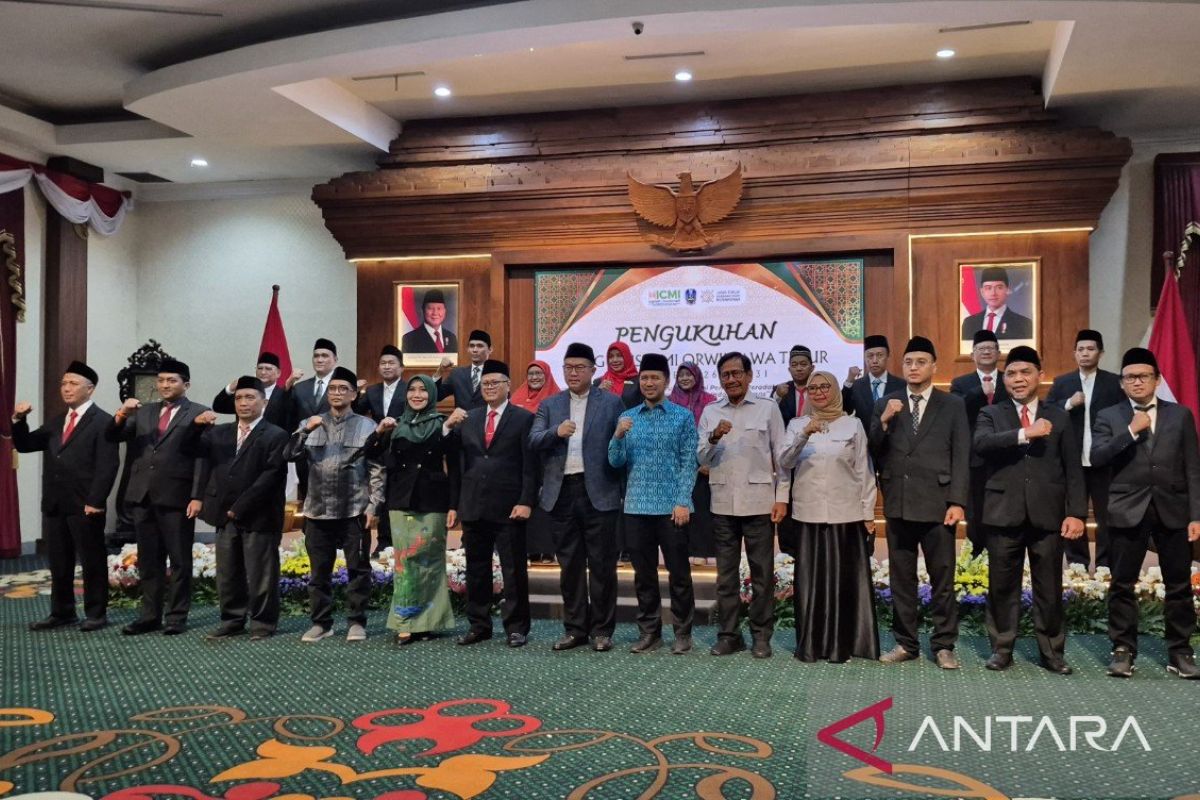
Surabaya (ANTARA) - The Deputy Governor of East Java, Emil Elestiability Dardak, believes that the Indonesian Muslim Intellectuals Association (ICMI) holds a strategic role in strengthening public policy based on science and innovation within the region.
“If ICMI can play its part, its resonance in East Java could be extraordinary. We hope for discourse like this to occur in the public sphere, demonstrating that within every problem, there is a root cause that needs to be investigated scientifically,” said Emil while attending the inauguration of the ICMI East Java Regional Board for the 2026-2031 term at the Grahadi State Building, Surabaya, on Saturday night.
Emil stated that the role of intellectuals should not stop at academic studies but must be translated into public policies capable of addressing societal issues. According to him, East Java offers vast opportunities for service by intellectuals, given its population of approximately 42 million, its industrial base, natural resources, and the presence of numerous universities across various regions.
“The space for service for Muslim intellectuals in East Java is certainly very wide across various sectors,” he noted.
Emil cited the issue of forest and land fires as an example of a problem that needs to be analysed based on scientific field conditions before determining handling measures. He stated that the government needs to translate scientific findings and analyses into realistic policies, including by optimising available resources.
“This is what we want to encourage moving forward: how to investigate scientifically and then translate those findings into public policy,” he said.
According to Emil, a science-based approach is essential to ensure that problem-solving is not merely based on assumptions or public reactions. He also noted that applying technology to solve public issues requires testing and development processes to ensure results are appropriate for field conditions.
Emil expressed hope that ICMI could serve as a partner to the regional government in strengthening knowledge-based policies while simultaneously developing innovations that benefit the community.
Meanwhile, the Chairman of ICMI East Java, Pitono Nugroho, stated that the management for the next five-year period is directed towards strengthening the organisation’s four driving engines: strategic thinking, innovation, collaboration, and impact.
“In the future, ICMI does not aim to be a large organisation, but rather to have a large impact,” said Pitono.
The General Chairman of ICMI, Arif Satria, remarked that East Java possesses strengths in both natural and intellectual resources that can serve as capital for developing innovation. He mentioned that ICMI needs to strengthen evidence-based scientific policies, support regional innovation, and increase public literacy in science and technology to produce tangible impacts.