
Early Exodus Traffic Dominated by Vehicles Heading to Trans Java Toll Road
BEKASI — The Director of PT Jasa Marga (Persero), Rivan A Purwantono, has stated that vehicle traffic leaving Jakarta on the first day of the 2026 Ketupat Operation remains dominated by travellers heading towards the Trans Java toll road. Movement towards other directions, including Bandung and Sumatra via Merak Port, has not yet shown significant increases.
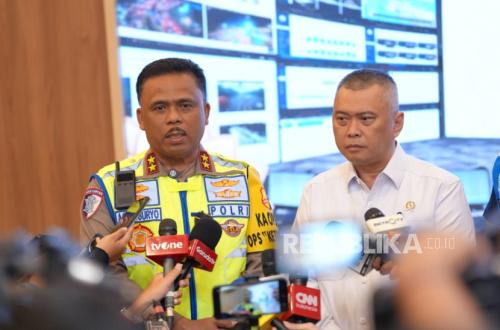
PT Jasa Marga’s director monitored traffic flow alongside the Transportation Minister, Dudy Purwagandhi, and the National Police Traffic Command Chief, Inspector General Agus Suryonugroho, from the Jasa Marga Traffic Management Centre (JMTC) in Jatiasih, Bekasi, on Saturday morning (14 March 2026). Throughout Friday (13 March 2026), approximately 14 per cent of the total projected exodus traffic volume had left Jakarta.
“The distribution remains the same, with the majority heading towards Trans Java,” said Rivan.
He elaborated that approximately 285,000 vehicles had been recorded from the total projection of around 3.5 million vehicles during this year’s Eid exodus period. Vehicle flow during the initial phase of the exodus remains manageable without implementing traffic engineering measures on major toll routes.
The growth in vehicle volume leaving Jakarta was recorded at approximately 3.5 per cent on the first monitoring day. “So in one day, as the Transportation Minister mentioned, there is indeed a 3.5 per cent increase. From Jasa Marga’s projection regarding the number of vehicles, currently 14 per cent have left Jakarta,” said Rivan.
He noted that vehicle movement towards Bandung was not significant on the first day of the Ketupat Operation. A similar situation has occurred on routes towards Sumatra via Merak Port.
According to Rivan, vehicle mobility still has the potential to increase over the coming days, particularly towards the end of the week. Traffic surges typically become apparent when the public takes advantage of longer holiday periods to begin their exodus journeys.
“The other directions have not yet appeared significant, such as towards Bandung, which also has not shown the projected volume. However, this is still the first day. There is still potential that on Saturday and Sunday there will be further movement,” he explained.
Transportation Minister Dudy Purwagandhi also monitored traffic conditions from Jasa Marga’s control centre. He assessed that traffic flow on the first day of the Ketupat Operation remained relatively conducive despite an increase in traffic volume.
“Tonight I, along with the Traffic Command Chief and the PT Jasa Marga director, are observing the situation on the first day since the Ketupat Operation and Eid Transport Command posts were implemented,” said Dudy.
National Police Traffic Command Chief Inspector General Agus Suryonugroho also monitored vehicle flow developments through surveillance camera networks and coordination with various stakeholders. Monitoring was conducted on toll roads and arterial roads to ensure the exodus remained safe and orderly.
“From today’s monitoring, traffic conditions remain relatively controllable. There is an increase, but it is not yet significant,” said Agus.
He ensured that Ketupat Operation security focuses not only on traffic but also on maintaining public safety and order during Ramadan until Eid al-Fitr. Security measures encompass transportation routes, tourist areas, places of worship, ports, and airports.
Agus stated that this year’s Ketupat Operation involves hundreds of thousands of National Police personnel together with various related agencies throughout Indonesia. Security measures are in place to ensure the exodus journey proceeds safely, smoothly, and conducively for the public.