
Dukcapil Releases Clean Population Data 2025: Indonesia's Population Reaches 288 Million
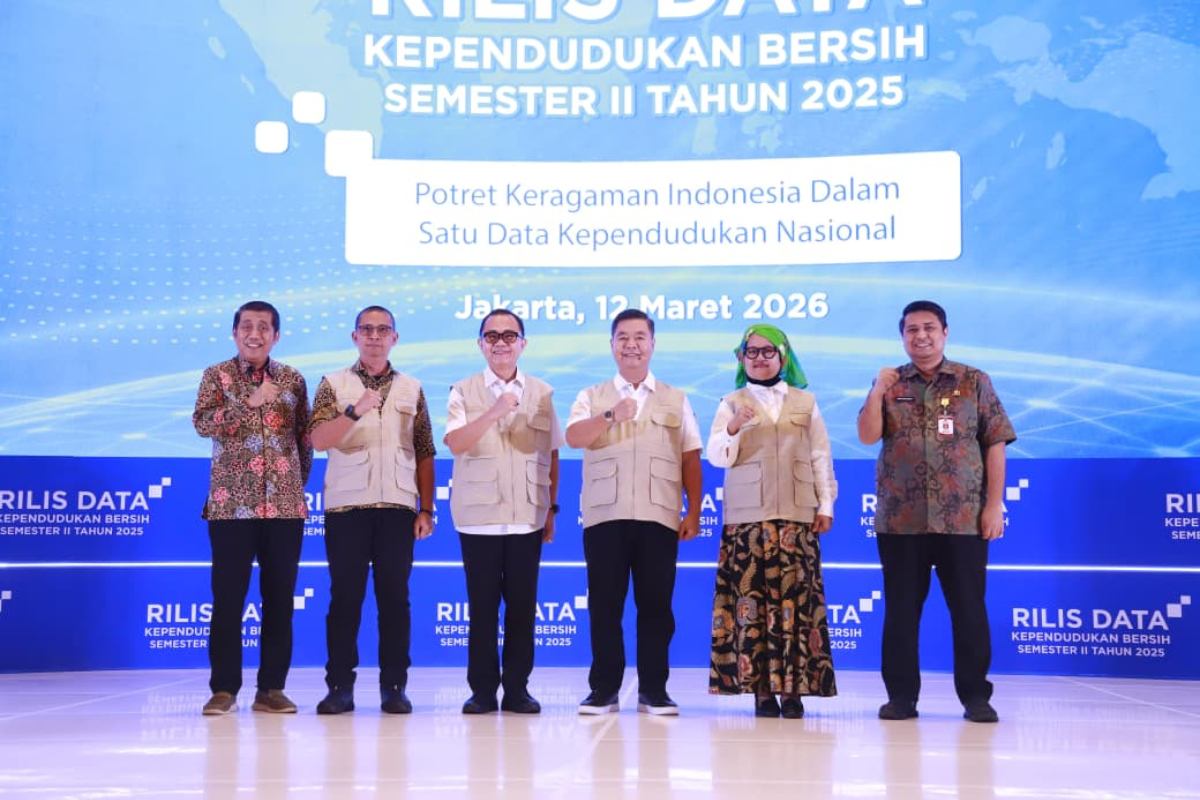
The Directorate General of Population and Civil Registration (Dukcapil) under the Interior Ministry (Kemendagri) has officially released the Clean Population Data (DKB) for the second semester of 2025. The data release, titled “Portrait of Indonesia’s Diversity in One National Population Data”, was held at the Birawa Assembly Hall, Hotel Bidakara, Jakarta.
Dukcapil Director General Teguh Setyabudi emphasised that the DKB is the result of strict data cleansing and synchronisation processes to eliminate duplicate data or anomalies.
“The DKB is the sole single reference for all institutions. With this data, public services become more accurate, development planning more precise, and social assistance genuinely reaches those entitled to it,” said Teguh.
Teguh explained that the National Identification Number (NIK) serves as the database utilised by the banking sector, BPJS Health Insurance, and other private institutions. NIK integration enables faster and safer validation of customer or service user identities.
Beyond administrative matters, Dukcapil data plays a crucial role in law enforcement. Through biometric integration, the National Police (Polri) and law enforcement agencies can track criminals’ identities with high accuracy.
“The NIK by name by address data also assists the Ministry of Finance in determining the amount of General Allocation Fund (DAU) fairly based on the latest population figures in each region,” he added.
Teguh stated that one important breakthrough is the use of Digital Population Identity (IKD) in distributing social assistance. This system ensures energy subsidies and food aid are provided to citizens validated digitally, minimising misallocation.
In the political sphere, the DKB plays a vital role as the basis for compiling the List of Potential Voters (DP4) for elections. This ensures that the permanent voter list in future elections remains more accurate with minimal duplicate data.
“This portrait of our nation’s diversity is not merely statistics, but official recognition of every community’s existence in national development. With valid data, we ensure every rupiah of the budget reaches its target and every public service reaches society fairly,” said Teguh.
Furthermore, Teguh ensured that population administration services (Adminduk) continue to run at maximum capacity. He has instructed all ranks across 514 districts/cities and 38 provinces to place staff on standby to serve urgent community needs.
This step was taken to anticipate citizens requiring population documents urgently, such as replacement of lost identity cards or administration requirements for hospitals and BPJS Health during holiday periods.
“We have requested Dukcapil Service ranks to be on standby. This is in place during joint leave or Lebaran. This is not new; every major moment such as Eid, Christmas, or elections, our officers are always on alert,” said Teguh.
Beyond readiness during holidays, Teguh affirmed his institution’s commitment to continuing direct outreach services. Dukcapil officers no longer merely wait at offices but conduct sweeps of public areas such as schools and shopping centres, whilst reaching remote indigenous communities and disadvantaged, frontier, and outermost areas (3T).
This year, Dukcapil is prioritising intervention in 12 provinces where Adminduk service coverage remains low, particularly in eastern Indonesian regions and island areas hindered by infrastructure constraints.
“Population documents are the basis of all public services, development planning, and law enforcement. We will directly venture into remote areas to ensure all citizens have official documents so their access to public services is not disrupted,” said Teguh.
On that occasion, Teguh also warned against illegal levies. He affirmed that all population document processing is provided completely free of charge.
“Adminduk services are free. There are no costs whatsoever. If any individual demands payment, ensure you report to us or law enforcement agencies (APH),” said Teguh.
On that occasion, Teguh also outlined Indonesia’s population figures based on DKB for the second semester of 2025, reaching 288,315,089 inhabitants, an increase of 1,621,396 from the first semester of 2025. The breakdown comprises 145,498,092 males and 142,816,997 females.
“This ratio shows that the male population exceeds the female population, but remains within normal demographic bounds. The government typically monitors this ratio for long-term planning, for instance in reproductive health, education, and social welfare,” said Teguh.
Teguh explained that Indonesia’s population distribution remains concentrated on Java at 55.55%, followed by Sumatra at 21.88%, whilst other regions such as Kalimantan, Sulawesi, Bali-Nusa Tenggara, Maluku, and Papua have smaller proportions.
The three provinces with the largest populations are West Java (52.2 million inhabitants), East Java (42.2 million), and Central Java (38.6 million). Conversely, areas with the smallest populations are in the east, namely West Papua (588,000 inhabitants), South Papua (588,000), and South West Papua (632,000).
At the district/city level, Bogor Regency has once again solidified its position as the most densely populated area with a population nearly reaching 6 million inhabitants. This figure far exceeds Bandung Regency (3.9 million) and Tangerang Regency (3.5 million). Meanwhile, Supiori Regency in Papua is recorded as the area with the smallest population, with only 29,000 inhabitants.
Teguh also highlighted the high mobility of Indonesia’s population, likened to a river current continuously flowing. The most dynamic population movements were recorded in Bogor Regency (133,000), Bekasi Regency (104,000), Bandung Regency (96,000), Tangerang Regency (87,000), and Batam City (80,000).