
Driving Self-Sufficiency in the Health Sector, Indonesia Needs This
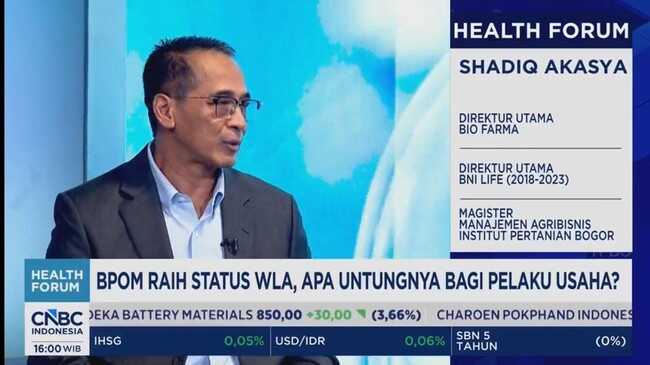
Jakarta — The Chief Executive of Biofarma (Persero), Shadiq Akasya, acknowledges that Indonesia’s national pharmaceutical industry faces several challenges, particularly regarding raw material supply. He notes that even vaccine production requires certain raw materials to be imported from abroad.
“One issue is the source of raw material supply, and this concerns quality. We currently have dependencies in several areas. Why? This upstream industry starts from R&D. Our R&D should be more advanced, as vaccines are produced in various ways, from seeking seeds—the genetic material—through research,” he explained during a Health Forum discussing “BPOM Achieves WLA Status, What Benefits for Business Actors?” on Monday (2 March 2026).
Shadiq stated that Biofarma collaborates with international research institutions and universities to obtain vaccine seeds, which are then developed into finished vaccines by Biofarma. Vaccine production also requires media, much of which is still imported, as well as solvents and adjuvants for liquid formulation that require foreign imports.
He emphasised that achieving health industry self-sufficiency requires cross-sectoral cooperation both upstream and downstream. “The upstream sector needs stronger effort. As for downstream, companies like ours can now produce around 20 antigens and have exported to approximately 150 countries globally. That represents the downstream,” he explained.
Strengthening the upstream sector in the health industry depends on domestic raw material availability. Additionally, Indonesia’s Food and Drug Supervisory Agency (BPOM) recently achieved WHO Listed Authority (WLA) status from the World Health Organization, which helps boost confidence in Biofarma’s products.
Previously, Biofarma operated under WHO Prequalification (PQWHO) standards, which were considered rigid. However, with WLA status, requirements have become more flexible as Indonesia’s standards now closely align with WHO’s specifications.
Both upstream and downstream sectors of Indonesia’s national health industry remain under BPOM oversight. For example, vaccine seeds undergo preclinical and clinical trials under BPOM supervision.
Biofarma will optimise development of polio vaccines as part of the vaccine supply chain. The company hopes to export beyond polio vaccines. “Should new vaccine products emerge, the WLA status will increase global trust in Indonesia and Biofarma’s offerings, which previously operated under PQWHO. Direct government-to-government or business-to-government transactions may become feasible, making global supply chains easier to fulfil,” he stated.
Shadiq hopes Biofarma is not the only Indonesian pharmaceutical company benefiting from WLA status, viewing the status as advantageous for the entire national health industry ecosystem.