
DPR's Special Committee on International Private Law Bill Discusses Issues of Indonesian Citizens Marrying Interfaith or Same-Sex Abroad
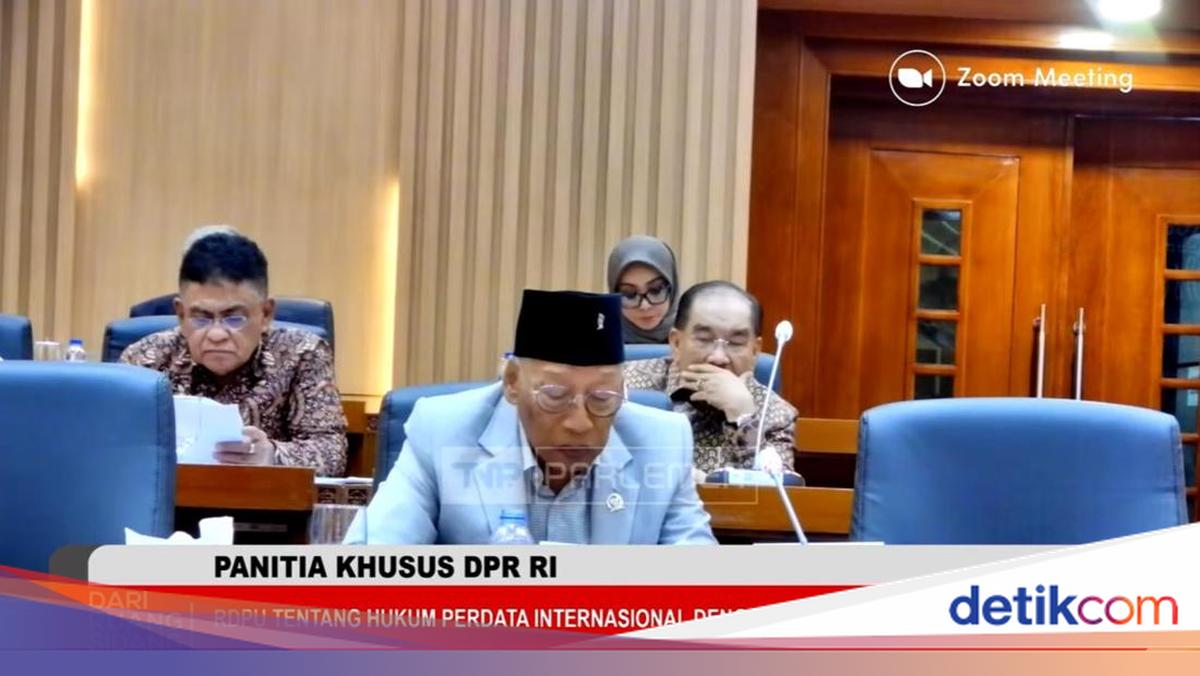
The Special Committee (Pansus) for the International Private Law Bill (RUU HPI) of the Indonesian House of Representatives (DPR RI) is highlighting practices of interfaith marriages up to same-sex marriages conducted by Indonesian citizens (WNI) abroad. Pansus RUU HPI member and Commission III DPR RI member, I Wayan Sudirta, assesses that such practices raise legal issues that require clarity.
“Marriages conducted abroad according to the law of the host country can be recognised in Indonesia if we look at Article 56 of Law No. 1 of 1974 on Marriage, and this is also recognised by the general principles of International Private Law,” said Wayan during a Working Meeting (RDPU) with the Indonesian Judges Association and the Indonesian Notaries Association, at the Parliamentary Complex, Senayan, Jakarta, on Wednesday (1/4/2026).
“So same-sex marriages are recognised as long as they are conducted under the law of the country where the marriage takes place. Not only recognised, our Marriage Law is willing to record such marriages, to recognise and register them,” he continued.
However, he highlighted the practices in society. According to him, this is a long-standing issue.
He said that so far, WNI in the country cannot marry interfaith. Then, they choose to marry abroad, making the marriage valid.
“Moreover, the practice so far is that interfaith marriages domestically are not considered valid, but why are interfaith marriages abroad, when registered in Indonesia, considered valid,” he stated.
According to him, such practices constitute a form of legal smuggling that potentially conflicts with public order and the basic values of national law. Including, he said, conflicting with religious norms.
“I may not have the exact terminology, but we feel it as legal smuggling, Sir, legal smuggling, please correct me. Not only legal smuggling, it greatly conflicts with public order, greatly conflicts with public order,” he explained.
“Why? If I look at Article 2 paragraph 1 of the Marriage Law, marriages domestically are only valid and recognised if conducted according to each religion and belief. So if the religions are the same, it’s allowed,” he continued.
Wayan assesses that the Marriage Law in Indonesia requires the validity of marriage to be based on each party’s religion. Therefore, according to him, there needs to be reinforcement in the RUU HPI.
“According to the experts, is it necessary in the International Private Law Bill to have reinforcement, provisions that affirm that marriages conducted abroad can only be validated in Indonesia if they do not conflict with the basic values of national law, including religious norms that form the basis of our Marriage Law?” Wayan asked.
Meanwhile, another Pansus member, Soedeson Tandra, also highlighted the issue of same-sex marriages conducted abroad. According to him, in Indonesia, marriage is not only a civil matter but also related to religious norms.
“There are several matters, for example, regarding the Marriage Law. If in Japan, for instance, as mentioned earlier, marriage is just a civil matter, marriage is a state affair. In Indonesia, marriage is a religious affair. Well, this is the problem, we ask for input. How about this?” he said.
“Whereas the law on marriage is mandatory in nature here. Earlier he said if a man marries a man, to me, that already conflicts with our norms, invalid by law, cannot enter. Our religious norms are like that. But it is recognised there and there is a provision that if married there within one year, it can be recorded,” he continued.
He assesses that same-sex marriage conflicts with legal norms and values prevailing in Indonesia. According to him, there should be no same-sex marriages.
“No man with man, woman with woman. That’s a bit strange, tilted, in my opinion,” he said.
He highlighted the existence of legal loopholes when such marriages are conducted abroad and then impact other aspects, such as inheritance or child adoption.
“Then related to this issue, we ask for input, for example, they have an agreement to marry same-sex there, but then there is inheritance here,” he said.
“Whereas we completely do not recognise such marriages. Then they adopt a child there. Well, of course, as mentioned earlier regarding adoption, I was shocked to learn we don’t have a law yet, I was shocked. This certainly must be a lesson for us. How to regulate this?” he continued.
On the same occasion, the General Secretary of the Indonesian Judges Association (IKAHI), Heru Pramono, responded to the practice of WNI marrying interfaith abroad and registering it in Indonesia. He explained that in law, the recognition of a legal act from abroad must meet the principle of not conflicting with public order in Indonesia.
“This is actually like in arbitration. That arbitration can be enforced, one condition is that it does not conflict with public order, with order in Indonesia. So as long as it does not conflict with public order, if in court it is interpreted as our statutory regulations,” he said.
“So as long as it does not conflict with our statutory regulations, it can still be registered earlier, Sir. But if not, it should not be registered,” he continued.
Heru likened the mechanism to the enforcement of foreign arbitration awards in Indonesia. In practice, he said, the court will first assess whether the decision complies with public order and morality before it can be executed.
“Arbitration, to be enforceable, the Chief Judge must first see if this conflicts with public order? Conflicts with morality? If not, only if it meets these requirements will we enforce it.”