
DPR Questions BI Over Rupiah's Failure to Hit Target; Here Is Perry's Explanation
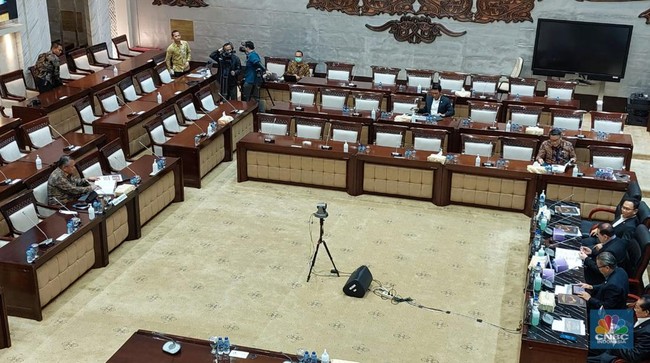
Jakarta, CNBC Indonesia – Deputy Speaker of Commission XI of the DPR RI, Dolfie Frederic Palit, pressed Bank Indonesia (BI) Governor Perry Warjiyo about the rupiah’s deeper depreciation day by day, even as stability is maintained. He warned that the rupiah’s fundamental value, often touted by BI, has not been touched since 2014 and has fallen to around Rp17,600 per US dollar, the weakest level. “If we look at the history from 2014-2025, we’re talking about performance in 2025; we have never been in a situation where the rupiah’s fundamental economic position was right,” Dolfie said during a working meeting with BI at the DPR/MPR building in Jakarta on Monday, 18 May 2026.
Dolfie also questioned how much it would really cost the central bank to push the rupiah toward its fundamental value. “That is what we want to know, sir, to bring it closer to fundamentals or how much cost is needed. BI’s revenue has been rising regardless of the rupiah’s fundamentals. If from 2014-2026 stability has seen rupiah weaken rather than strengthen or approach fundamentals,” he said.
Meanwhile, BI Governor Perry Warjiyo said rupiah fundamentals are calculated based on the range set out in the state budget (APBN), namely Rp16,200 to Rp16,800 per US dollar, with an average of Rp16,500 per US dollar for 2026. Perry regards the rupiah’s exchange rate against the US dollar as actually still stable when viewed against the year-to-date depreciation percentage. Although, the exchange rate fell to Rp17,630 per US$ in yesterday’s trading, Monday 18 May 2026.
“We checked earlier that year-to-date depreciation is 5.4%, which is actually still stable,” Perry said during a working meeting with Commission XI of the DPR in Jakarta, Monday 18 May 2026.
Perry explained that the central bank’s main focus is maintaining stability of rupiah movements, not defending a specific exchange-rate level. Stability here is measured by volatility or the fluctuations of the rupiah over a certain period.
“The term is rupiah exchange-rate stability, not the level of the rupiah. We are talking about stability, not the level. Now what we are approaching is what we call stability. This is rupiah exchange-rate volatility with an average over 20 days,” Perry said.
He also asserted that rupiah volatility year-to-date (YTD) is currently at 5.4%. This figure is considered relatively stable and manageable compared with several other countries facing pressures from global volatility.
“We checked it earlier; year-to-date it is 5.4%. 5.4% — which is actually still relatively stable. Again, the mandate is the law on rupiah exchange-rate stability. Let us discuss stabilising — stability, not level, but how it moves up and down,” he said.
He expressed confidence the rupiah will strengthen again against the US dollar, especially in July and August 2026.
“July and August the rupiah will strengthen,” Perry said.
Perry is optimistic the rupiah will move in line with the assumptions set by the government and BI for 2026, around Rp16,200–Rp16,800 per US dollar. He is confident the rupiah will return to the Rp16,500 per US dollar level. The current year-to-date average rupiah rate stands around Rp16,900 per US dollar.
“What are the fundamentals? The average for the year is Rp16,500. The lower bound is Rp16,200, the upper bound Rp16,800. Will BI be sure to hit it? Yes. Because now it is Rp16,900 year-to-date. From experience, April, May, June are usually high. Then July, August will strengthen. Therefore for the whole year we still believe the exchange rate will be within Rp16,200–Rp16,800,” he explained.