
DPD RI Urges Strengthened Role of Indigenous Communities in Teluk Bintuni Investment
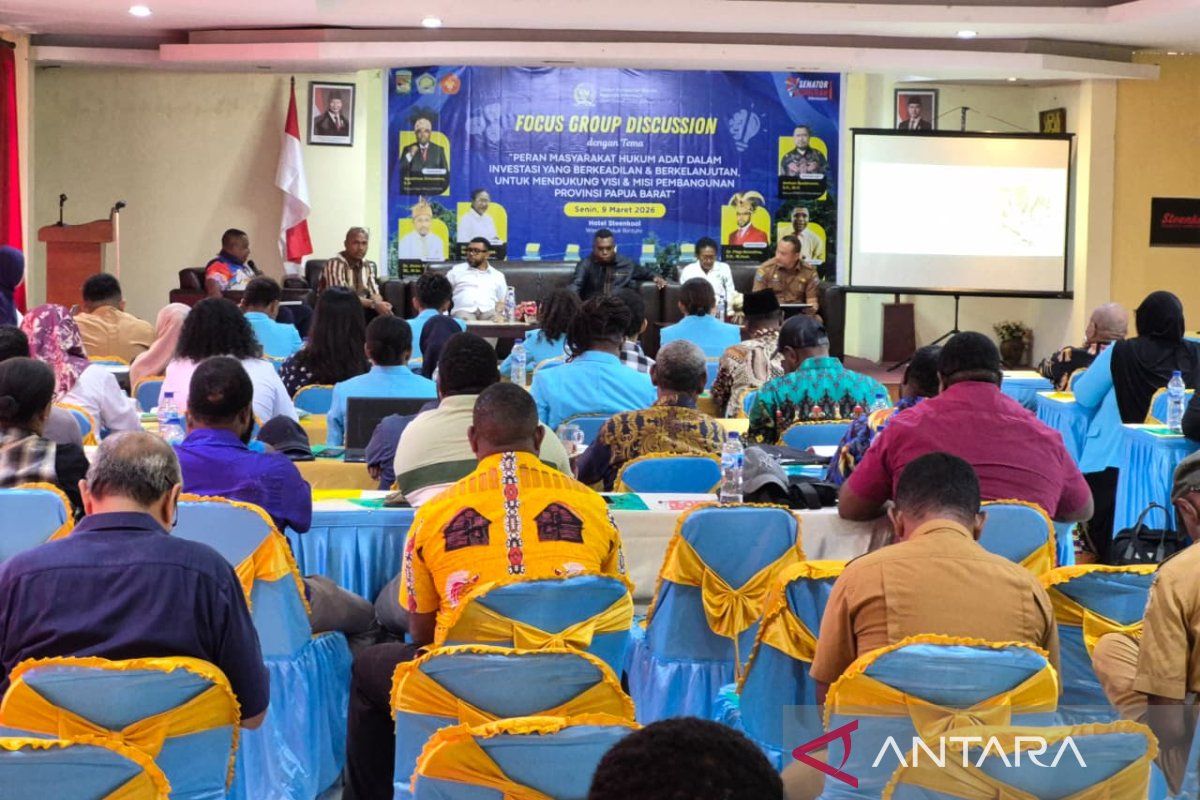
Teluk Bintuni – An Indonesian House of Regional Representatives (DPD RI) member, Filep Wamafma, has urged strengthening the role of indigenous legal communities in managing equitable and sustainable investment in Teluk Bintuni Regency, Papua Barat, so that investment benefits directly improve the welfare of local communities.
“We see substantial investment flows in Teluk Bintuni with high economic growth, but the challenge is ensuring that this investment truly impacts the welfare of indigenous communities,” he said in Teluk Bintuni on Monday.
He made the remarks during a focused group discussion with the Papua Barat People’s Assembly (MRPB), the Indonesian Association of Economics Graduates (ISEI) Manokwari, and the Research and Community Service Institute of the Manokwari School of Legal Studies (STIH).
According to data from the Central Statistics Agency (BPS), the percentage of poor citizens in Teluk Bintuni in September 2025 reached 25.34 per cent or approximately 18,480 people, with rural poverty rates higher at 26.34 per cent compared to urban areas at 9.50 per cent.
“Equitable investment requires recognition of indigenous community rights, meaningful participation, and proportional benefit distribution,” he stated.
According to him, Teluk Bintuni’s economic structure is relatively strong compared to other regencies in Papua Barat, as reflected in the regional gross domestic product (GDRP) at current prices in 2024 reaching IDR52.36 trillion, whilst GDRP at constant prices stands at IDR35.02 trillion.
The manufacturing, mining and quarrying sectors provide very significant contributions to Teluk Bintuni Regency’s GDRP growth and serve as a buffer for Papua Barat’s economic expansion. However, this must be balanced with policies ensuring more equitable distribution of investment benefits to local communities, particularly indigenous communities living around investment areas.
“This needs to be serious attention for local government,” said Filep.
He assessed that the integration of indigenous community rights in investment policy remains suboptimal due to minimal participation levels during planning stages, necessitating implementation of the free, prior and informed consent (FPIC) principle.
The potential for unequal distribution of investment benefits can be minimised through strengthening indigenous community institutional governance so they can participate in oversight to prevent social conflict and other potential impacts on environmental damage.
“We hope that in the future, there will be regulations that provide legal certainty for investors whilst guaranteeing protection of indigenous community rights, so that incoming investment truly contributes to improving community quality of life,” said Filep.