
DPD RI Member: Fulfilling Teacher Needs is Key to National Education Success
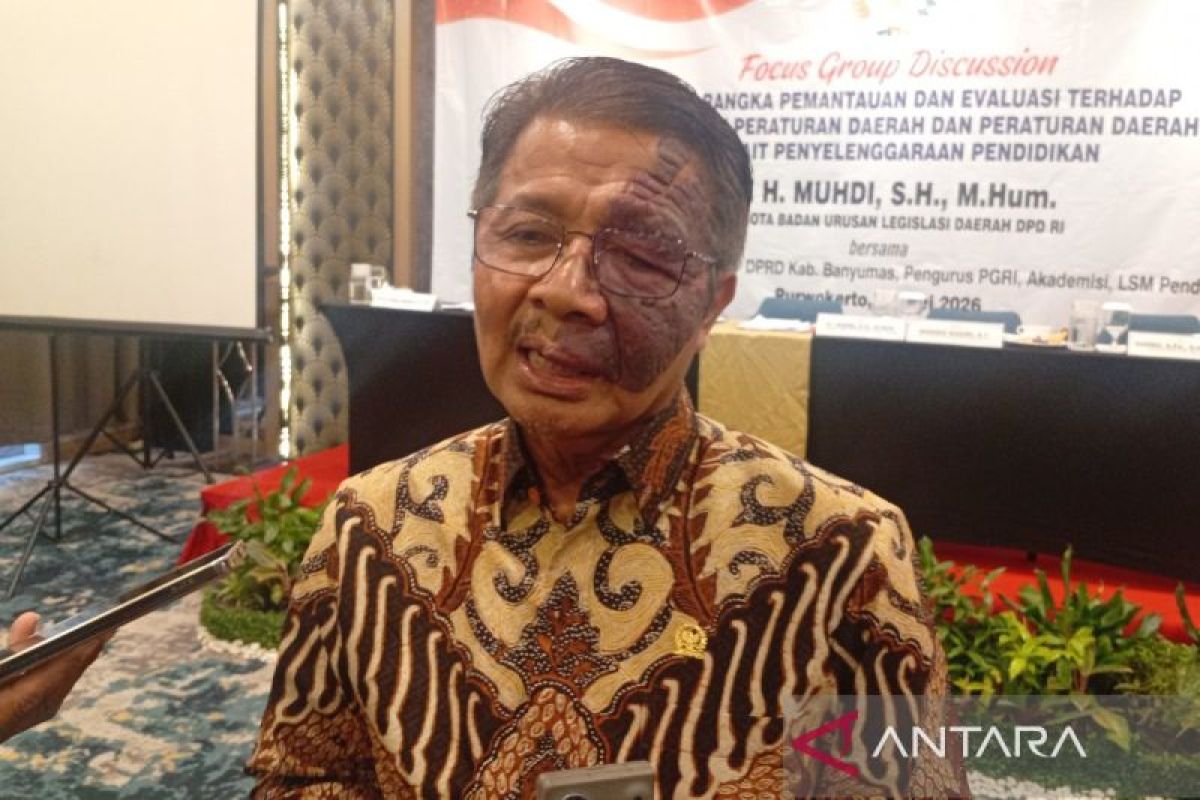
Purwokerto (ANTARA) - Muhdi, a member of the Regional Legislation Affairs Body (BULD) of the Regional Representative Council (DPD) of the Republic of Indonesia, emphasised that fulfilling teacher needs is the key to the success of national education.
Therefore, meeting teacher requirements must be a priority in national education policy because the quality of educators forms the primary foundation in realising superior human resources towards a Golden Indonesia.
“If our aspiration is a Golden Indonesia, the key lies in education, and the problem that everyone agrees on is in governance, particularly related to teachers, teacher welfare, teacher protection, and policy synchronisation,” he said in Purwokerto, Banyumas, Central Java, on Monday afternoon.
According to him, various inputs received from regional parliaments, education offices, academics, teacher professional organisations, and educational units indicate that education problems in the regions essentially stem from the same root cause, namely the lack of synchronisation between central and regional government policies.
He stated that the most fundamental issue currently is the absence of comprehensive mapping of teacher needs, both regarding the number of active teachers, retirement figures, and the requirements for new educators that must be met in the coming years.
He assessed that this condition causes several education policies to not fully address real field needs, and even has the potential to create new problems when policies to stop honorary staff emerge without clear appointment solutions.
“The central government apparently has not properly mapped the current number of teachers needed, how many are retiring, and the future needs. Even the existing needs have not been adequately fulfilled to date,” he said after the Focus Group Discussion (FGD) on Monitoring and Evaluation of Regional Regulation Drafts and Regional Regulations Related to Education Services.
He also highlighted the policy on appointing Government Employees with Work Agreements (PPPK), which he believes has not fully resolved the issue because the financial burden is largely borne by regional governments.
“This is the first time there is an appointment policy that is rejected by the regions because the burden is placed on them. Yet education is mandatory, and the state has an obligation to educate the nation’s children,” he said.
The Chairman of the Indonesian Teachers’ Association (PGRI) of Central Java Province stated that the constitutional mandate regarding the allocation of 20 percent of the education budget should truly be directed towards ensuring optimal education services, starting from fulfilling the number of teachers, improving quality, welfare, and professional protection.
In addition to teacher issues, he also spotlighted the inequality in educational facilities and infrastructure between schools under the Ministry of Basic and Secondary Education and educational institutions under the Ministry of Religious Affairs, which he views as indicating a lack of synchronisation in national education policies.
He also received many aspirations regarding the low welfare of honorary teachers and part-time teachers in several regions who still receive incomes far below the minimum wage standard.
In Banyumas Regency, he said, part-time or honorary teachers receive an honorarium of around Rp700,000 per month, while in other regencies it is only around Rp500,000 per month with unclear employment status.
“We force the private sector to pay minimum wages, but on the other hand, the state still employs teachers with honorariums that have no standards. This must be straightened out immediately,” he said.
He hopes that the central and regional governments will soon take concrete steps, including accelerating the appointment of part-time ASN teachers to full-time positions to fill the need for educators due to the many teachers entering retirement age.