
Dozens of Hectares of Rice Fields at Risk of Crop Failure, Kuningan Acts Swiftly to Control Brown Planthoppers
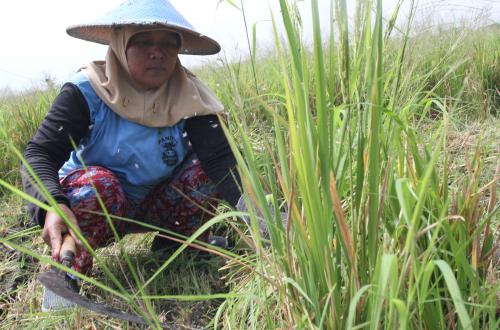
The Kuningan Regency Food Security and Agriculture Service has acted swiftly in response to the attack of green leafhopper pests, which pose a potential threat of crop failure. Through the Plant Pest Organism Control Movement (Gerdal OPT), handling is being carried out on 20 hectares of land in Cikaso Village, Kramatmulya District.
The relevant agency is distributing pesticide aid for controlling green leafhoppers on the 20-hectare area. In addition, simultaneous spraying on the affected land is being directly carried out together with the government, technical officers, and local farmers.
This rapid response is not only through technical measures but also a direct approach to farmers, namely by providing education while listening to the problems faced in the field.
“Control must be carried out in an integrated and simultaneous manner across one expanse to effectively suppress the pest population,” said the Head of the Kuningan Regency Food Security and Agriculture Service, Wahyu Hidayah, on Sunday (19/4/2026).
She explained that the green leafhopper is a strategic pest that not only directly damages crops but also has the potential as a vector for diseases that can significantly reduce harvest yields.
In fact, if not controlled quickly and accurately, brown planthopper attacks can cause harvest losses of 30 to 100 percent or crop failure. Therefore, this pest poses a serious threat to farmers’ food security.
Wahyu also conveyed to farmers about crop conditions, pest attack patterns, and appropriate control measures. The education was delivered in a simple and applicable manner so that it is easy to understand and can be directly implemented in the field.
The approach implemented is Integrated Pest Management (PHT), namely by emphasising farmers’ understanding of the agricultural ecosystem, not just the use of pesticides.
Control is carried out through pest population monitoring, implementation of simultaneous planting patterns, utilisation of natural enemies, and selective use of pesticides in accordance with the principles of the right type, right dose, right time, and right method.
“Pesticide use must be wise to be effective while still maintaining environmental balance,” she said.