
Downstream Investment Realisation Reaches Rp147.5 Trillion in Early 2026 – GoodStats Data
Downstream processing has become one of the government’s main strategies to drive the transformation of the national economy. Through this policy, natural resources previously exported as raw materials are processed domestically first to produce higher value-added products.
In addition to strengthening the competitiveness of the national industry, downstream processing is also expected to create jobs, broaden the manufacturing base, increase state revenue, and attract more investment to strategic sectors.
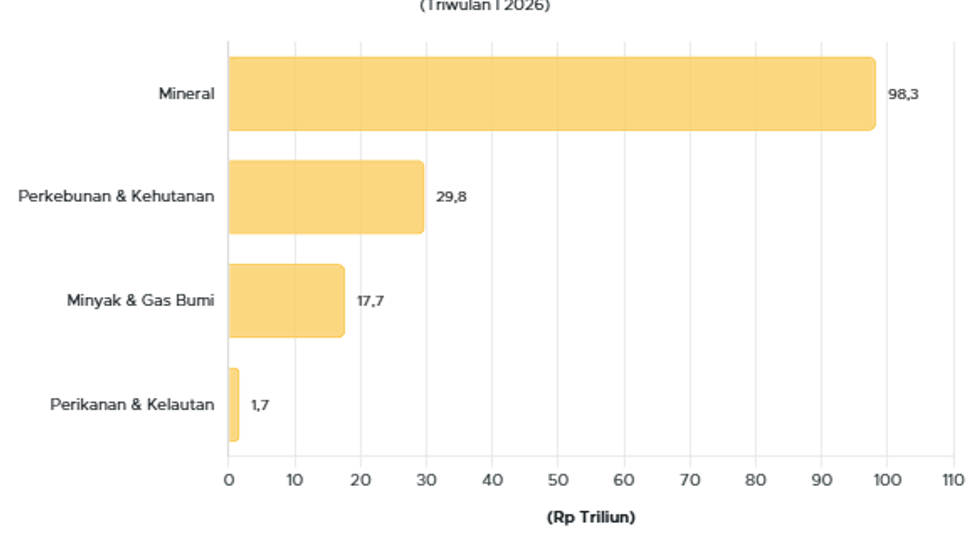
The mineral sector was the largest contributor to investment, valued at Rp98.3 trillion, or around two-thirds of total downstream processing investment. Of this mineral sector investment, nickel accounted for Rp41.5 trillion. Next, investment in copper stood at Rp20.7 trillion, followed by iron and steel Rp17.0 trillion and bauxite Rp13.7 trillion. Meanwhile, tin contributed Rp2.5 trillion, while other mineral commodities reached Rp2.9 trillion.
The second largest contribution came from downstream processing in the agribusiness and forestry sector, with investment realised at Rp29.8 trillion. Investment in this sector was dominated by the palm oil industry at Rp18.3 trillion and timber at Rp7.0 trillion. Meanwhile, rubber recorded Rp2.4 trillion and other commodities Rp2.1 trillion.
Then downstream processing of oil and gas contributed Rp17.7 trillion in investment. The amount consisted of downstream investment in oil at Rp13.6 trillion and natural gas Rp4.1 trillion. As for the fisheries and maritime sector, downstream investment reached Rp1.7 trillion, covering the development of various flagship commodities such as salt, fish, shrimp, seaweed, blue swimmer crab, and tilapia.