
Done! The Fed Holds Interest Rates, Only One Cut Amid the War?
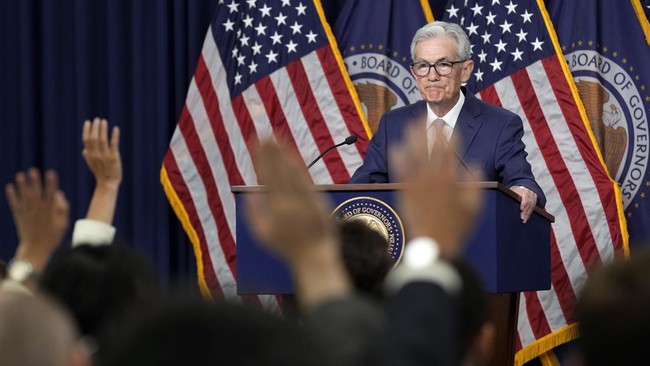
The US Federal Reserve (the Fed) has once again maintained its interest rate at 3.50-3.75%. The Fed is also expected to cut interest rates once this year, despite surging oil prices due to the war with Iran.
The Fed announced the interest rate decision on Wednesday US time, or early Thursday Indonesian time (19/3/2026), after holding a two-day Federal Open Market Committee (FOMC) meeting.
As is known, in 2025 the Fed held interest rates steady until August at 4.25-4.50% before cutting them in September, October, and December to 3.50-3.75%. In January 2026, the Fed held the benchmark interest rate.
In the meeting, FOMC members voted 11 to 1 to maintain the interest rate.
“Uncertainty regarding the economic outlook remains high. The impact of developments in the Middle East on the US economy is still uncertain. The Committee is attentive to risks to both sides of its dual mandate, namely price stability and maximum employment,” the Fed’s statement read, quoted from its official website.
In the press conference after the meeting, Fed Chair Jerome Powell acknowledged that the central bank now faces a policy dilemma.
On one hand, risks to the labour market are tilted towards weakening, which typically requires interest rate cuts.
On the other hand, inflation risks are increasing, which could keep interest rates high.
“We are in a difficult situation. We must balance both risks,” he said, quoted from CNBC International.
As is known, the US unemployment rate rose to 4.4% in February 2026 from 4.3% in January, and slightly above market expectations. This figure is also approaching the four-year high of 4.5% recorded in November.
Meanwhile, the annual inflation rate in the US remained stable at 2.4% (year on year/YoY) in February 2026, unchanged from January. This figure matches market forecasts and is still at the lowest level since May 2025. However, inflation is expected to rise due to the impact of the Iran war.
Amid concerns that a surge in oil prices could boost inflation while weakening growth, Powell said he would not describe the US economic condition as stagflation.
According to him, that term is more appropriate for the economic conditions of the 1970s era, when unemployment was very high and inflation surged sharply.
“At that time, unemployment was in double digits and inflation was very high. Now our unemployment is very close to the long-term normal rate and inflation is only about one percentage point above it,” he added.
Powell added that the term stagflation should be used for much more serious situations.
Powell emphasised that no one really knows the impact of the war on the economy. According to him, the US economy is currently running quite well. However, Powell said he does not know what the impact of this conflict will be.
The Iran war and its impact on the Strait of Hormuz have shaken the global oil market and could potentially keep inflation above the Fed’s 2% target.
Powell said the oil price surge due to the Iran war could pressure the US economy by increasing inflation and reducing consumption and employment.
However, that impact could partly be offset by increased domestic energy production, given that the US is a net energy exporter.
If oil prices remain high for a long time, US oil companies are likely to increase drilling activity.
Powell said higher energy prices due to the Iran war are likely to push inflation up in the short term.
“Short-term inflation expectations have increased in recent weeks, likely reflecting the large rise in oil prices due to supply disruptions in the Middle East,” he said.
However, according to him, it is still too early to know how large and how long the impact will be on the economy.
One More Cut?
Despite high uncertainty, Fed officials have again signalled that they still expect several interest rate cuts ahead.
The interest rate projection chart known as the “dot plot”, which reflects each member’s forecasts, shows one interest rate cut this year and another in 2027, though the timing is unclear.
Of the 19 FOMC participants, seven expect interest rates to remain unchanged this year, one more than the last update in December.
For the following years, projections are quite varied, but the median forecast shows one additional cut in 2027, before the federal funds rate stabilises around 3.1% in the long term.
Before the conflict broke out, markets expected two interest rate cuts this year, with a small chance of a third cut.
However, rising oil prices and a series of strong inflation data have lowered expectations to at most one cut in 2026.
Robust US Economic Growth
In the economic projection update, Fed officials forecast US gross domestic product (GDP) to rise 2.4% this year, slightly faster than the December forecast. Growth is also projected to remain strong at 2.3% in 2027, up 0.3 percentage points from the previous projection.
The Fed’s Summary of Economic Projections also shows the personal consumption expenditures (PCE) inflation projection rising to 2.7% in 2026 from 2.4% in December 2025. Meanwhile, the core inflation projection, which excludes volatile food and energy prices and is more closely watched by the Fed, also rose to 2.7% from 2.5% previously.
The Fed also continues to forecast an unemployment rate of 4.4% by year-end, although d