
Domestic Workers Barely Protected as PPRT Bill Urgently Pushed for Enactment
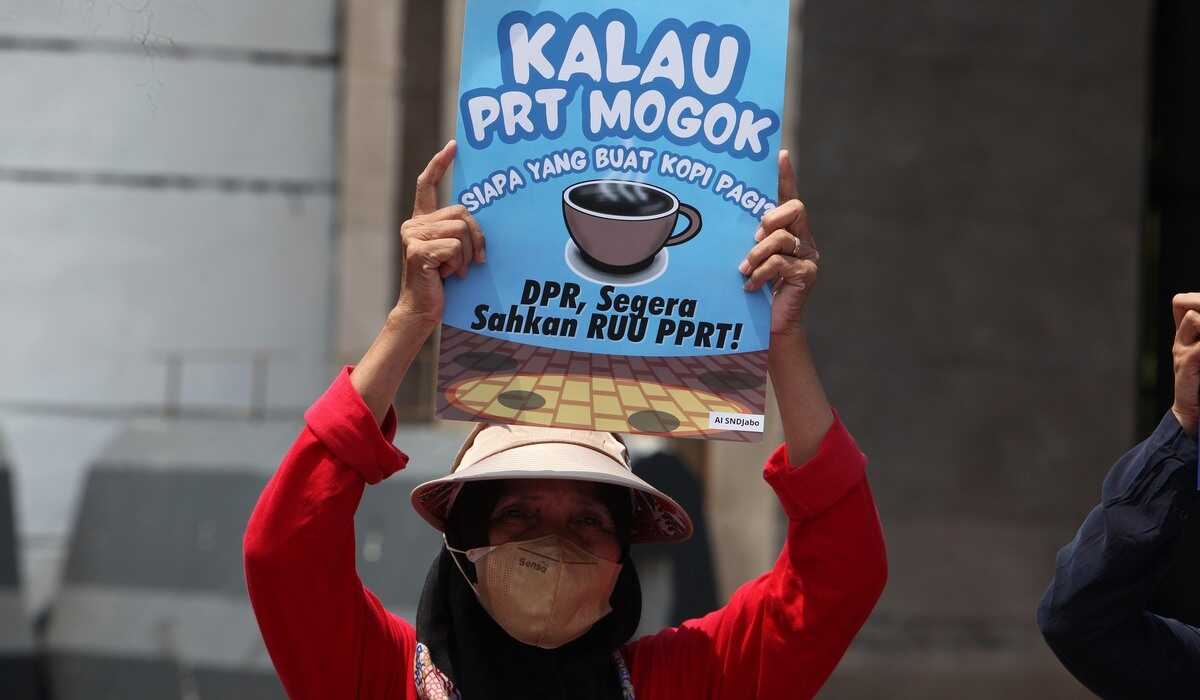
Chairman of the Indonesian People Workers Confederation (KRPI) and a member of the DPR’s Commission XIII, Rieke Diah Pitaloka, says Indonesia has about 5.2 million migrant workers abroad, with around 2.5–3 million of them employed as domestic workers (PRT), placing roughly 100,000 new placements each year. This makes PRT one of the largest sectors in Indonesian labour migration. On the other hand, the economic contribution of migrant workers is substantial. According to Bank Indonesia data, remittances by Indonesian migrant workers in 2024 reached about USD 15.7 billion or around Rp253 trillion, accounting for about 1% of GDP. This means migrant workers, including millions of PRT, are pillars of the national economy and drivers of family economies across migrant communities.
“Ironically, the sector that generates such large economic activity remains under the weakest legal protection. Indonesia has yet to ratify ILO Convention 189 on decent work for domestic workers, and domestic PRT are not fully recognised within the national labour law system,” she said during a public hearing with the DPR’s Legislative Body (Badan Legislasi), on Thursday (5/3).
Moreover, the vulnerability of PRT does not only stem from regulatory gaps but also from an outdated paradigm that views domestic work in a narrow way. Key issues include: PRT status is not recognised as workers and therefore lacks access to basic workers’ rights; there is a power imbalance between workers and employers, worsened by social stigma as servants or even more pejoratively as babu. Care work has not been recognised as an economically valuable occupation; there is fragmentation of legal protection whereby migrant domestic workers have protection under the Indonesian Migrant Worker Protection Act, while domestic PRT are not adequately protected.
“The State still regards PRT as a private household matter rather than an employment relationship that should be regulated by law,” emphasised Rieke.
In the same session, Maria Ulfah Anshor, Chair of Komnas Perempuan, added that the Government has prepared Indonesia’s care economy roadmap, placing care issues as a priority for inclusive and equitable national development. “PRT is an essential part of the care economy that sustains other families’ participation in work, yet they are often treated as an innate role and thus their economic value is not recognised, a bias we describe as gender bias,” she said.
The enactment of the PPRT Bill is important to recognise care work as work of economic value, to provide fair and specific labour protections, and to support the development of the national care economy. “The PPRT Bill is not yet regulated in the Labour Law, where it only mentions formal employer–employee relationships in companies or business entities and does not recognise domestic household work. Therefore, PPRT should be regulated through a dedicated law, not via the Labour Law,” Maria asserted.
On the other hand, Muhamad Isnur, Chairman of the Indonesian Legal Aid Foundation (YLBHI), views that PRT, in many respects, faces limitations. “Often, if employers are wealthy they can hire a lawyer and so on, which creates extreme inequality. We must be able to achieve equality or equity going forward to realise fairness before these mechanisms,” he explained. He argued this is where oversight must be strengthened; unfortunately, oversight has often been blunt and ineffective. “There is no oversight over employers. That is a profound weakness. That is why there are many labour cases. If labour inspectors can issue warnings and prosecute cases, that would be very good, because they are investigators and possess authority so the state can be present,” he said.
Meanwhile, Lita Anggraini, National Coordinator of the National Network for Advocacy of Domestic Workers (Jala PRT), stressed that the PPRT Bill must be expedited for immediate enactment. “I urge DPR factions to champion their constituents without delay because the RDPU on the PPRT Bill has the most participants, the most extensive studies, and has even conducted comparative study visits to South America and Argentina, among others. So what more is needed except their own fear? I call the Legislative Budget Body to explain the PPRT Bill to DPR members who refuse to read and hinder its progress,” she said. (H-3)
Ariati Dina Puspitasari, Chair of the Pusat Leadership of Nasyiatul Aisyiyah (PPNA), questioned the fate of the PPRT Bill which has been hanging for more than two decades.
Atnike Nova Sigiro, Chair of the National Commission on Human Rights (Komnas HAM), urged the public to oversee the PPRT Bill until it is enacted into law.
Several rules and data that lack validity have caused social assistance (bansos) — a key mechanism for poverty alleviation — to fail to reach domestic workers (PRT). Local government roles are crucial to informing recipients about these aids, including PRT.
Drafts of the PPRT Bill’s Article 11 state that PRT are entitled to social health insurance as beneficiaries of premium subsidies. Kowani (the Indonesian Women’s Congress) also urged the state to actively guarantee the rights, safety and welfare of PRT as citizens equal before the law.
The DPR’s Baleg (Legislation Body) together with the Ministry of Law and Human Rights (Kemenkumham) and the PPUU (Special Bill for the Pluralistic Law) in the DPD RI set Priority Prolegnas for 2025–2026 with a total of 67 Bills. The PPRT Bill must provide certainty of social protection for domestic workers. LAB 45 has urged the President to act.