
Dollar Kicked Out Everywhere: Rupiah and Ringgit Dominate Asia
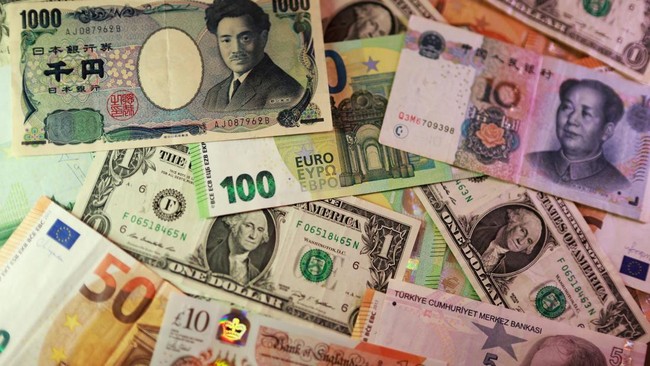
Asian currencies moved higher against the US dollar in trading on Thursday (7/5/2026). The strengthening occurred alongside the weakening of the US dollar in global markets, as investors grew more optimistic about the chances of ending the US-Iran war.
According to Refinitiv at 09:15 WIB, out of 10 Asian currencies, seven strengthened and three weakened against the US dollar.
The rupiah was also in the green this morning. The Garuda currency stood at Rp17,350/US$, strengthening by 0.17%.
However, the largest strengthening was recorded by the Malaysian ringgit, which stood at MYR 3.90/US$ after gaining 0.31%. The Japanese yen also strengthened to JPY 156.25/US, up0.09.
The Taiwan dollar and Singapore dollar also strengthened by 0.06% each, with the latter at TWD 31.359/US$ and SGD 1.267/US.TheVietnamesedongalsoroseslightlyby0.04.
On the other hand, the Thai baht faced the most pressure this morning. The baht stood at THB 32.28/US$ after weakening by 0.50%. The Korean won also corrected by 0.30% to KRW 1,449.3/US, whilethePhilippinepesostoodatPHP60.756/US, depreciating by 0.16%.
The movement of Asian currencies today is still influenced by the direction of the US dollar in global markets. The US dollar index (DXY) at 09:15 WIB was seen weakening by 0.09% to 97.935.
The weakening of the US dollar occurred because the market began to see the possibility of easing US-Iran tensions.
Investors became increasingly optimistic after news emerged that Washington and Tehran were getting closer to an agreement to end the conflict.
Sources from the Pakistani mediator familiar with the negotiation process stated that the two countries were approaching an agreement in the form of a one-page memorandum to end the war. This sentiment has made market participants more daring to enter risk assets, thereby reducing demand for the US dollar as a safe-haven asset.
Michael Brown, senior research strategist at Pepperstone in London, assessed that the more positive market sentiment is truly pressuring the US dollar. According to him, investors are starting to buy into the optimism regarding the potential US-Iran agreement, although the process towards de-escalation could still be lengthy.
The weakening of the US dollar is a breath of fresh air for Asian currencies. When the DXY weakens, pressure on other countries’ currencies tends to decrease. However, the room for strengthening may still be limited because market participants are waiting for further certainty regarding the direction of the US-Iran agreement.
With that sentiment, Asian currencies have the potential to move more positively in the short term. However, if peace news encounters obstacles again, the US dollar could still reverse and strengthen due to its status as a safe-haven asset.