
Dollar Breaks Through Rp17,000/USD, Rupiah Performance Still Bleeding
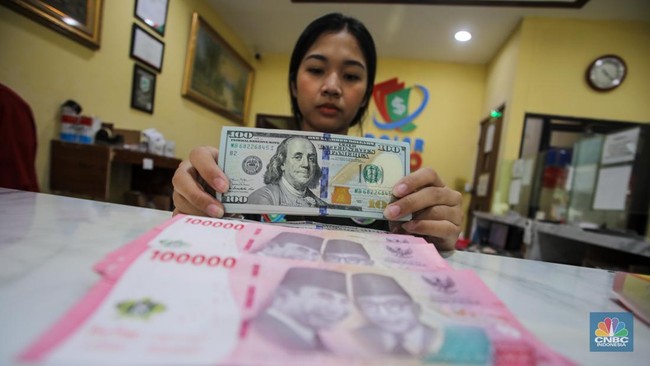
Jakarta, CNBC Indonesia - The rupiah exchange rate against the US dollar weakened throughout this week, even touching Rp17,000 per USD. This weakening occurred while the majority of Asian currencies also strengthened during the week.
Based on Refinitiv data at the close of trading on Thursday (2/4/2026), the rupiah exchange rate against the US dollar was at USD 16,990 per USD, or weakened by 0.09% compared to the previous day. Meanwhile, on a weekly basis, the Garuda currency weakened by 0.18%.
Meanwhile, the Malaysian ringgit and Thai baht became the most battered Asian currencies, with exchange rate weakening against the US dollar this week falling 0.4% to 4.04 baht per USD.
The Asian currency that also experienced the worst weakening is the Korean won, which collapsed 0.17% against the US dollar throughout this week to 1,509.8 won per USD.
Meanwhile, the Asian currency that strengthened is the Indian rupee, which surged 2.2%. The strengthening occurred because the Reserve Bank of India (RBI) has taken steps to curb arbitrage and speculative trading betting against the rupee.
These steps aim to ease concerns about risks to India’s external balance due to the war in the Middle East continuing to disrupt global markets and the economy of energy importers.
In addition, the Reserve Bank of India also prohibited banks from offering non-deliverable forward rupees to resident and non-resident clients and stated that companies cannot rebook cancelled forwards. This step follows tighter restrictions on banks’ foreign exchange positions in the domestic market.
“The RBI appears quite serious about following up on new regulations to control the weakening of the INR. Further policy changes by the RBI and the Indian government to manage the weakening of the INR are likely to occur,” said Michael Wan, senior currency analyst at MUFG, quoted from Reuters on Saturday (4/4/2026).
Why is the Rupiah Collapsing?
The rupiah exchange rate touched the level of Rp17,000 per USD during intraday trading on Wednesday (1/4/2026) and Thursday (2/4/2026).
Chief Economist David Sumual said that the pressure faced by the rupiah today is more due to external factors, namely the continued rise in world crude oil prices due to the war in the Middle East, which is causing concerns among financial market players.
However, he acknowledged that internal problems also cannot be overlooked as factors adding pressure to the sentiment of financial market players, especially related to the spillover effects from the rise in oil prices to the state budget. As a result, selling pressure is seen in the government bond market.
“So it’s still about negative external sentiment like rising oil prices and concerns about its impact on the state budget. There is quite strong selling pressure from foreigners in the SUN market,” Sumual told CNBC Indonesia, quoted on Saturday (4/4/2026).
Head of Macro Economic and Market Research at Permata Bank, Faisal Rachman, added that besides the ongoing Middle East war sentiment, even though it started to ease last night, creating a risk-on sentiment, the rupiah is still burdened by negative domestic sentiment.
He explained that among them is the government’s decision not to raise the price of non-subsidised petrol, which creates uncertainty and concerns about Indonesia’s fiscal condition going forward, thus there is risk-off from that side.
The second factor is that improving global sentiment makes Bank Indonesia likely not to rush into interventions in the FX market like in previous days. Third, this has entered the second quarter where payments of returns on Indonesian financial assets to non-residents tend to increase seasonally.
“And fourth, there is also anticipation of the release of inflation data and Indonesia’s trade balance today,” he said, quoted on Saturday (4/4/2026).