
Dollar Breaks Through Rp17,000, This Businessman 'Saved' by Importing with Yuan
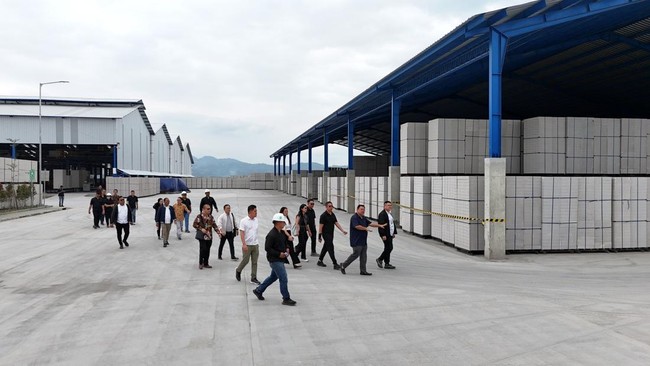
The weakening of the rupiah, which has broken through Rp17,000 per US dollar, is currently a concern for manufacturing industry players. This exchange rate pressure comes amid global uncertainties, including conflicts in the Middle East that are affecting supply chains and logistics costs. The industry states that currency fluctuations continue to exert pressure, although the impact on companies is relatively limited.
“We do not have much direct involvement with the US dollar because most import transactions use the Chinese yuan. However, the rupiah’s weakening against various currencies, including the CNY, still exerts pressure, though it is relatively small on margins,” said Andrew, Finance Director of PT Superior Prima Sukses Tbk (BLES), to CNBC Indonesia on Friday (10/4/2026).
This situation requires the company, which operates in lightweight bricks, to maintain a balance between efficiency and expansion. At the same time, external pressures such as geopolitics are adding to operational challenges, including pressure on supply chains and logistics costs.
“Operational efficiency and optimisation of factory utilisation, especially the new factory, can directly reduce production costs. This has been evident since last year, where the cost per cubic metre has been decreasing,” he explained.
On the efficiency side, the company reduced production costs by 7.3% per m³ compared to the previous year, which is an important foundation for improving margins going forward.
Efficiency will be even more useful because on the other hand, the potential increase in fuel and energy prices is the next challenge that must be anticipated. This increase risks pushing up production and distribution costs.
“Energy costs are a major component in production, while transportation costs affect marketing costs. Ideally, this increase will impact product selling prices,” he stated.
To mitigate this impact, the company combines internal efficiency with more flexible pricing strategies.
“With investments in renewable energy and optimisation of distribution networks, we can reduce sensitivity to energy tariff increases. Price adjustments are also made gradually and selectively, considering market purchasing power,” Andrew added.
Meanwhile, on the supply side of imported raw materials such as petrochemicals, the company ensures that conditions are still under control despite global pressures. The brick company does not require much petrochemical or plastic raw materials in its production.
“Imported components are very few and the majority come from domestic sources. There are no supply difficulties, only internal efforts to keep import prices as low as possible,” he explained.
Amid these various challenges, the prospects for the lightweight brick industry in 2026 are still seen as growing. Demand is driven by ongoing housing development programmes and infrastructure projects.
“We are optimistic about increasing sales volume while maintaining growth in 2026,” he said.
For the whole of 2025, BLES recorded net revenue of Rp1.50 trillion, an increase of 2.8% from Rp1.46 trillion in 2024.
In the fourth quarter, net sales were Rp430.2 billion or 28.6% of total annual sales, and sales volume was 1.0 million m³ or 28.5% of total annual volume. Cumulatively, total sales volume for 2025 reached 3.7 million m³, indicating solid demand levels in the market.
“We view 2025 as a year of strengthening foundations. With increased capacity and emerging efficiencies, we are optimistic that profitability will improve with future operational optimisation,” he said.