
Dollar at Risk of Breaking Through Rp17,000 After Eid, Economists Reveal Key Factors
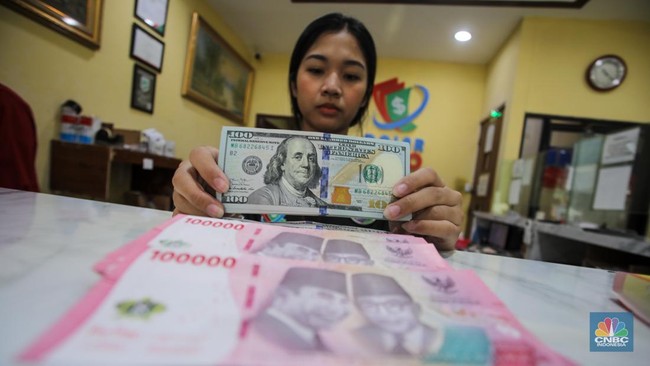
Jakarta, CNBC Indonesia – Economists estimate that rupiah movement will remain under pressure following the Eid 2026 holiday break. Economists believe that global uncertainties such as Middle East conflict and the direction of US interest rate policy are key factors that must be monitored.
Myrdal Gunarto, Global Markets Economist at Maybank Indonesia, views the rupiah’s current position as quite vulnerable, particularly if geopolitical tensions increase. He highlighted rising tensions, including Iran’s ballistic missile test that could potentially trigger a spike in global oil prices.
“So for the next week, we see that for rupiah exchange rate movement, the current conditions are indeed quite risky for breaking through the 17,000 level, that is if there is an increase in geopolitical tension,” Myrdal told CNBC Indonesia on Tuesday (17 March 2026).
However, the rupiah has a chance of remaining stable if tensions ease and oil prices fall during the holiday period. As noted, Bank Indonesia will be operationally closed during the Eid holiday period from 18 March to 24 March 2026.
“So we hope that BI, even during the holiday period, must be anticipatory towards potential market movements from offshore,” he said.
On the other hand, Faisal Rachman, Head of Macro Economic Research at Permata Bank, views rupiah movement as remaining under pressure. This is because during the holiday period, there will be results released from the meeting of the US central bank committee, The Federal Reserve or Federal Open Market Committee (FOMC).
“So it is possible that pressure will only be realised when the market reopens after the long Eid holiday,” Faisal told CNBC Indonesia on Tuesday (17 March 2026).
Faisal explained that the rupiah level of 17,000 per US dollar, which is temporary in nature, will be highly dependent on global developments. Particularly the results of the FOMC meeting and the Fed’s stance going forward.
“If the war continues for a long time and thus puts pressure on inflation and fiscal conditions, and the Fed also shifts to a hawkish stance, then that level might well persist until global conditions improve,” he said.
Bank Indonesia (BI) has heightened vigilance to protect rupiah exchange rate movement during the Eid holiday.
BI Deputy Governor Destry Damayanti said that although domestic financial markets close during the Eid 2026 holiday period, rupiah currency continues to be traded abroad, so fluctuations must still be monitored 24 hours.
“Indeed the domestic market closes, but the market outside does not. This is what we continue to be vigilant about; we monitor the market 24 hours for the dollar, for rupiah dollar, which in this case we observe through the NDF market,” said Destry during a press conference on the results of BI’s board of governors meeting held online on Tuesday (17 March 2026).
Destry emphasised that vigilance over exchange rate transaction movements is important because the Middle East conflict has proven to have worsened global financial market uncertainty, marked by foreign capital flows that continue to flow out of emerging market economies.
In March 2026, portfolio investment recorded net outflows of US$1.1 billion triggered by increased global financial market uncertainty due to war in the Middle East. This reverses the capital and financial flows in January-February 2026 that cumulatively saw net inflows of US$1.6 billion.
Foreign capital outflows are also one of the key triggers for the weakening movement of the currency against the US dollar.
“With rising risk premiums due to very high global uncertainty, emerging markets as shown currently all currencies in emerging markets are weakened,” Destry explained.