
DKI Targets 5% of Food Needs through Urban Farming by 2030
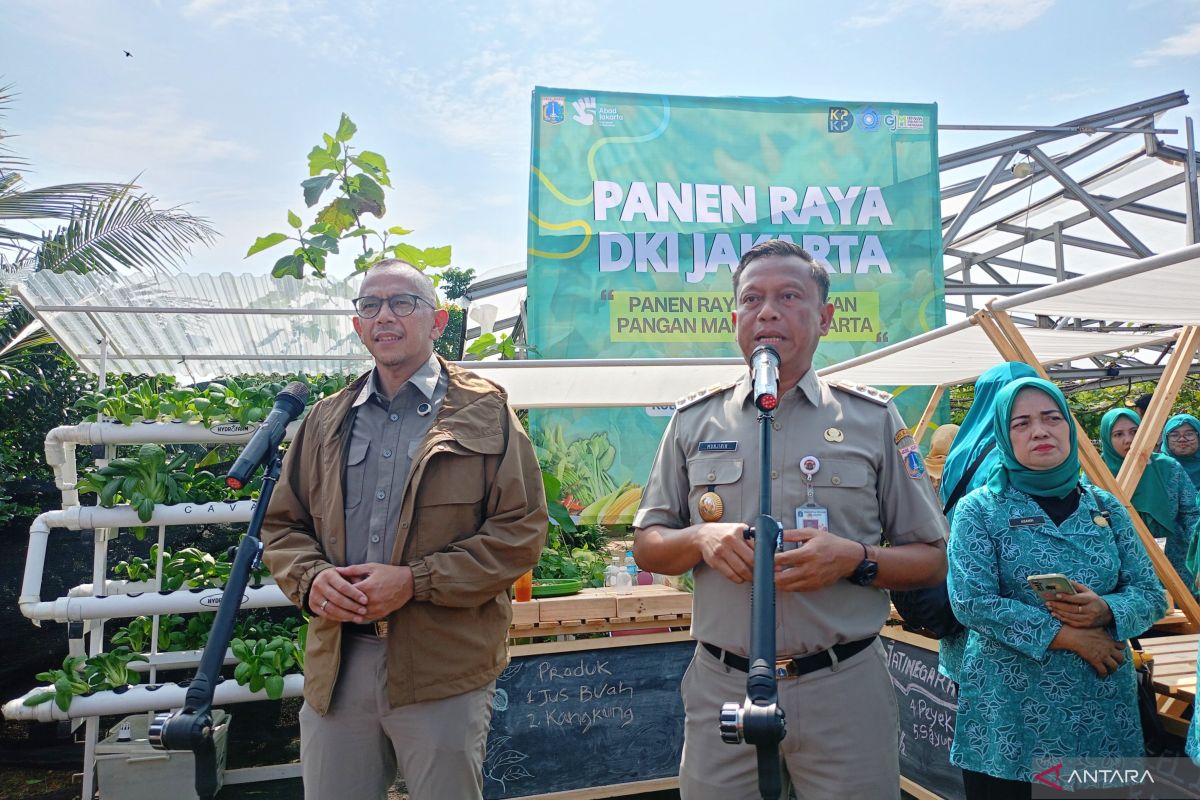
Jakarta - The DKI Jakarta Provincial Government is targeting an increase in food self-sufficiency through the development of urban farming to reach five per cent of total needs by 2030. “Our target for 2030 is for Jakarta to be able to meet up to five per cent of its own food needs, one of which is through urban farming,” said the Head of the DKI Jakarta Food Security, Maritime, and Agriculture Office (KPKP), Hasudungan Sidabalok, after attending the simultaneous grand harvest event of DKI Jakarta at the agricultural land on Jalan Raya Pulo Gebang, RT 12/RW 06, Cakung, East Jakarta, on Monday. Currently, according to him, the contribution of food production from within Jakarta is still very small, at around two per cent. Meanwhile, about 98 per cent of residents’ food needs are still supplied from outside the region. “This condition is a challenge for us. However, through the grand design of urban farming, we are optimistic that dependence on supplies from outside the region can continue to be reduced,” Hasudungan stated. He explained that achieving this target is focused on strategic commodities that directly affect regional inflation, including red chillies and shallots as top priorities because they often trigger price fluctuations in the market. “Our focus is on commodities that affect inflation, such as red chillies and shallots. If production increases within the city, it is hoped that it can help stabilise prices,” Hasudungan clarified. However, Hasudungan acknowledged several challenges that must be faced, including limited land, urban climate conditions, and the need to increase community participation. “Limited land is indeed the main challenge. But as long as there is sunlight, land of any size can be utilised for farming,” Hasudungan said. In addition, his side is also intensifying socialisation to the public so that more residents are involved in urban farming activities. Hasudungan also assessed that changing mindsets is key to the success of the programme. “No less important is building the community’s mentality. We continue to educate that urban farming is possible and has great benefits,” he said. Furthermore, he emphasised that the success of several areas, such as East Jakarta, in developing hundreds of harvest points proves that urban farming has great potential to be widely developed in Jakarta. With collaboration between the government, the community, and various related parties, he added, the DKI Provincial Government is optimistic that the five per cent food self-sufficiency target by 2030 can be achieved, while also strengthening food security amid the dynamics of the metropolitan city. The event was spread across 807 locations throughout DKI Jakarta, with East Jakarta having the most harvest points, namely 414 locations. This was followed by South Jakarta with 177 locations, North Jakarta with 94 locations, West Jakarta with 60 locations, Central Jakarta with 58 locations, and the Thousand Islands with 4 locations. One of the main locations for the event was centred at the Greenhouse Agricultural Land Pulo Gebang area, East Jakarta. Besides East Jakarta, the harvest activities were also carried out at several pilot points in other areas, including the balcony urban farming at the Central Jakarta Mayor’s Office, GSG 07 Kembangan Utara in West Jakarta, the Integrated Child-Friendly Public Space (RPTRA) Cilandak KKO in South Jakarta, RPTRA Sunter Jaya Berseri in North Jakarta, and the Tidung Kecil Island area in the Thousand Islands. Hasudungan revealed that the total area of agricultural land harvested in the grand harvest event reached around 12,567 square metres. These lands were developed as integrated agricultural areas that serve as showcases for urban farming in Jakarta. The harvested commodities included chillies, various types of vegetables, fruits, food crops, family medicinal plants (TOGA), and consumption fish. Overall, the potential harvest yield from this event is estimated to reach 15 tons.