
DKI Closes Temporary Waste Storage in River Body at TPU Tanah Kusir
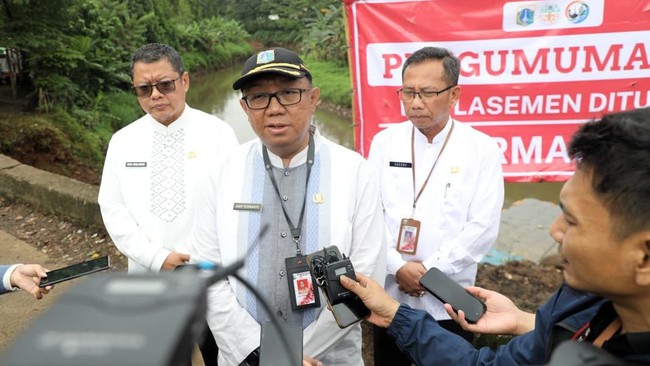
The Jakarta Provincial Government, through the Environmental Agency (DLH), has halted operations of the emplasemen or temporary waste storage site in the river body within the TPU Tanah Kusir area, South Jakarta. This step is taken as part of an evaluation and commitment to enhancing waste management governance, especially for waste originating from water bodies.
Head of the DKI Jakarta Environmental Agency, Asep Kuswanto, stated that the emplasemen in the TPU Tanah Kusir river body will be closed permanently starting Friday (27/3/2026). Moving forward, DLH DKI Jakarta will conduct a comprehensive overhaul of the emplasemen system, including the arrangement and gradual closure of similar locations along riverbanks.
“So starting today, we are closing the emplasemen at this TPU Tanah Kusir. Next, we will carry out improvements and ensure that emplasements along riverbanks are arranged and closed gradually,” said Asep Kuswanto at TPU Tanah Kusir, South Jakarta, as quoted from a press release on Monday (30/3/2026).
If still needed, Asep said, DLH will reorganise by adding boundary fences to prevent waste from re-entering the water body, as well as using containers as storage basins to minimise environmental impact. Additionally, information boards will be installed explaining the site’s function as a temporary storage for water body waste.
“The existence of this emplasemen is to accelerate the handling of waste in water bodies. However, its management will continue to be evaluated to make it increasingly organised and environmentally friendly,” he stated.
As a follow-up to the closure of the TPU Tanah Kusir emplasemen, DLH DKI Jakarta is redirecting waste management to the TB Simatupang waste screening facility, which is deemed more representative and has a more optimal processing system. Although the travel distance is longer, Asep assured that it will not hinder water body waste handling services. He also emphasised that waste lifted from rivers will not return to pollute the water body.
“We are committed to preserving the environment, including ensuring that waste lifted from rivers does not return to the water body. The river barrier system will continue to be optimised to hold waste before it is transported to land,” he stressed.
Asep added that the TPU Tanah Kusir emplasemen is one of the initial locations that has been operational since 2014 and functions as a temporary storage site for waste from water body cleanups, such as rivers and reservoirs in the Pesanggrahan, Kebayoran Baru, and Kebayoran Lama areas.
“The emplasemen at TPU Tanah Kusir is one of the first used in the water body waste handling system in Jakarta,” he explained.
According to Asep, the waste stored at the site does not come from households but is purely waste from river cleanups. After collection, the waste is then transferred using heavy equipment to mini dump trucks for transport to final processing facilities at TB Simatupang or TPST Bantar Gebang. There are six mini dumps operated to transport waste from the site.
“This emplasemen is temporary in nature, like a temporary waste storage on land. We ensure that incoming waste is processed within one day and does not accumulate,” he clarified.
Furthermore, Asep explained that the location is also used by the Parks and City Forestry Agency to store tree pruning results before transport to processing sites.
“In the TPU Tanah Kusir area, there are many leaves, so the Parks and City Forestry Agency places leaf waste and tree pruning results here, which is then transported together with water body waste to TB Simatupang or TPST Bantar Gebang,” he elaborated.
Asep also expressed apologies and appreciation for the incident that had previously attracted public attention regarding the activities of mini dump trucks dumping waste at the site.
“We thank the public for the input and suggestions given. This serves as a lesson for us to continue improving waste management governance in Jakarta,” he concluded.