
Djoko Setijowarno Urges National Electric Motorcycle Programme to Target Mineral Regions
Transport observer Djoko Setijowarno has reminded the government to pay attention to market segmentation so that the national electric motorcycle programme (Molinas) does not merely add to traffic congestion in major cities on Java.
According to Djoko, following the launch of Molinas at the production facility of PT Ilectra Motor Group (ALVA) in Bekasi by President Prabowo Subianto a week ago, the government needs to prepare the right market share to ensure the sustainability of this industry.
“The non-urban market, directing penetration to areas outside Java, border regions, rural areas, small islands and 3T regions (Disadvantaged, Frontier and Outermost) will provide a blue ocean strategy for national electric motorcycles,” said the Advisory Board member of the Indonesian Transportation Society (MTI) to Media Indonesia on Tuesday (18/8/2026).
Djoko reasoned that logistics efficiency in mineral-producing regions such as Morowali, North Morowali, Banggai, Kolaka, Konawe, Bombana, Central Halmahera, East Halmahera, South Halmahera and East Luwu is crucial. The Molinas programme is considered capable of providing significant economic value for local communities in the operational centres of these areas.
The same applies to mineral regions in Southwest Papua, Siak, Meranti, Natuna, Anambas, East Kalimantan, North Kalimantan, South Kalimantan, Papua, South Sumatra and Aceh. These regions are considered to be in great need of fuel cost savings by switching to electric motorcycles.
“Agats City in Asmat Regency, South Papua, provides an example of a region experiencing difficulties in fuel distribution, so that since 2007 it has already switched to electric motor vehicles,” added the academic from the Civil Engineering Programme at Soegijapranata Catholic University.
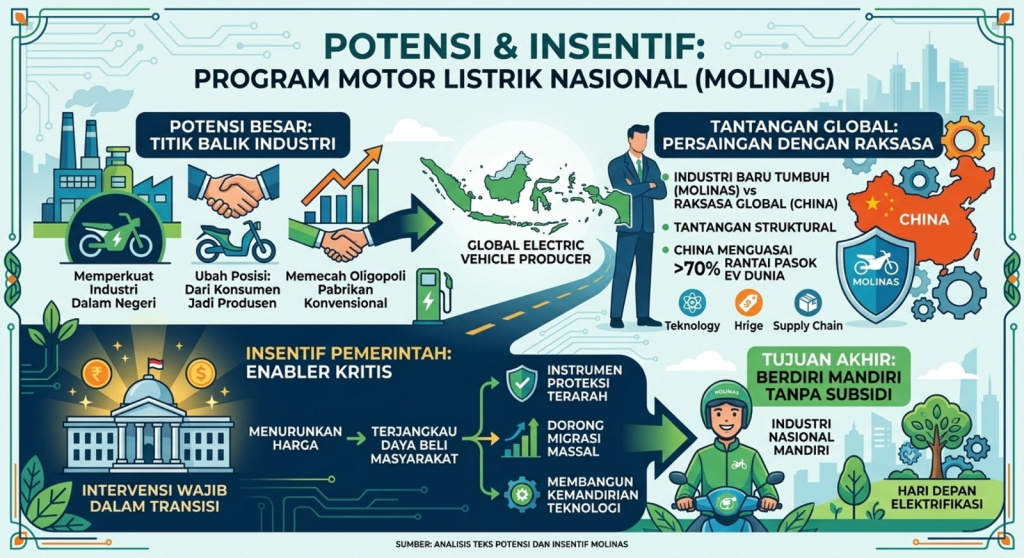
The Molinas programme has great potential to strengthen the domestic industry while changing the competitive landscape of the two-wheeler market in Indonesia. Its presence has the opportunity to shift Indonesia’s position from merely a consumer market to a producer, as well as to break the oligopoly of conventional manufacturers.
However, Djoko said competition with Chinese products is a major challenge. Currently, China controls more than 70% of the world’s electric vehicle supply chain, creating structural challenges for national products across various key aspects.
MTI emphasised that government incentives are not merely a complementary policy, but a key factor for Molinas to compete commercially. Incentives are needed to lower prices so they are affordable for the public, while also serving as a protection instrument for the national industry to build technological independence.
On the other hand, Djoko also reminded the government not to ignore the road safety crisis. Data from the National Police Traffic Corps and the Road Safety Association (RSA) throughout 2025 recorded 212,414 motorcycles involved in traffic accidents.
“Two-wheeled vehicles account for 70% to 75% of total national traffic accident cases. This must receive serious attention along with the progress of Molinas development,” he concluded.