
Discussion on Mental Health Resilience: Urging Gadget Regulation and Strengthening Digital Literacy
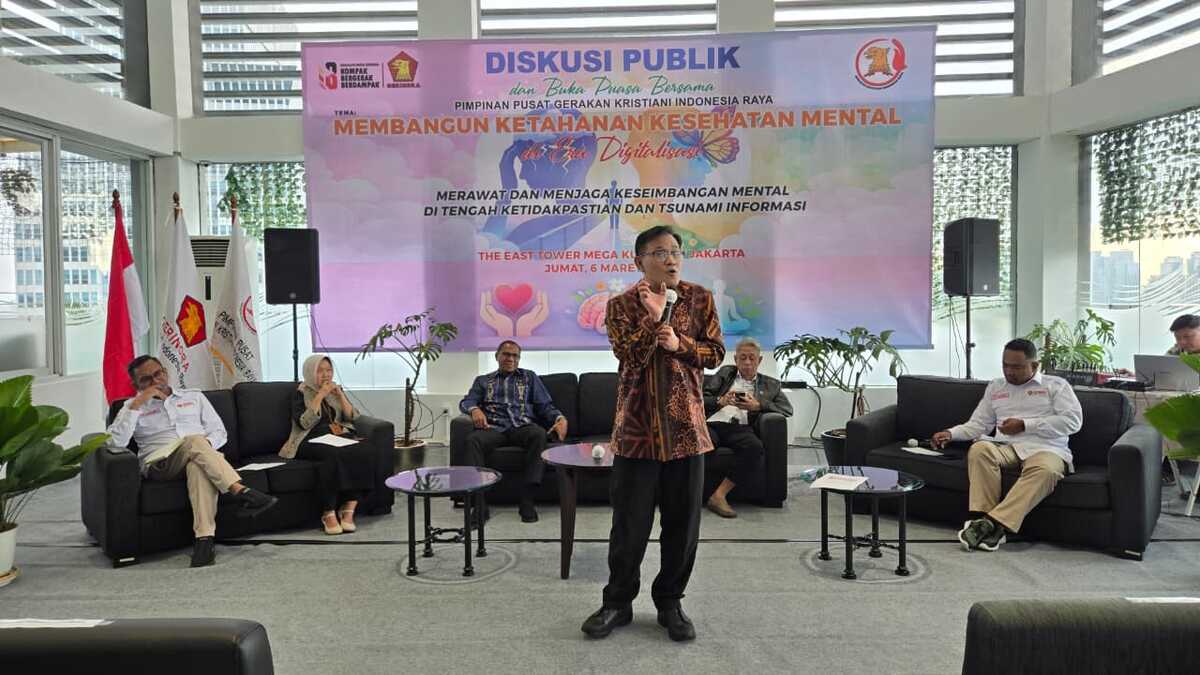
Indonesia has suspended discussions on the Peace Council. The Central Leadership of the Indonesian Raya Christian Movement (PP GEKIRA) officially urged the Government and the DPR RI to promptly formulate a comprehensive national policy on mental health resilience in the digital era. This was conveyed at a public discussion entitled “Building Mental Health Resilience in the Digitalisation Era” held in conjunction with a breaking of the fast gathering at The East, Mega Kuningan, South Jakarta.
The General Chairman of PP GEKIRA, Nikson Silalahi, stressed that Indonesia is facing a “tsunami of information” which, if not managed with proper policy, could damage the foundations of national unity. “Mental health is no longer just an individual health issue; it is a fundamental pillar of national resilience. We must not allow society, especially the younger generation, to fight the rapid currents of digital disruption alone without clear state policy guidance,” he said in a statement.
Based on the results of the discussion which included figures such as the Head of BP Taskin Budiman Sudjatmiko, the Deputy Minister of Social Affairs Agus Jabo Priyono, the Deputy Governor of NTT Johni Asadoma, Endah Sri Rejeki, Assistant Deputy for Policy Implementation Coordination for Child Rights in Region III at the Ministry of PPPA, and Yeremias Ndoen, the Secretary General of PP GEKIRA, Nikson outlined five strategic recommendations of GEKIRA. One of the most emphasised points was the urgency of regulating gadget use among children.
“We recommend that the government draft age-based gadget regulation. For children aged 0–5, it is best not to provide free access to devices. For school-age children, there must be strict time regulation. This is not about limiting technology, but preventing digital addiction and sleep disturbances that adversely affect the brain development of our children,” Nikson asserted.
He further highlighted the need to integrate mental health into the education system and basic health services. “Psychology services should not be a luxury. GEKIRA urges that emotional resilience literacy be included in school curricula and that counselling services be strengthened up to the level of Puskesmas. We want access to mental help as fast and as easy as patients can access physical treatment,” he added.
Meanwhile, Yeremias Ndoen, Secretary General of GEKIRA, reminded digital platform providers of their responsibility to be more proactive in filtering content that triggers cyberbullying and algorithms that are addictive.
“The state must ensure our digital ecosystem is healthy. We hope these recommendations become a tangible contribution from GEKIRA in guiding digital transformation that remains humane and maintains the mental balance of Indonesians,” Yeremias concluded.
As a result of the public discussion and scientific studies, GEKIRA presents several policy recommendations to the Government and the DPR RI to strengthen national mental health resilience, including:
- Making Mental Health a National Priority
The government should include mental health as part of the national development priorities and make it a key indicator in measuring societal welfare.
- Expanding Mental Health Services
Mental health education, emotional resilience, and digital literacy should be integrated into school curricula. In addition, counselling and psychology services need to be strengthened up to the level of Puskesmas and schools so that communities can obtain help quickly and affordably.
- Regulation of Gadget and Social Media Use by Children
The government should formulate national policies on gadget use by children, including:
Children aged 0–5: smartphone use not recommended freely.
Children aged 6–12: usage limited with parental supervision.
Adolescents 13–17: use with time management and digital literacy education. This policy is deemed important to prevent digital addiction, sleep disturbances, and declines in mental health among children and adolescents.
- Protection of Children in the Digital Ecosystem
Digital platforms should bear greater responsibility to protect children from harmful content, cyberbullying, and algorithms that trigger addiction and exposure to negative messages.
- Strengthening Family Resilience
Family education programmes should be strengthened so that parents can support their children facing social, cultural, and digital pressures that are increasingly complex. (H-2)
To make gadget rules effective, parents need to apply reasonable and collaborative parenting styles.
Schools should adopt an educational and contextual approach so that gadget restriction policies are not seen negatively by students.
What we need is a living Pancasila in every click, every post, and every digital interaction we have.
Collaboration between families, schools, the government, and society is the key to protecting the younger generation from the mental health crisis that is increasingly worrying.
CIVILISATION never grows in a vacuum. It is built by ideas, nurtured by values, and safeguarded by reason.
DJKI, Department of Law and Human Rights, again emphasises the importance of international regulation that governs the distribution of copyright royalties in the digital era.
Doomscrolling is the term used to describe the habit of continually reading negative news or content on the Internet, especially via social media.
Copyright © 2026 Media Group - mediaindonesia. All Rights Reserved