
Discussing the B50 Biodiesel Programme, Experts Share This Insight!
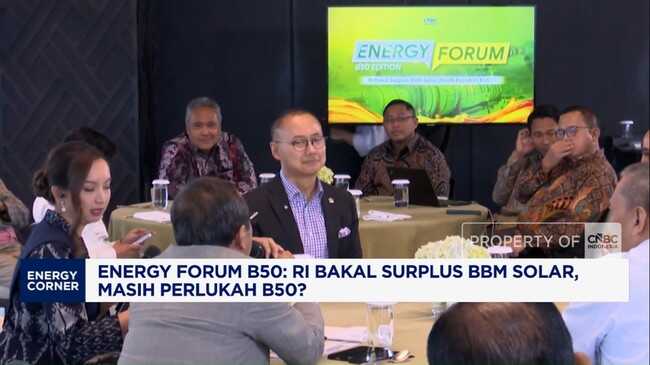
Jakarta, CNBC Indonesia — The government will soon roll out the B50 biodiesel programme in 2026. Several parties have provided input to ensure the implementation runs smoothly.
A member of the National Energy Council (DEN), Satya Widya Yudha, said that at its core, increasing the biodiesel blending towards B50 is part of a grand plan towards Net Zero Emission (NZE) 2060. The programme targets sectors that contribute most to carbon emissions, namely industry and transport.
The biodiesel programme has a long trajectory and has been implemented gradually starting from B5, B10, B20, B30, B40, up to B50 this time. The approach is intended so that the process of industry adaptation, feedstock availability, and technology readiness can progress in tandem.
“We try to see what can be done so that the programme that has been set and already included in the National Energy Policy (KEN) can be achieved together,” he said at the Energy Forum B50 Edition, reported on Friday (6 March 2026).
Satya added that the B50 programme must be able to balance two main goals: reducing carbon emissions through the use of renewable energy and maintaining state revenue from the export of crude palm oil (CPO).
In the same event, Deputy Speaker of the Indonesian People’s Consultative Assembly (MPR RI), Eddy Soeparno, viewed that the blending increase from B40 to B50 is an important part of the national energy transition agenda. However, he reminded that the implementation of the programme must consider two fundamental concepts: energy resilience and the country
���s capability and needs.
In essence, the biodiesel implementation is aimed at strengthening national energy resilience. Through the programme, Indonesia could reduce diesel imports. It could even achieve a diesel surplus.
“Secondly, capability and needs. What is our capability to increase the blend from B40 to B50? This includes what our current needs are. Will the needs later sacrifice something else?” he explained.
Eddy continued, he highlighted challenges in implementing B50 that require increased domestic palm oil production. The risk is that the programme might have to sacrifice land, if efforts to increase production via intensification strategies cannot be implemented optimally.
Furthermore, the B50 programme also requires adequate refinery readiness so that national needs can be met. Another aspect to consider is the impact of the B50 programme on vehicles and transport, which may require adjustments or revitalisation so their engines are compatible with this fuel.
Meanwhile, Mukti Sardjono, Executive Director of the Indonesian Palm Oil Association (GAPKI), stated that one of the challenges in implementing B50 is the ability of national crude palm oil (CPO) production to grow, which has tended to stagnate. In the last five years, domestic CPO production has hovered around 48–51 million tonnes.
Against stagnant production, domestic CPO consumption continues to rise, particularly since the biodiesel mandate began. For example, in 2023 CPO consumption for biodiesel already exceeded that for food.
When B40 is implemented, CPO consumption to support that programme reached over 12 million tonnes. If B50 is introduced, demand for CPO for biodiesel would rise to around 16 million tonnes. The result is that Indonesia would need to sacrifice CPO exports to meet the domestic priority programme.
“Energy resilience must be safeguarded; downstream energy must be safeguarded as well. Whether we like it or not, exports have to be sacrificed. If exports fall, the revenue from export levies also falls. The export levies have so far been used to subsidise biodiesel,” he said.
Therefore, domestic CPO production must be increased to make B50 a success. Otherwise, exports could decline again as production is prioritised for the B50 programme.
To date, constraints in boosting production relate to land availability limited by moratorium or prohibitions on adding new palm plantations.
GAPKI also notes that the government actively pursues productivity improvements through the smallholder oil palm replanting programme (PSR) since 2015–2016, targeting 180,000 hectares per year. However, actual realisation has fallen short of expectations.
Mukti therefore advised the government to allocate a dedicated area for palm oil production linked to the B50 programme. The land could be managed by state-owned enterprises (BUMN). This would ensure the programme does not encroach on CPO needs for food or exports.
“So it will not affect food needs or exports. So even if moratorium is lifted, it should be opened but specifically for BUMN,” he said.
On the other hand, Kukuh Kumara, Secretary General of the Automotive Industry Association (Gaikindo), hopes the B50 programme can be implemented through a gradual transition and more comprehensive technical testing. Because policy changes to biodiesel mandates will have immediate impacts on motorists.
In fact, automakers have already been involved in early B50 trials, covering more than 10,000 kilometres. So far, no major issues have been found in vehicles, unlike during the B35 trials. Vehicle performance remains relatively stable.
“Now perhaps the stage is to test in areas with relatively cool temperatures,” he said.
Kukuh warned that there remains a risk to engine performance when biodiesel is blended at higher proportions. In this context, there is potential a reduction in engine performance of around 2.5% to 3%. However