
Discovery of an Inverted Planetary System Changes Humanity's View of the World
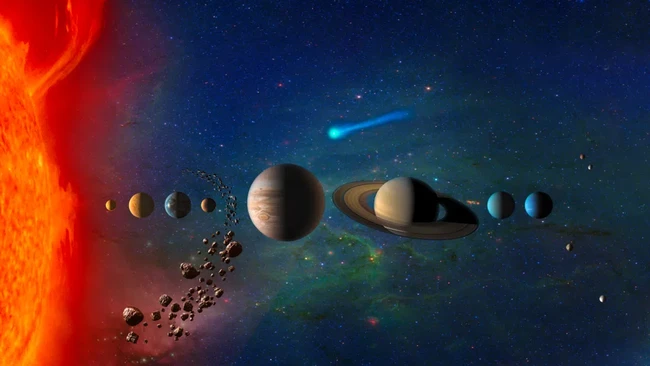
Jakarta — A long-standing understanding of planetary systems has placed rocky planets close to their star, with gas giants further out. In the Milky Way and in our Solar System, the inner planets are rocky, from Mercury to Mars, while the outer planets are gas giants. However, a team led by Thomas Wilson of the University of Warwick has altered that view. Using an telescope from the European Space Agency (ESA), they observed a star named LHS 1903 and detected what appears to be an inverted planetary system.
The planets orbiting LHS 1903 appear to follow the same arrangement: the planet nearest the star is rocky, followed by two gas giants. In subsequent observations, they identified a fourth planet at the outer edge of the system, which proved to be rocky rather than gaseous.
“Such an odd disturbance has made this an inverted, unique system. Rocky planets typically do not form far from their parent star, on the outer side of gas giants,” Wilson said, quoted by Phys, on Wednesday 4 March 2026.
From their findings, the researchers showed that the four inner planets did not form simultaneously. Planets formed one by one in a inside-out formation process. As a result, each planet evolved sequentially, with the more distant ones potentially forming under different environmental conditions. According to Wilson, the last planet formed when the system had exhausted its gas.
“By the time the last planet formed, the system may already have run out of gas, which is considered vital for planet formation. Yet here there is a small rocky world that defies that assumption,” he said.
ESA researcher Isabel Rebollido commented that theories of planet formation need revisiting, as those theories have been based on what is known from our Solar System. “Historically, planet-formation theories have been grounded in what is observed about our Solar System. As we increasingly observe exoplanetary systems that differ, we are revisiting these theories,” she explained.