
Disaster Response Task Force Reveals Key Strategy for Relocating Sumatran Disaster Evacuees
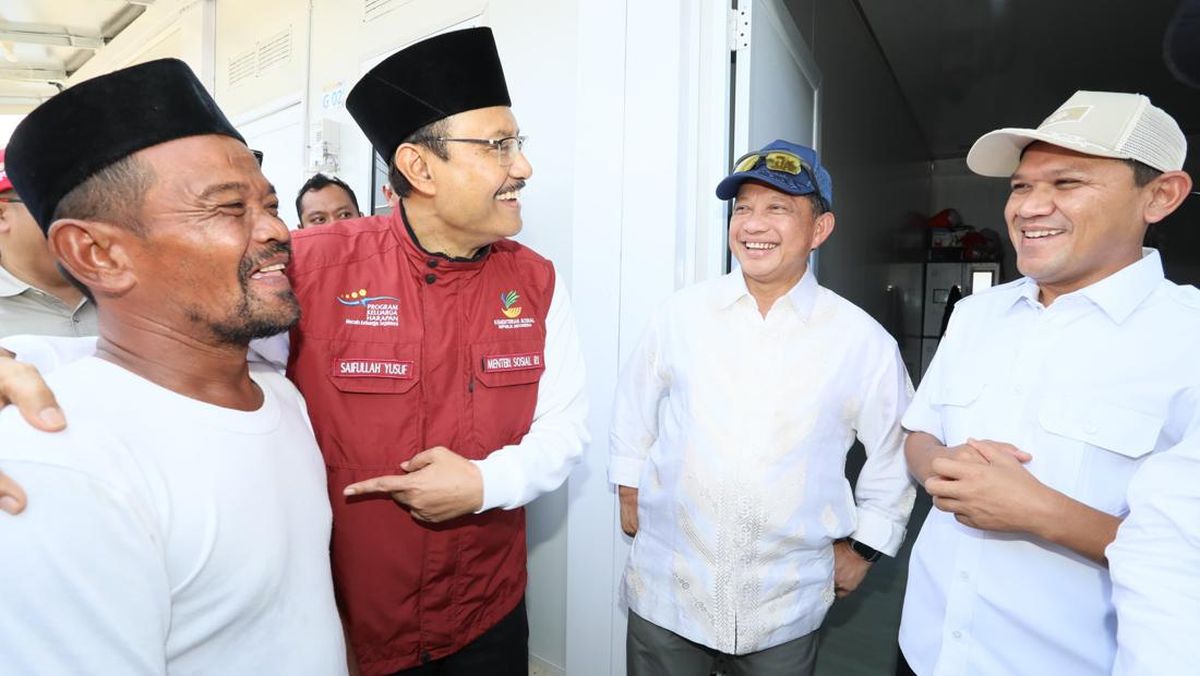
The Disaster Rehabilitation and Reconstruction Acceleration Task Force (Satgas PRR) for Sumatra continues to increase occupancy of temporary shelters (huntara) for disaster evacuees in Sumatra.
This effort is coupled with the distribution of housing allowance funds (DTH) to reduce evacuees still residing in tents due to floods and landslides in Aceh Province, North Sumatra (Sumut), and West Sumatra (Sumbar).
The daily Satgas PRR report as of 10 March recorded that 14,725 temporary shelter units have been completed across the three affected provinces. The total target is 18,697 units.
Aceh is the region with the most temporary shelter construction. Here, 12,926 units have been completed out of a planned 16,847.
Meanwhile, in North Sumatra, 969 units have been completed out of 1,020 planned. In West Sumatra, all targeted units have been completed, totalling 830 units.
The task force is also gradually building permanent shelters (huntap). A total of 1,463 units are currently under construction out of 36,669 targeted units, whilst six units have been completed.
For Housing Allowance Fund (DTH) assistance to disaster victims who choose not to live in temporary shelters, the assistance provided is 600,000 rupiah per month for three months, so each household head receives a total of 1.8 million rupiah.
To date, all DTH recipient accounts have received the assistance transfer.
The strategy of accelerating temporary shelter, permanent shelter construction and DTH distribution has had a significant impact on reducing the number of evacuees in tents.
The Satgas PRR Spokesman for Post-Disaster Sumatra, Amran, emphasised that they will continue to reduce the number of evacuees in tents before Eid al-Fitr 2026.
“(Evacuees in tents) will continue to decrease until the coming Eid al-Fitr. We are optimistic that the number of evacuees will continue to decline and occupy temporary shelters. So we will no longer see evacuees in tents,” said Amran at a press conference at the Ministry of Home Affairs office in Jakarta, Monday (9/3).
Road and bridge functional improvements
Meanwhile, the Head of the Satgas PRR for Post-Disaster Sumatra, Muhammad Tito Karnavian, stated that recovery efforts on connectivity are focused on repairs to roads and bridges that still function on a temporary basis.
This step is a continuation of the basic infrastructure recovery process. With improved transport networks, public mobility and logistics distribution are gradually returning to normal.
Tito noted that most national and provincial roads in the affected areas can now be used again, so community activity is beginning to return to normal.
“Functionally, it is relatively normal. National and provincial roads can be used, with only one road remaining towards Blangkejeren in Lokop,” said Tito in Banda Aceh, Aceh, Friday (6/3).
Based on Satgas PRR data as of 10 March 2026, cumulatively there are 2,520 regional road sections affected by the disaster across the three provinces, with 2,277 of them having returned to functionality or approximately 90 per cent.
Meanwhile, on the national road network, all affected sections have returned to full functionality at 100 per cent, so main inter-regional connectivity has been restored.
For bridge infrastructure, of 1,180 regional bridges affected, 790 bridges have returned to functionality or approximately 67 per cent. The national bridge network has also fully returned to function.
In addition to road and bridge repairs, recovery of basic services such as electricity and communication networks has been widely undertaken in the affected areas. For villages that have not yet received full electrification, the government is distributing generator sets to ensure that basic public needs remain met.
With improved infrastructure access, community economic activity is also beginning to move again. Markets that were previously disrupted by floods and infrastructure damage are gradually resuming operations.
Nevertheless, Tito emphasised that the government continues to prioritise the handling of several connecting infrastructure currently still on a temporary basis, particularly emergency bridges built during the emergency response phase.
“In the recovery process later, what will be made permanent are the bridges, then the roads that are currently still functional,” he said.
In the process of accelerating connectivity recovery, the government is also involving various stakeholders, including the Indonesian military and police through the Bridge Task Force tasked with building emergency bridges at several isolated points.