
Disaster Relief Task Force: Second Phase Aid Drives Economic Activity in Sumatra
Jakarta — Indonesia’s Acceleration Task Force for Rehabilitation and Reconstruction (PRR) in Aceh has stated that the government continues to accelerate the distribution of aid to victims of hydrometeorological disasters in Sumatra through a phased assistance scheme based on accurate data.
“Post-disaster management is being carried out in phases. The first wave focused on housing damage, whilst the second wave targets individual assistance such as living allowances, economic stimulus, and household furnishing support,” said Safrizal Zakaria Ali, Head of the PRR Task Force’s Regional Post in Aceh, in a statement received in Jakarta on Tuesday.
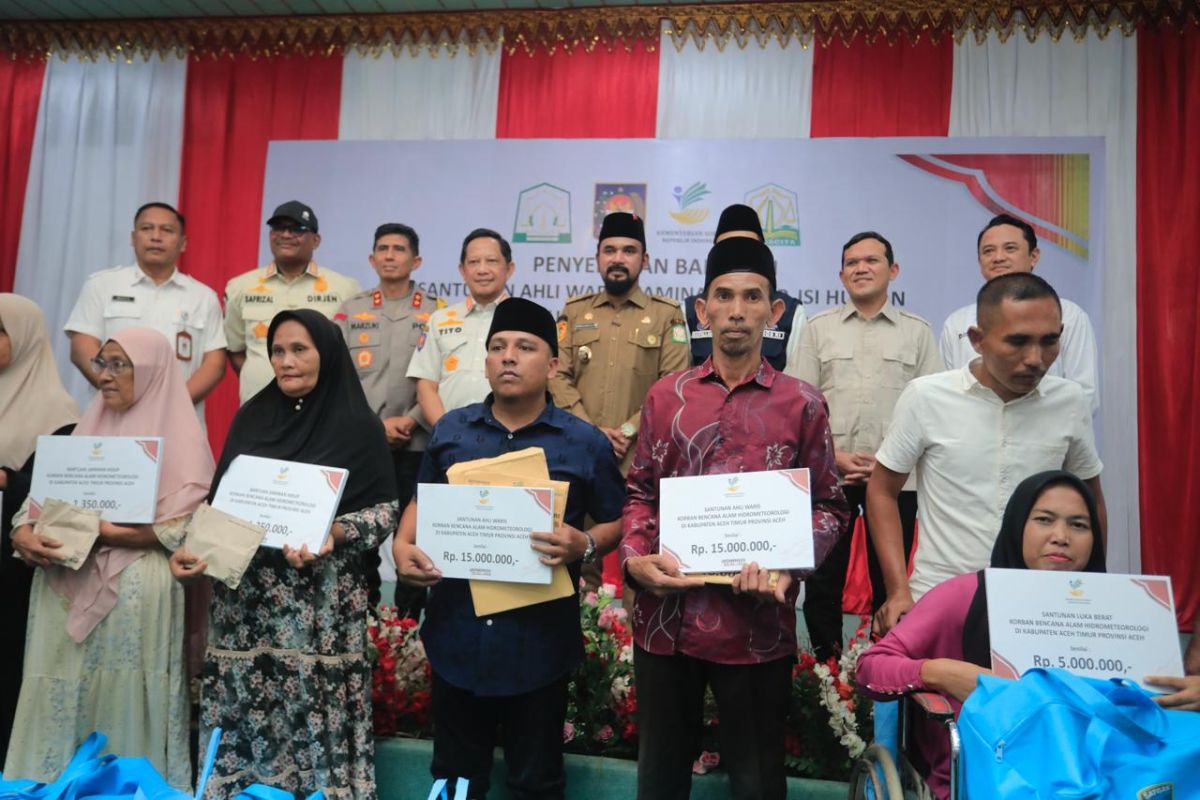
This was conveyed by Safrizal whilst accompanying Home Minister Muhammad Tito Karnavian during the handover of the second phase of aid for victims of Sumatra’s hydrological disasters by the Ministry of Social Affairs in Idi Rayeuk, East Aceh District, on Monday (16 March).
According to Safrizal, the government has thus far distributed aid in two waves. The first wave focused on assistance related to housing damage classification, whilst the second wave targets individual assistance such as living allowances, socio-economic stimulus support, and housing furnishings for affected victims.
During the event, the Home Minister stated that data represents the most important instrument in accelerating post-disaster rehabilitation and reconstruction.
He assessed that the quality of data collection is crucial in determining the government’s speed in distributing financial support to affected communities.
Furthermore, Safrizal emphasised that the data collection process in disaster-affected areas is not straightforward, and is therefore conducted in phases or waves to ensure data accuracy.
“Data collection must be accurate and precise, because from that data all government support can be channelled correctly to the communities entitled to receive it,” said Safrizal.
During the event, economic stimulus assistance was symbolically handed over to affected communities in East Aceh. For this second phase, East Aceh received over 100 billion rupiah.
Safrizal believed that this aid not only helps disaster victims recover but also has the potential to drive the regional economy forward again.
“Economic stimulus funds, living allowances, and other assistance will increase public purchasing power. When that money is spent, economic activity in the region will also begin to move,” he said.
At the conclusion of the event, he also conveyed a message urging local government to quickly complete data collection on affected homes that remains incomplete. He emphasised that housing construction for disaster victims cannot be carried out without valid data.
Therefore, he encouraged local government to promptly establish a special team, provide funding support, and deploy field teams so that the data collection process can be completed swiftly and accurately.