
Directorate General for Islamic Boarding Schools to Oversee 42,000 Boarding Schools Across Indonesia
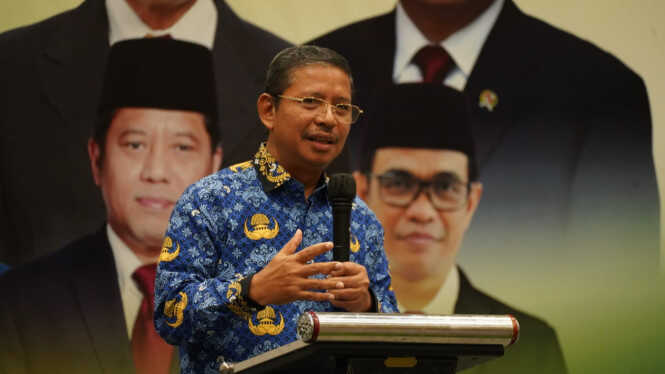
Directorate General for Islamic Boarding Schools to Oversee 42,000 Boarding Schools Across Indonesia
- Special
Jakarta, VIVA – The Ministry of Religious Affairs (Kemenag) is continuing preparations for the establishment of a Directorate General for Islamic Boarding Schools, which will be a tier-I level structure and will oversee more than 42,000 boarding schools.
The Director General of Islamic Education at the Ministry of Religious Affairs, Amien Suyitno, said that the establishment of the Directorate General for Islamic Boarding Schools is an important moment. This is because, so far, the management of Islamic boarding schools has been under the Directorate General of Islamic Education (Pendis), which has a very broad scope of work.
“So far, the Directorate General of Islamic Education has been handling madrasahs, from Raudlatul Athfal (RA) to Madrasah Aliyah (MA), Islamic higher education institutions, as well as more than 42,000 Islamic boarding schools. Its scope of work is very large. This separation of structure will make the management of Islamic boarding schools more focused, faster, and measurable,” said Suyitno in a statement in Jakarta, Wednesday.
According to him, the establishment of the Directorate General for Islamic Boarding Schools is still awaiting the issuance of a Presidential Regulation (Perpres) concerning the Ministry of Religious Affairs. Currently, the applicable regulation is Presidential Regulation No. 152 of 2024 concerning the Ministry of Religious Affairs, which was issued on November 5, 2024.
In this Presidential Regulation, the organizational structure of the Ministry of Religious Affairs consists of the Secretariat General, the Directorate General of Islamic Education, the Directorate General of Hajj and Umrah Management, the Directorate General of Islamic Community Guidance, the Directorate General of Christian Community Guidance.
Then, the Directorate General of Catholic Community Guidance, the Directorate General of Hindu Community Guidance, the Directorate General of Buddhist Community Guidance, the Inspector General, the Agency for Religious Moderation and Human Resource Development, and three staff experts.
“The new Presidential Regulation concerning the Ministry of Religious Affairs is in the process of cross-ministerial harmonization, including the Ministry of Law and Human Rights and the State Secretariat,” said Suyitno.
He is optimistic that the regulation will be completed soon, because the establishment of the Directorate General for Islamic Boarding Schools has long been an aspiration of the Islamic boarding school community.
“This is not a new idea. It has been fought for for a long time and is now finding its momentum,” he said.
Suyitno views the establishment of the Directorate General for Islamic Boarding Schools not just as an addition to the bureaucratic structure, but also as being directly related to the priority of national human resource (HR) development.
Islamic boarding schools, he said, not only function as religious education institutions, but also have a role in da’wah (Islamic outreach) and community empowerment.
“If it is managed more focused, the impact will not only be on education, but also on strengthening the economy of Islamic boarding schools and social development in the regions,” he said.