
Dino: "Middle powers" influence the direction of global war and peace
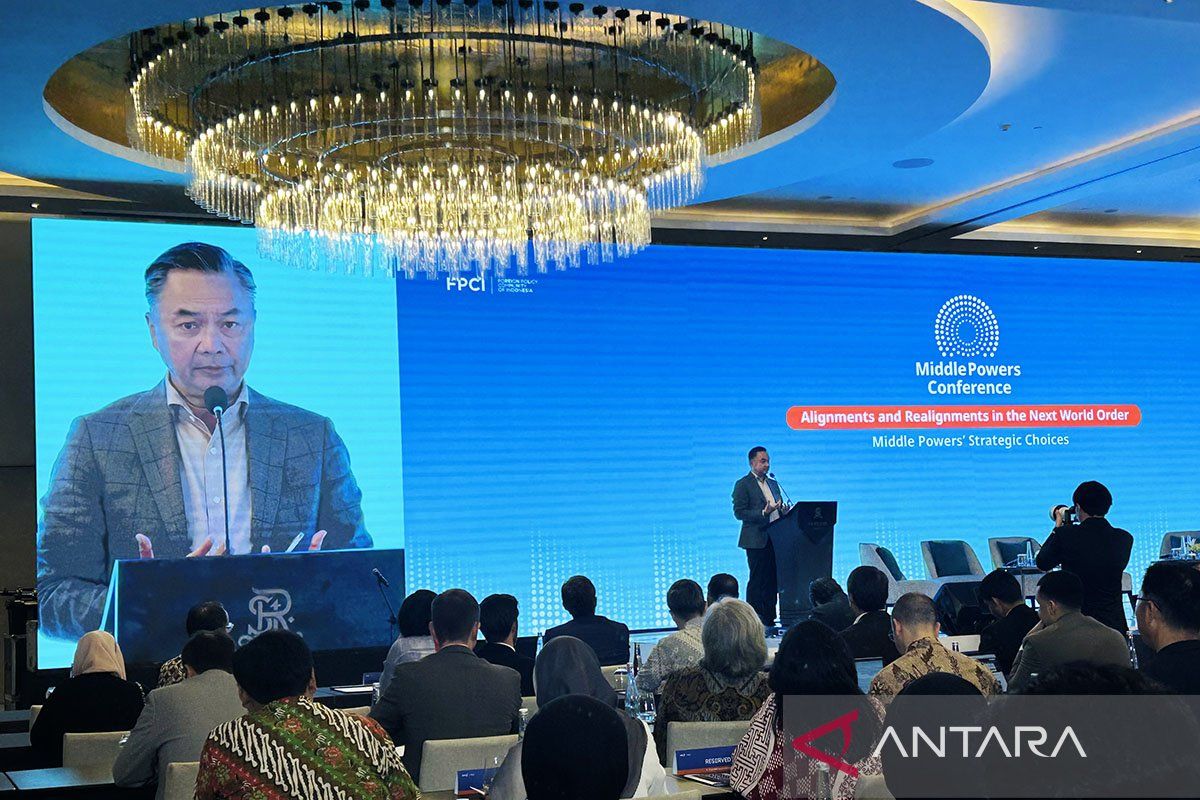
Middle powers… will play an important role in shaping the next world order
Jakarta (ANTARA) - Dino Patti Djalal, founder of the Foreign Policy Community of Indonesia (FPCI), stated that the role of middle power countries is becoming increasingly prominent in determining the direction of global conflicts and peace.
Dino’s statement refers to changes in international relations dynamics that are no longer dominated by a single great power.
“The world is shifting and transforming, and we do not know how this transformation will end. However, what we do know is that the group of middle powers from the North and South, around 20 countries, will play an important role in shaping the future of the next world order,” Dino said at the Middle Power Conference in Jakarta on Tuesday.
The former Indonesian deputy foreign minister explained that the active role of middle power countries in various global crises is also evident in the war between the United States and Iran, cited as an example of a war between a great power and a middle power.
On the other hand, Saudi Arabia, also a middle power country, is assessed to have the potential to expand the conflict, although so far it has chosen to restrain itself.
“So, we see how the dynamics of war and peace as well as the direction of the world order are influenced by countries known as middle powers,” Dino said.
He quoted the BRICS group (Brazil, Russia, India, China, South Africa), which has a gross domestic product value surpassing the Group of Seven or G7, consisting of advanced economy countries.
In addition, the defence budgets of several countries, such as South Korea, Saudi Arabia, and India, even exceed some European countries.
“So with all this, the assumption is that middle powers, around 20 countries in the global North and South, will play an important role in shaping the next world order,” Dino stated.
According to Dino, there are still questions regarding the ability of middle power countries to unite, resolve conflicts, and take on leadership roles in the international system.
Nevertheless, he emphasised that the trend of strengthening cooperation among middle power countries is beginning to emerge. Indonesia, for example, in recent years has enhanced bilateral relations with several countries, such as Australia, France, India, South Korea, and Turkey.
FPCI assesses that this situation demands Indonesia to immediately formulate strategies as a middle power country, including in determining positions and strategic partners amid changes.