
Digital technology revives the history of the Terracotta Army
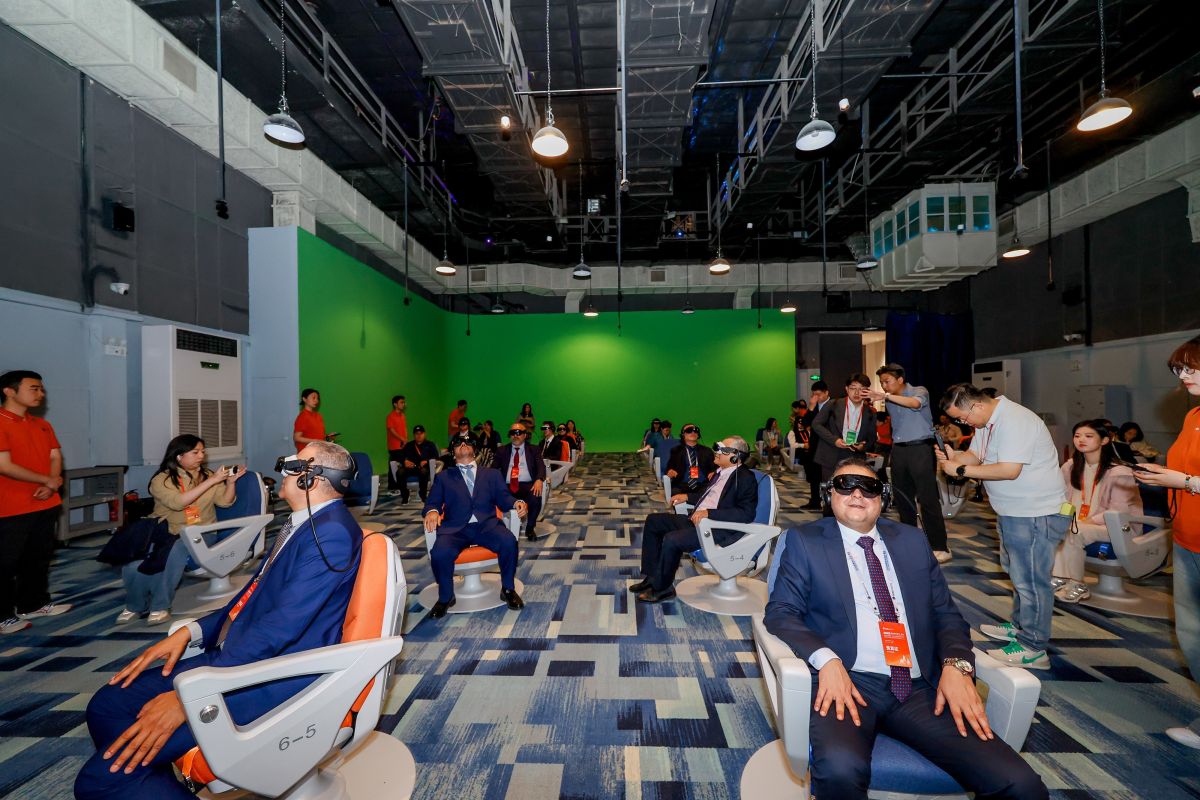
Xi’an (ANTARA) - When Arthur removed the headset at an extended reality (XR) cinema in the ancient city of Xi’an, the international student from Turkmenistan was still immersed in the new world he had just entered. ‘This is truly different from conventional cinema,’ he said. ‘The images surround you in 360 degrees, and you can choose where to look.’
Arthur had just watched ‘Xuanzang and Kucha’, an XR film shown at Boundless XR Cinema operated by XiYing Group, not far from the Giant Wild Goose Pagoda.
The film, which has received official screening approval from the China Film Administration (CFA), opened to the public on 1 May. More than 1,000 years ago, the monk Xuanzang returned to Chang’an during the Tang Dynasty after his journey to India, and oversaw the construction of the Giant Wild Goose Pagoda to safeguard Buddhist scriptures and statues. Now, his legendary journey westward is retold through XR technology.
Unlike conventional cinemas where audiences sit facing a screen fixed in a single position, XR productions create a 360-degree narrative space with immersive imagery, spatial sound, and virtual scenes. Audiences do not merely watch Xuanzang’s journey; they feel as though they have entered the film and joined him on the journey.
The cinema also differs from the usual concept of watching a film. There is no giant screen. Instead, the theatre is equipped with more than 40 spectator seats, each fitted with a headset and capable of playing the film independently.
As inbound tourism grows, more technology-based products are designed with international visitors in mind to make cultural experiences easier to enjoy.
‘XR technology offers more than just visual spectacle to the world of cinema,’ said Wang Jixuan, director of the Xi’an XR Film Industry Base Management Office. ‘This technology broadens storytelling through space–time narratives and breaks the ’fourth wall’ between spectators and imagery.’
For Xi’an, one of China’s ancient capitals with 13 dynasties and home to the Terracotta Warriors, such experiments mark a shift in how historical culture is presented to visitors. The city has long drawn visitors with the Terracotta Warriors, the Giant Wild Goose Pagoda, and its ancient city walls. Now, Xi’an is leveraging digital technology to transform cultural heritage from something to be viewed into something that can be entered, interacted with, and experienced firsthand.
In ‘The Great Qin’, a popular theatre production themed on Qin culture inspired by a family letter written on a wooden blade and found at the Shuihudi Qin tomb in Yunmeng, smart translation glasses supported by an AI-based translation platform began trials on 1 May. As actors speak on stage, subtitles appear before audiences almost instantaneously, with a delay calibrated to be imperceptible to the human eye. The devices being tested currently support translation into English and Mandarin subtitles for the deaf and hard of hearing. In the future, the devices will support English, Russian, French, Japanese, and Korean.
Since its premiere in September 2024, ‘The Great Qin’ has staged more than 800 performances, with attendance consistently above 95 per cent. Through the tale of Heifu, a Qin soldier, the production presents the historic process of Qin unifying the other six states.
Xi’an’s efforts are part of a broader trend across China. In 2024, China launched 42 new immersive smart tourism experience spaces to explore new forms of tourism products shaped by digital technology. In recent years, China has introduced a series of policies to support the application of digital technology in culture and tourism, promoting the integrated development of digital performances, digital art, and immersive experiences.
Deng Ning, a senior researcher at Beijing International Studies University, said digitising culture and the integration of culture and tourism have entered a stage of accelerated development. The next step, Deng said, is to move beyond scattered, localised experiments and adopt a more systematic approach that coordinates technological innovation, data governance, and product supply, creating a smoother full-chain development pattern.