
Digital Infrastructure Investment: The New Foundation for the Future Economy
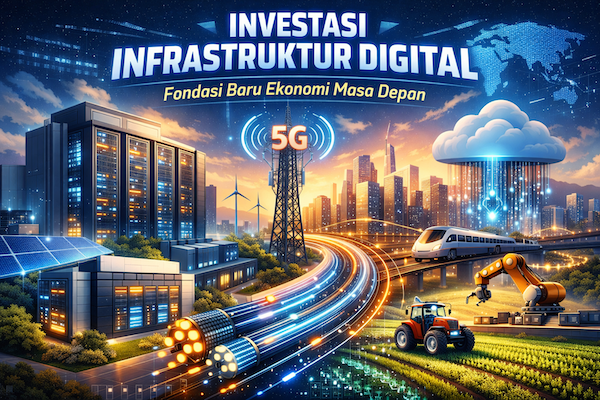
In the midst of the rapid digital transformation, one thing is becoming increasingly clear: the future economy no longer relies solely on physical resources but on the power of digital infrastructure. If toll roads and ports were once symbols of progress, that role is now gradually being taken over by fibre optic networks, data centres, and cloud computing.
This transformation is not merely a technological trend but a fundamental shift in how nations and industries build competitiveness.
Digital Infrastructure, the ‘Motorway’ of the Modern Era
The term digital infrastructure encompasses various components that support digital activities, from telecommunications networks and data centres to cloud platforms. Without this foundation, digital services—from e-commerce to artificial intelligence—cannot operate optimally.
In many countries, investments in digital infrastructure are now positioned on par with physical infrastructure development. Governments and the private sector are competing to expand networks, increase data capacity, and build large-scale data centres.
Indonesia itself is not left behind. With rapid growth in the digital economy, the need for reliable infrastructure is becoming increasingly urgent—especially to reach areas that are not yet fully connected.
Why Is This Investment Becoming Increasingly Strategic?
There are several factors driving the surge in investments in this sector.
First, the explosion in data consumption. Daily activities—from working and learning to entertainment—now depend on digital connectivity. Every video watched, transaction made, and data stored in the cloud all require strong infrastructure behind them.
Second, the growth of new technologies. Artificial intelligence, the Internet of Things (IoT), and big data analytics demand far greater computing capacity than before. Old infrastructure is no longer sufficient.
Third, the need for data sovereignty. Many countries are beginning to realise the importance of storing and managing data domestically, thus encouraging the development of local data centres.
Data Centres: The Heart of Digital Investment
Among the various components of digital infrastructure, data centres are one of the main focuses of investment.
Data centres function as hubs for data storage and processing. In recent years, there has been a trend towards building hyperscale data centres—massive facilities capable of handling the needs of global technology companies.
Additionally, the concept of edge data centres is also emerging. Unlike traditional data centres, edge ones are placed closer to users to reduce latency, which is particularly important for real-time applications such as autonomous vehicles or augmented reality.
On the other hand, sustainability issues are also shaping the direction of investments. Many operators are now switching to renewable energy and efficient cooling technologies to reduce their carbon footprint.
Broader Economic Impacts
Investments in digital infrastructure not only impact the technology sector but also create a domino effect across various industries.
The financial sector, for example, increasingly relies on digital systems for real-time services. The manufacturing industry is adopting data-based automation. Even the agricultural sector is beginning to utilise sensor-based and analytics technologies.
Furthermore, digital infrastructure also creates new jobs—from network technicians to cybersecurity specialists.
For developing countries, this becomes a strategic opportunity to ‘leapfrog’ traditional development phases and directly enter a digital-based economy.
Challenges: From Energy to Regulation
Although the potential is great, investments in this sector are not without challenges.
Energy needs are one of the main issues, especially for large-scale data centres that consume significant amounts of electricity. In addition, regulatory aspects—including data protection and permitting—also become determining factors.
The availability of digital talent is also a concern. Advanced infrastructure will not be optimal without human resources capable of managing it.
Towards a Digital Future
Looking ahead, investments in digital infrastructure will increasingly determine a country’s position on the global economic map. Nations that can build a strong digital ecosystem will have significant competitive advantages.
In the end, digital infrastructure is no longer just a supporter—it has become the main foundation. Like motorways that connect cities, digital infrastructure connects data, services, and people on a global scale.
And that is where the future economy is being built—not just on the ground, but also within the invisible networks.