
Difficult to Eradicate: BRIN's Solution to Combat Plecostomus Fish
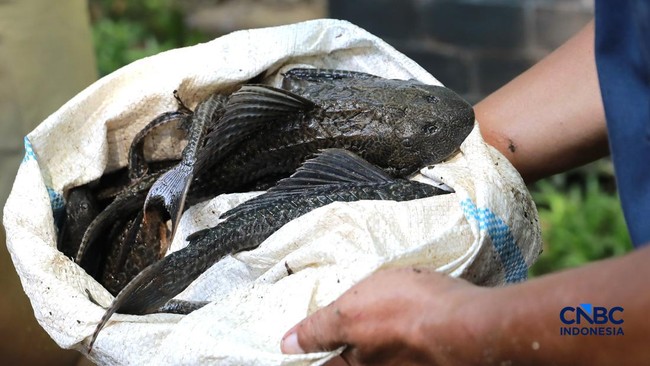
The capture of plecostomus fish is rampant in several rivers in Jakarta in recent times. This step is taken to suppress the population of the invasive fish, which is considered increasingly dominant in the waters and threatens local fish. However, such efforts are deemed insufficient without the presence of predators.
Triyanto, a researcher from the Centre for Limnology and Water Resources Research at the National Research and Innovation Agency (BRIN), states that controlling the population of this invasive fish requires a holistic approach, including introducing natural predators to prevent its numbers from continuously surging.
“A holistic effort is needed from addressing the root causes, controlling the plecostomus population, and improving the aquatic ecosystem conditions. This ensures that other fish capable of preying on plecostomus are available in balanced numbers,” Triyanto told CNBC Indonesia on Thursday (23/4/2026).
He explained that plecostomus has high resilience, allowing it to survive in various environmental conditions.
This fish is tolerant of low water quality, low oxygen levels, and even polluted waters. Moreover, plecostomus can directly absorb oxygen from the air, enabling it to survive even when water conditions deteriorate.
Additionally, the plecostomus’s body structure is relatively hard, making it difficult for predators to consume. Its reproduction rate is also very rapid, producing a large number of eggs, building nests, and being guarded by the male parent until hatching. This pattern increases the survival rate of its offspring.
In Indonesian waters, natural predators of plecostomus are very scarce compared to its native habitat. Furthermore, this fish has a long lifespan of 10-15 years and reaches maturity quickly in about 6-12 months.
“In Indonesian waters, its natural predators are very minimal. Unlike in its native habitat,” Triyanto noted.
The surge in plecostomus population also directly impacts local fish by dominating space and food sources.
Not only that, plecostomus can act as a predator to local fish by consuming their eggs and larvae. Its suction mouth allows it to suck up eggs and fry of other fish.
Therefore, Triyanto emphasises the need for control measures, including routine captures, disrupting the reproduction process by capturing during peak rainy season, and educating the public not to release plecostomus into public waters.
Additionally, improving habitats and water quality is considered important to allow local fish with potential as natural predators to thrive. Some of these include snakehead, betutu, and baung fish, which can naturally suppress the plecostomus population.