
Different Fate: Rupiah Left Behind as Global Banks Pick This Asian Currency
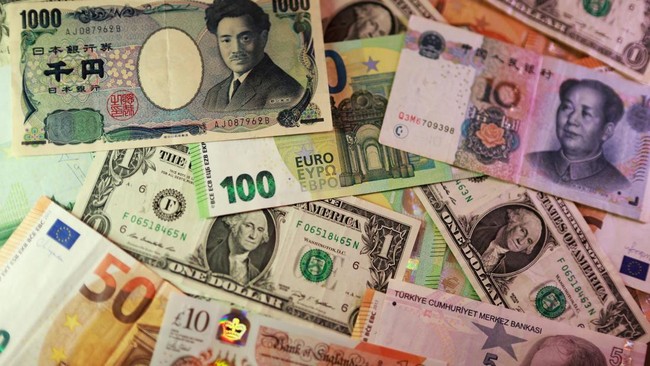
Jakarta, CNBC Indonesia - Pressure on the rupiah and Asian currencies has yet to ease. However, some Asian currencies managed to strengthen this week.
In the latest trading session on Friday (22 May 2026), the rupiah closed at Rp 17,690 per US$1, weakening 0.28% against the US dollar. Over the week, the rupiah fell 1.32%, marking eight consecutive weeks of declines. The Garuda exchange rate even breached the psychological Rp17,700 level amid heavy foreign outflows and a widening current account deficit.
Indonesia’s current account deficit in Q1-2026 was US$4 billion, or 1.1% of gross domestic product (GDP), the largest since Q4 2019. Bank Indonesia’s decision to raise the policy rate by 50 basis points to 5.25% on Wednesday (20 May 2026) could not rescue the rupiah.
Economist Maybank Indonesia Myrdal Gunarto attributed the rupiah’s pressure to a mix of global and domestic factors, with the primary driver being substantial foreign outflows. In addition to global sentiment such as high US rates and a stronger dollar, foreign investors are also watching various new government policies that are believed to affect business processes in Indonesia.
‘So they tend to seek safety in conditions like these,’ Myrdal told CNBC Indonesia on Friday. ‘Moreover, the new policies affect business processes. Then there’s the relocation of liquidity from domestic to foreign currencies.’
He added that markets are also anticipating potential foreign outflows related to decisions by global index bodies such as MSCI and FTSE Russell. Seasonal factors such as dividend payments and the Hajj season are said to be providing only temporary pressure on the rupiah.
Asia in Recovery Facing Currency Pressure
Besides the rupiah, several Asian currencies weakened against the US dollar this week. The biggest decline was in the won, while other currencies like the rupee strengthened.
Policy makers across Asia this month have implemented measures to curb their currencies’ weakness. Since the Iran conflict erupted on 28 February 2026, Asian currencies have come under pressure.
On Wednesday, Indonesia surprised markets by raising the policy rate by 50 basis points to support the rupiah, which was at its lowest ever against the US dollar. The government also took control of commodity exports to ensure earnings stay in domestic currency. The Philippine central bank has also raised rates, and there is speculation that inflation could rise enough to trigger an out-of-schedule rate hike ahead of next month’s meeting.
‘How much rate hikes are needed to attract inflows? The answer could be very high,’ said Navin Saigal, head of Asia-Pacific fixed income at BlackRock, to Reuters. ‘On the other hand, what is the impact on the domestic economy? The answer could also be very large.’
India, Indonesia, and the Philippines are thought to be very vulnerable as oil-importing countries hit by capital outflows when investors move their money elsewhere. The sudden shift in US rate expectations, with a potential rate increase this year, adds to the pressure. The rupiah slipped to Rp17,700 per dollar, the rupee approached 97 per dollar, and the Philippine peso nearly touched 62 per dollar.
Markets become increasingly unfavourable. In Indonesia, the rupiah has weakened 12% against the dollar under President Prabowo Subianto. The rupiah weakened again a day after Indonesia raised rates. Shares on the Indonesia Stock Exchange fell after government steps centralising commodity exports deepened investor concerns already placing Indonesia at risk of credit rating downgrades.
S&P Global Ratings warned that Indonesia’s plan to centralise commodity export controls could hurt exports, reduce government revenue, and weaken the balance of payments.
In India, the use of the central bank’s forward market for dollars is also under scrutiny after the commitment of short-term forward dollars surpassed US$100 billion, reducing foreign exchange reserves of about US$700 billion. ‘When foreign exchange reserves become a market focus, perception matters,’ said macro strategist Asia JB Drax Honore, Vivek Rajpal. ‘The room to intervene aggressively to counter further pressure is increasingly limited. The Philippines and Indonesia are already on a rate-hike track, and India is likely to follow,’ he added.
India is considering all options to stabilise the rupee, including possible rate hikes. Although India, Indonesia, and the Philippines still have room to raise rates and use foreign exchange reserves to cushion currency turmoil, market pressure remains very strong. Some investment banks have even begun recommending clients sell weakening Asia currencies and shift into stronger Asian currencies.
‘Because no one can predict the Iran-US situation, we prefer a relative value strategy,’ said Chandresh Jain, market strategist for emerging markets at BNP Paribas. He advised investors to consider positions in the Singapore dollar, Malaysian ringgit, Chinese yuan, or South Korean won against the Thai baht, Indian rupee, or Indonesian rupiah.