
Despite Ramadan and Eid al-Fitr Moments, Consumer Confidence Index Falls in March 2026
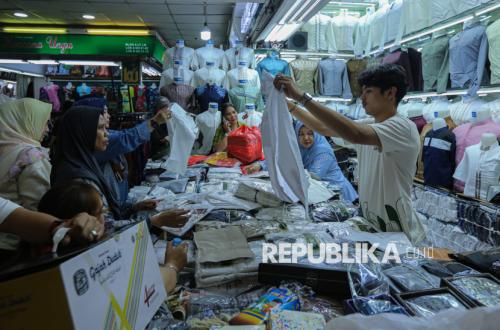
Indonesia’s Consumer Confidence Index (IKK) weakened in March 2026, despite coinciding with the momentum of Ramadan and Eid al-Fitr. This decline indicates the beginning of pressure on public optimism towards the economic situation.
Bank Indonesia recorded the IKK for March 2026 at 122.9, down from 125.2 in the previous month. Nevertheless, this level remains in the optimistic zone above 100. “The BI Consumer Survey in March 2026 indicates that consumer confidence in the economic situation remains strong. This is reflected in the IKK for March 2026, which is at an optimistic level (index >100) of 122.9,” said the Head of BI’s Communication Department, Ramdan Denny Prakoso, in his statement on Friday (10/4/2026).
The IKK decline occurred amid weakening perceptions of the current economic situation and future expectations. The Current Economic Condition Index (IKE) was recorded at 115.4, down from 115.9, while the Consumer Expectations Index (IEK) fell to 130.4 from 134.4.
The weakening of IKE was triggered by a decline in perceptions of job availability and durable goods purchases. The Job Availability Index stood at 107.8 and the Durable Goods Purchase Index at 109.2, both lower than the previous month.
From the expectations side, consumers remain optimistic about income, employment, and business activities over the next six months, albeit with a declining trend. Income expectations were recorded at 137.7, job availability at 128.0, and business activities at 125.5.
Spatially, the IKK decline occurred in most cities, particularly Pontianak, Surabaya, and Padang. Meanwhile, increases were recorded in Bandung, Bandar Lampung, and Samarinda.
By expenditure group, the highest optimism was in the Rp4.1–5 million group with an index of 125.7. By age, the 20–30 year group recorded the highest index of 129.6, although it experienced a decline compared to the previous period.
On the other hand, consumption patterns show increasing pressure. The proportion of income for consumption rose to 72.2 per cent from 71.6 per cent, while the savings portion remained relatively stagnant at 17.6 per cent.
Conversely, the debt-to-income ratio fell to 10.2 per cent from 10.6 per cent. This data reflects that the public is beginning to allocate a larger portion to consumption amid economic pressures, while room for saving remains limited.